A forum for jazz reviews, discussion of new jazz, blues music, the musicians, reviews of recent and historical releases, reviews of live performances, concerts, interviews and almost anything I find of interest.
by Ralph A. Miriello
Dave Stryker-Blue Fire: The Van Gelder Session- Strikezone Recds
The guitar stalwart Dave Stryker finally got to have his dream
come true and the results are his latest release Blue FireThe
Van Gelder Session was well worth the wait! Stryker has been on my radar
for years. His work with his long-term cohorts Jared Gold on the B3 organ and
McClenty Hunter on drums have provided some of the best Organ/Guitar/Drums music
for the last twenty years. I originally discovered Stryker’s compelling guitar
work as a co-leader of the progressive Stryker/Slagle Band, when I got into their
modern, sinewy sounding work on album’s like The Scene from 2008 and
Keeper from 2010.
Dave Stryker’s career started when this Omaha, Nebraska
based guitarist left for Los Angeles at the age of seventeen in 1978 to expand
his musical experience and cut his teeth on the circuit. He met organ master
Jack McDuff and eventually moved to New York, playing with McDuff from 1984 through
1985, before touring with saxophone great Stanley Turrentine from 1986 up to
his passing in 2000. With this experience steeped in the blues, soul jazz, jazz
funk, hard bop, and R&B there is no mystery why Stryker’s music is so
influenced by these sources.
Much of the best of jazz of the “prime time” era was
recorded by labels like Blue Note, Impulse, Prestige, CTI, and Savoy in the
studio of sound engineer magician Rudy Van Gelder in Englewood Cliffs, New Jersey. While
the master Van Gelder passed away in 2016 his iconic, wood-lined, cathedral-like studio has
been preserved and has been listed in the National Register of Historical
Places in 2022.
Van Gelder Studio in 2022 (photo via Wikipedia)
The currently active studio was willed by Van Gelder to his
longtime assistant Maureen Sickler, who had been working at the studio for three
decades before she became owner upon Rudy’s passing. The Sickler's are now actively running, restoring and preserving this gem of jazz history. We wish them continued success. It’s so great to have
them pay it forward.
Recording at the Van Gelder studio is like playing the
Village Vanguard, reaching a goal that for some is seemingly never attainable. No
wonder guitarist Stryker wanted to check this achievement off his bucket list so
Blue Fire:The Van Gelder Sessioncomes to life.
The album opens with a Stryker cooker, the deeply grooved “Van
Gelder’s Place” that just shuffles onto the stage with cool and soul. Dave’s guitar
is so smooth, so in touch with his soul, as he attacks his notes with aplomb, both singularly and in octaves vis a vis Wes. Gold gets his turn adding to the jazz
history here, as he attacks the same Hammond B3 that was once played by esteemed practitioners like Larry Young,
Jack MacDuff and Jimmy Smith. Jared he sets it on fire on this album; what more could a B3 man ask for? The drummer, McClenty Hunter, bubbles with energy creating the stream upon which these guys float, just beautiful.
The music just doesn’t stop there. “Blue Fire” is another
Stryker composition that has a feel like something Larry Young might have
brought into the studio. The trio create a brewing chicane of sounds that swell
and pulse with electricity. Stryker and Gold synch-in so precisely that it has
you holding your breath as they anticipate each other’s moves. Hunter’s drum
work is a syncopated whirlwind of pure propulsion. It becomes apparent that these musicians are savoring every
minute of this session. I find myself repeating this impressive song multiple times just to make sure I catch all the
intricacies. Whew!
Stryker uses the Beatles’ “A Fool on the Hill” to create a soft, breezy swing. You can listen to this and imagine your feet up as you
sip a drink with an umbrella in it. A fun and carefree groove.
If bebop is your thing, how about this group’s take on Charlie
Parker’s “Dexterity”? Stryker ‘s guitar lines spell out the melody with
dexterous fluidity. He is pushed by Gold’s throbbing organ work, probing foot
driven bass lines and Hunter’s incendiary drum work. Gold’s creativity is on
display, as his solo never ceases to surprise and Hunter offers his own buoyant
solo of note.
Stryker’s beautiful ballad, “Waiting for Ruby,” is one of my favorites
on this album. Dave opens with a sensitive guitar entre that pulls at your
sensibilities. His playing is so personal it’s like he is playing this one
just for you. Stryker has an inherent melodicism that is never far from his
playing. Although George Benson’s influence is often heard in Dave’s playing, his absorption of some of Jim Hall’s sensitivity certainly
serves him well. Gold and Hunter brilliantly accompany with a gossamer-like
delicacy. This one is a keeper; just beautiful.
“Back and Forth” is a Jared Gold composition that has a
cadenced opening featuring a repeating line that unexpectedly changes time
throughout. This one challenges your sense of getting settled into a groove. Instead,
it bobs and weaves, keeping you unbalanced and paying attention. The trio is in synch as they navigate the obstacle course that Gold has written with
ease and skill.
Stryker includes a Jerome Kern classic “The Folks Who Live
on the Hill” at a slow, lingering
pace. In the seven plus minutes, the trio explores the harmonic possibilities of this
melody making their own imprint. Stryker explores his
octave chording possibilities as Gold’s B 3 swells and moans and Hunter
breezily shuffles.
Stryker’s cinematic “Every Dark Street” is like being in a film
noir thriller. Gold’s organ emanates with a sense of suspense and danger.
Stryker’s blues-tinged guitar lines introduces a tension and eeriness of the unknown. The hair on your
neck rises in anticipation. They paint a picture with their instruments
that elevate your senses and transport you to this eerie dark street.
This satisfying album closes with a song by Harry Warren and
Al Dublin titled “Summer Night.” The song was first heard in 1936 in the film Sing
Me A Love Song. But this composition has been
substantially altered when it was made part of the jazz canon by Miles Davis and Gil
Evans. This duo revised and recorded this song on the album Quiet Nights
in 1963 and it never was quite the same. The song was again modified by Chick Corea and
played by the saxophone ace Stan Getz on his album The Master released in 1982. (Many
thanks to Ethan Iverson for bringing the evolution of this song to my attention which you
can read here.)
Stryker and company seems to have been influenced more by the swinging
Corea arrangement than to the more sedate Davis/Evans version. Stryker added some probing octave chording, as Gold embellished the music with his own more
progressive explorations. Hunter never fails to keep the drive lively and propulsive no matter the time signature. The history of this song is a testament to how diverse musical improvisation can
transform any composition's interpretation.
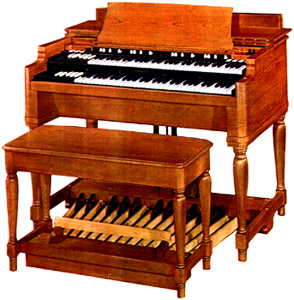
The Hammond B3 is a beast of an instrument and the jazz-organ-trio
format is a staple of the jazz idiom.
Tracings its origins back to a wind driven instrument-compressed
air being pushed through multiple length tubes to sound various notes-the
pipe-organ made its way into western religious ceremonies in the eighth century
when Charlemagne installed one in his chapel in Aachen. For centuries since,
the organ has been the musical instrument of choice in churches, temples and
synagogues.
Laurens Hammond
Then came along came Laurens Hammond. Hammond was a mechanical
engineer and he developed a patent in 1934 for an “electrical musical
instrument” that was based on using tonewheel generators to produce sounds. His
goal was to offer a cheaper alternative to the pipe organ for churches and
places of worship and he succeeded with the introduction of his Hammond model A
console organ in 1935. The low cost, much more compact electric organ was
wildly successful and by the end of the nineteen thirty’s Hammond was producing
two hundred of these organs a month. It wasn’t until 1954 that the B3, the
prominent instrument used in jazz organ trios, was introduced by Hammond. The B3 added an
additional percussive harmonic feature and its popularity with jazz and
progressive rock artists was legendary, especially when paired with the
rotating Leslie speaker system which produced a warbling, tremelo sound. The B3
model was modified in 1967 and has gone through numerous electronic iterations
including a new XB3 that was made by Hammond-Suzuki and purportedly faithfully
simulates the original tonewheel sound through electronics, but the original
tonewheel generator B3 had a distinctive sound and feel and is the model most prized by aficionados.
The Hammon B3 Organ
It is speculation, but I suspect that it wasn’t until organists, in predominantly Black churches,
found themselves trying to musically simulate some of the fiery rhetoric and
gospel sway of their preachers, that the instrument began to take on its powerfully soulful,
danceable feel. The B3 would eventually be brought out of the church and into secular world and become a staple of the jazz tradition.
This list of twenty-five + great jazz/blues organ performances is
an attempt to honor and celebrate some of the beautiful, soulful, swinging,
adventurous music that has been made using the Hammond B3 organ. It is
chronological staring with Waller and ending with Charette, but it easily could
have been more inclusive given enough space and time. Some artists deserve more
than one feature because of their exceptional body of work ( Jimmy Smith and Larry Young each have two selections), but space didn’t
allow for additional selections. There will undoubtedly be some musicians who are missing
entirely from the list and deserve to be included and for that I apologize.This is a very subjective list and lists by their nature are stupid ( as listmaker and jazz pianist/blogger Ethan Iverson has said), but somehow we are compelled to compile them, if only to ellicit some kind of response. and hopefully subsequent discussion. subjective and I have limited
space. Many thanks go to Mathew Kaminski the organist for the Atlanta Braves and a hullva fine jazzz organist himself, for his astute input. So for better or worse here is my list of twenty-five + great jazz/blues organ performances.
The organ tradition in jazz, is said to have started with Thomas
“Fats” Waller, his playing steeped in gospel and intermingled with stride. The
music had a certain bounce to it, a calliope sounding celebration. It was
played on an Estey pipe organ, so it doesn't technically belong in a list of B3 performances, but it is the germ from which all subsequent jazz organ performances grew. So for historical reference, here is a sample from a 1927 recording of
Waller at Trinity Church Studios in Camden, NJ.
Thomas “Fats” Waller:
1927 on the Estey Pipe Organ Camden, New Jersey “Stompin’ the Bug” 3min 39 secs
Using an organ was also seen by the club owners as a cheaper alternative to the
expense of hiring a seventeen-piece big band.
With its combined use
of chorus and single line notes, the organ could create a bigger, broader
sound. A deft technician could use creative positioning of his draw bars to
mimic other instruments. It was like having a band in a box. Here Count Basie
uses his organ technique to play his “KC Organ Blues” with his band reduced
quintet.
1.William
James “Count” Basie: “K C Organ Blues” from the 1954 release Count Basie Sextet with Paul Quinchette
(tenor), Freddie Green (gtr), Gene Ramey (bass), Buddy Rich (drms). 2min 52 secs
The innovators of the jazz organ trio sound could be heard
percolating by the nineteen fifties with the formation of an influential jazz
organ trio under the keyboard artistry of William Starthem “Wild Bill “Davis as
heard on his 1957 release “Wild Blues.”
2.. “Wild
Bill” Davis: “Wild Blues” originally released as a single in 1957 with
Wally Richardson (gtr) and unknown drummer
2min 16 secs
By the late nineteen fifties Hollywood was already being
influenced by the alluring sound of the jazz organ and one of my first
exposures to a jazz style organ was on Henry Mancini’s arrangements for
the silky Blake Edwards TV series Mr. Lucky from 1959. While technically not a traditional jazz or even a B3 performance ( the organ used was a Wurlitzer Theater Organ,) Mancini did intorduce the organ's lush, jazzy possibilities to a wider audience. I know it had a lasting effect on me. Here we hear Mancini’s
deft use of studio musician Buddy Cole on this unforgettable tune.
3.Buddy
Cole: Wurlitzer Theater Organ on “Mr. Lucky from the 1960 album” Music from Mr. Lucky by Henry Mancini
and his Orchestra. 2 min 2secs
In the fifties, on a parallel course to Wild Bill Davis in pioneering the use of
the organ in the jazz trio format, was Missouri born Milton Brent “Milt”
Buckner. Buckner is credited with developing the parallel chords style. Here he is
heard playing with guitarist Kenny Burrell. The use of a guitarist as the other
voice in the jazz organ trio became a popular format for the form.
4.Milt
Buckner: “Mighty High” from his album from 1960 Mighty Highwith Kenny
Burrell 9gtr) Joe Benjamin (bass), Maurice Sinclaire (drms) 2 min 48 secs
Undoubtedly one of the most influential of all the Hammond
B3 practitioners was “The Monster,” James Oscar “Jimmy” Smith. He switched to
organ after hearing Wild Bill Davis in 1954. By 1956 he was offered a recording
contract with Alfred Lion’s Blue Note Label after the impresario heard him in a
Philadelphia club. Smith developed his own distinctive setting on the pull bars and along his percussive attack, this technique became known as the Jimmy Smith signature sound. He was also a facile
improviser and was adept as using his bass pedals to simulate the sound of a
walking string bass. Here is an early example of Smith’s indelible sound.
5.Jimmy
“The Monster” Smith: “The Sermon” from the 1959 album The Sermon with Lee Morgan(trpt), Kenny Burrell (gtr), Art Blakey
(drms), Lou Donaldson (alto), Tina Brooks (tenor)
20m 12 secs.
"Organ Grinder Swing" from the 1965 album Organ Grinder Swing with Kenny Burell (gtr) and Grady Tate (drms) 2 min 10 secs features Smith in his prime.
Smith was touring in Europe when German guitarist Paulo
Morello asked him what it was like to work with such famous guitarist like Wes
Montgomery, George Benson and Pat Martino. Smith was quoted as telling Morello
“Listen man-I teach guitar.” In fact,
Smith played with many of the most notable jazz guitarists of his time
including the aforementioned, Montgomery, Benson, Morello and Martino as well
as Kenny Burrell, Grant Green and other fine players. He also played with horn
players like Lou Donaldson, Lee Morgan and Tina Brooks.
After Jimmy Smith, there were whole legions of players who
were undeniably influenced by his style on the B3. While many took on their own
unique sound leaning more on soul, blues or funk, it wasn’t until Larry Young
that the organ was taken into a completely different and more modern direction.
Here are some of my remaining choices for most memorable performances on the
instrument all the way into the modern day.
6.James
Harrell “Jimmy” McGriff: “All About My Girl” from MG Blues 1962 drummer
unknown
3min 54 secs
7.“Brother”
Jack McDuff : “That’s A Goodun” from
the 1963 album Live with George
Benson (gtr), Red Holloway
(tenor). Joe Dukes (drms). 8min 16 sec
Don Patterson had arguably some of the most memorable performances on the B3, I choose this one.
8.Don
Patterson: “Hip Cake Walk” from the 1964 album Hip Cake Walk with Leonard Houston (tenor), Billy James
(drms).
16 min 40 sec
9.Larry
Young: aka Khalid Yasin “Luny Tune” on Grant Green’s 1964 Talkin’ About! With Grant Green (gtr),
Elvin Jones (drms). 7 min 43 secs
Later on his brilliant 1966 album Unity with Elvin Jones (drms) "Monk's Dream."
10.Richard
“Groove” Holmes: “Misty” from the 1965 release Soul Message with George Randall (gtr) and Jimmie Smith
(drms). 6min 1 sec
11.Shirley
Scott : “Rapid Shave” from Queen of
the Organ live at the Front Room,
Newark, NJ 1965. with Stanley Turrentine (tenor), Bob
Cranshaw (bs), Otis Finch (drms). 8 min
23 secs
12.Charles
“The Mighty Burner” Earland: “More Today Than Yesterday”from Black Talk 1969 with Melvin
Sparks (gtr), Idris Muhammad (drms), Buddy Caldwell (congas), Houston Person (
tenor), Virgil Jones (trmpt). 11 min 12sec
The next selection is my tip of the hat to the whole generation of prog
rockers that took up the mantle of the B3. While not truly jazz players, they
did make the organ a memorable part of the music of the sixties, seventies and
beyond. Lee Michaels played one of the best, most animated Blues organ solos I
have ever heard “live.” He just rocked the house on that B3 and his playing was
more traditionally rooted in the B3 jazz /blues sound, so I have used him as a
surrogate for all those guys who rocked the B3. That list includes Keith
Emerson, Jon Lord, Rod Argent, Brian Auger, Stevie Winwood, Greg Allman, Greg
Rolei, Rick Wakeman, Booker T. Jones, Billy Preston, Mark Stien, Ray Manzarek,
Garth Hudson, Mathew Fisher and Al Kooper.
13.Lee
Michaels “Stormy Monday” Blues from Lee
Michaels 1969 with “Frosty” Bartholomew Eugene Frost-Smith 5 min 15secs
For many United States B3 followers the French organist
Eddie Louiss will be a new name and many thanks to Noah Baerman at http://blog.noahjazz.com for pointing this
fine artist out to me.
14.Eddy
Louiss: “Bohemia After Dark” from the 1972 album Bohemia After Dark with Jimmy Gourley (gtr), Guy Pederson (bass),
Kenny Clarke (drms). 5min 53 secs
15.Joey
DeFrancesco: “Work Song” from
the 1993 Live at the Five Spot with
Robert Landham (alto), Paul Bollenback
(gtr), Byron “Wookie” Landham (drms), Grover Washington Jr. (tenor), Jim Henry
(trmpt). 9 min 33 secs
16.Larry
Goldings: “The Acrobat” from Peter Bernstein’s 1998 Earthtones with Peter Berntstein (gtr) and Bill Stewart
(drms). 9 min 59 secs
17.Barbara
Dennerlein and Rhoda “Barefoot Lady” Scott : “Nova” from a live performance
in Switzerland in 2002 with Felix Simtaine (drms). 8min 22 secs
18.Sam
Yahel: “Truth and Beauty” from his 2005 album Truth and Beauty with Joshua Redman (tenor) and Brian Blade (drms.) 7min 59 secs
19.Pat
Bianchi: “Theme for Ernie”from
his 2006 album East Coast Roots with
Mark Whitfield (grt), Bryon Landham (drms)
20.Vince
“The Prince” Seneri: “Overdrive” from the 2007 album The Prince’s Groove with Randy Brecker (trpt), Paul Bollenback
(gtr), Gary Fritz (perc), Buddy Williams (drms). 4 min 33 secs
21.Tony
Monaco: “S’About” from his 2008 album Tony
Monaco Live at the Orbit Room with
Ted Quinlan (gtr), Vito Rezza (drms).
11 min 49 secs
22.Dr.
Lonnie Smith: “A Matterapat” from his Up! from 2009 with Peter Bernstein (gtr),
Donald Harrison (alto), Herlin Riley (drms). 6min 47 secs
23.Mike
LeDonne: “Bopsolete” from his 2010 release The Groover with Eric Alexander (tenor), Peter Bernstein (gtr), Joe
Farnsworth (drms). 6 min 5 secs
24. Jared Gold: “Shadowboxing” from his 2013
release Intuition with Dave Stryker
(gtr) and McCLenty Hunter (drms). 5 min 5 secs
25.Brian
Charette: “Aiight!!” from 2014 release Square_One
with Yotam Silberstein (gtr) and Mark Ferber (drms). 3 min 23 secs
Lest we forget anyone not mentioned above. honorable
mentions go out to John Medeski, Will Blades, Big John Patton, Greg Allman, Clare Fischer, Peter Levin, Radam Schwartz, Hank Marr, Reuben
Wilson, Leon Spencer Jr., Lou Bennett, Johnny Hammond Smith, T. Lavitz, Dave Seibel,
Robert Walter, Neal Evans, Gary Versace, Don Pullen and Booker T. Jones and all the other prog rock B3 players that were mentioned above.