Showing posts with label Marcin Wasilewski. Show all posts

Wednesday, April 30, 2025

Saxophone Titan Joe Lovano Creates Magic with the Marcin Wasilewski Trio on "Homage"


Joe Lovano w/ Marcin Wasilewski, Slawomir Kurkiewicz and Michal Miskiewicz; Homage; ECM

There is no denying that saxophonist Joe Lovano is one of this era's giants on his instrument. On his latest release Homage from ECM released on April 25, 2025, we find Lovano's titan tenor brilliantly matched with the Polish trio of pianist Marcin Wasilewski that includes bassist Slawomir Kurkiewicz and drummer Michal Miskjewicz. My most recent exposure to this anticipatory trio was on the late Tomasz Stanko's album September Night released in 2024. As their work with Stanko, this trio is a remarkably intuitive unit that meshes so well with Lovano's extemporaneously fluid approach to this music . Consequently the music has a unified feel  that makes this release just a joy to listen to.

Homage, the title song, was written by Lovano as an homage to ECM's founder Manfred Eicher for saxophonist's appearance at the celebration of Eicher's 80th birthday in Hamburg, Germany in 2023. Lovano has a special feeling for the music that Eicher has so steadfastly produced since the early seventies. The song is an acknowledgment of the excellence that the body of work created and the appreciation for how it influenced him and so many other artists over the decades. 

The album was recorded in the Van Gelder Studio in New Jersey when the group  had a residency at the Village Vanguard in New York during the autumn of 2023. This wasn't the first time the group played together or recorded, as they also released Artic Rift  back in 2020.

Joe Lovano with Marcin Wailweski, Slawomir Kurkiewicz and Michal Miskjewicz. 

The opener is a composition by Polish violinist Zbgniew Seifert titled "Love in the Garden." The song was originally released on his Man of the Light from 1977 and had a distinctive poignancy with Seifert's emotionally charged violin playing this ballad over  drone-like organ work by Jasper Van't Hof. The artist, who unfortunately died from cancer, at the age of thirty-two,  was dedicated to bringing the music of John Coltrane into the world of jazz violin. The song was purportedly dedicated to Coltrane's pianist McCoy Tyner. Seifert's Polish heritage and his connection to trumpeter Tomasz Stanko, who he played with in 1968, make this music so vitally important to Wasilewski and his trio.

On Lovano and the trio's just over four minute interpretation of this music, it is  quite apparent that the music never loses any of Seifert's intended poignancy. Wasilewski's piano delicately opens the music before Lovano's tenor is heard briefly presenting the melody. His rubato treatment of the lines resonate with emotional commitment and simple beauty. Wasilewski's facile, light touch, and glorious embellishments enchant, as Kurkiewicz's bass and Miskjewicz's cymbal work provide subtle accompaniment.  As sensitive and endearing a take on this beautiful music as I have heard.

"Golden Horn" is a Lovano composition that takes a more modal approach. Here the trio is committed to creating a repeating framework as the armature on to which the group creates extemporaneous musical improvisational excursions for just over ten minutes. Lovano opens with some percussive accents from what sounds like shells, as Miskjewicz's trap and cymbal work set the tone. Kurkiewicz's ostinato bass line is mimicked by Wasilewski's repeating piano line, before Lovano's husky horn enters here. Joe's tenor is free, fluid and exploratory. His sound is mellow at times, deliberate and thoughtful, and yet he changes the pace of his playing in a split second, blowing a gush of notes that flow out of his horn like a cascade of free thought covering the listener. Wasilewski's piano is equally revelatory. His lines are swift and unpredictable, rippling, ascending and descending in bursts that shower you, as Miskjewicz's deft cymbal work adds another element to the feel. Lovano returns with shells before he adds the sinewy sound of his tárogató, a Hungarian woodwind instrument, that just adds a more exotic feel to the mix. The music feels so organic, a musical testament to just how simpatico these musicians are, as the group fades into a calming coda. Splendid! 

The title cut "Homage" finds Lovano and Wasilewski in a free mode. The two develop lines that seem to be released from the ether in the moment. There is some probing piano, tárogató , and tenor solos that spur interaction of the musicians, all intuitively responding to each other. Kurkiewicz has a short feature where his plucky bass is given a chance to express on a solo demonstrating his own free thinking. Lovano's higher-pitched instrument is often the  instigator that spurs  Wasilewski to respond in kind. Miskjewicz's facile drum skills produce a percussive answer to the magical interaction.

"Giving Thanks" is a two-plus-minute meditation of sorts. Lovano's large sounding tenor is featured solo here, as he musically offers thanks. There are no fireworks here, simply a heartfelt, reverent outflow of this man's feelings, brilliantly played on an instrument he has made another extension of his soul. 

"This Side-Catville" is another Lovano composition that is probably the most "in-the -moment" of the songs on this album. Lovano's overblown tenor sets the tone as Wasilewski and the trio respond in a truly reactive way. Wasilewski explained this in the notes- “It was a spontaneous choice – no discussion about how or what to play. We just went for it, and the music unfolded naturally.” Listening to the way music can be created like this is a treat. No preconceived notions, just going with the flow, pure creativity at its finest. The music bubbles with a home grown essence that cannot be repeated, so rather then explain this, just enjoy and be happy it was preserved for us all to hear.

The closing piece  is another Lovano piece titled "Projection" and opens with a clashing cymbal or is it a gong? The changing rhythmic patterns on bells, rims, cymbals are continued like a exploration in sounds, tones and timbres. A peaceful two minute rhythmic excursion.

Saturday, November 16, 2024

The Tomasz Stanko Quartet from a 2004 Concert in Munich, Germany: "September Night"


Tomasz Stanko Quartet: September Night: ECM Recorded Sept 2004

The Polish trumpeter Tomasz Stanko created his own approach to the sound of his instrument. Inspired by the Polish modern pianist and film scorer Krzysztof Komeda, the saxophonist Ornette Coleman and the American trumpeter Miles Davis' sparse approach to the trumpet. The more is less style allowed Stanko to add elements of drama, Slavic melancholy, sadness and a metaphysical, free-style sense of pain into his expressive music. He had a distinctive tone. There was never any doubt of who you were hearing when you listened to Tomasz Stanko. His music had an identity,  a tattoo-like imprimatur all his own. 

Tomasz Stanko was born on July 11, 1941 in the city of Rzeszów, Poland. He attended the State Higher Music School in Kraków, where he had a classical music education and studied violin, piano and trumpet. Despite his classical training, Stanko was attracted to the expression and freedom of jazz music. Following his muse, he founded a quartet with a fellow secondary school student and received some critical recognition. In 1963 at the age of twenty-one, Stanko was asked to join the quartet of the progressive and influential pianist Krzysztof Komeda. Komeda was renowned for his free approach to piano as well as his formidable film scoring talents. Komeda scored over forty films, including all of Roman Polanski's, from his first in 1958 to the last one being the score to Rosemary's Baby, before the pianist's untimely death due to an accident in 1968. Stanko's four year stint with Komeda was artistically expansive.

In 1973 Stanko became one of the early Polish musicians who embraced the use of electronics and experimented with synthetic sounds in music, but by the nineteen nineties the artist returned to his acoustical format. In 1980 Stanko released a solo album recorded at the Taj Mahal and the Buddhist Karla Caves in India. Besides his Polish musician based groups, in the eighties and beyond Stanko collaborated with a rainbow of jazz luminaries. These included bassists Dave Holland, Arild Andersen, Palle Danielsson, Thomas Morgan and Gary Peacock, multi-reedist John Surman and Tomasz Szukalski, pianists Cecil Taylor, David Virelles and Bobo Stensen, guitarists Terje Rypdal and Jakob Bro, drummers Jon Christensen, Gerald Cleaver and Tony Oxley, in various formations. In all these diverse combinations and as a solo artist it was always the frail humanity, the  and expressive emotion that came through so clearly from Stanko's plaintive horn.

Stanko's perceptive use of romanticism, melancholy, developed melodic patterns and his evocative trumpet tone provide the listener with a uniquely penetrating music that reaches the soul. 

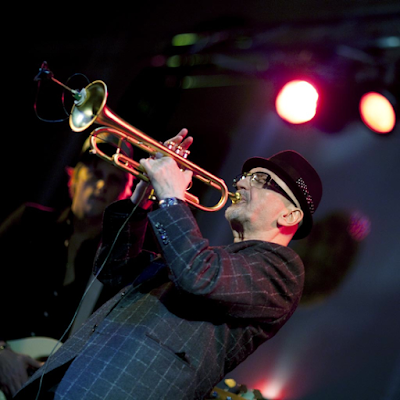
            Tomasz Stanko photo credit John Broughton

Perhaps the most symbiotic group of the bunch was the quartet Stanko formed  in 1993 with then sixteen-year-old drummer Michal Miśkiewicz and his two friends pianist Marcin Wasilewski and bassist Slawomir Kurkiewicz. This quartet was first  recorded work on the Stanko album Balladyne from 1994 on GOWI Records. The group became a working band for Stanko over the years and they released three other albums on ECM, Soul of Things (2002), Suspended Night (2004), and Lontano (2006) all studio albums.

The Tomasz Stanko Quartet ( photo credit unknown)


In June of this year, ECM decided to release September Night, a live recording from a Stanko and this quartet concert recorded in September 9, 2004 in Munich.  To any fan of Stanko and his music, it is certainly of interest to get a chance to look back and capture this soulful group in its most fluid situation, in front of a live an appreciative crowd. The album shows just how much this group had matured under the leadership of Stanko. Particularly noted is how much the quartet telepathically functioned with a heightened acuity to each other's ideas and responded accordingly.

The album has seven compositions six of which are by Stanko with only "Kaetano" credited to the group in total. The songs run from five and half minutes in length to almost eleven minutes. The opener "Hermento" starts with a pedal point bass line by Kurkiewicz as Stanko's searching horn enters the fray. Wasilewski's piano creates the barest of melodies upon which Miśkiewicz adds rolling percussive accents. Stanko creates the mood and you just find it enchanting.

"Song for Sarah" opens with Wasilewski's gentle piano lines that almost whisper out the melody. Stanko's horn has a film noir quality to it and the piano and trumpet dance with an elegant dialogue. Stanko goes silent as the trio show their own musical sympatico as a fully whole entity that can create their own beauty.  Stanko's plaintive horn always seems to bring a human voice-like quality to the music.

Kurkiewicz's plucky bass opens "Euforila" with tonally rich exploratory lines before he settles into a quick paced ostinato line that sets the music up for its throbbing pulse. Wasilewski and Miśkiewicz enter the swelling rhythm before Stanko's fluttering trumpet takes flight with repeating lines that raise the tension. Stanko and Wasilewski state a sparse melody before the pianist takes center stage with his own elastic solo that is beautiful and has elements of free jazz to it. Stanko's trumpet returns with his own sense of urgency to his horn as his backing trio create their own cauldron of excitement. Miśkiewicz finishes the composition with a roiling drum solo that leads to the group restating the brief melody at the coda.

Stanko's stark trumpet opens up "Elegant Piece" accompanied minimally by probing piano lines and roiling tom work. The music blooms into a beautifully  meandering trumpet stated melody. Stanko adds brief flutters, staggered stabs and piercing high register darts to low toned slurs create a tonal potpourri of aural delight that never losses it's elegance. Wasilewski's piano solo is particularly notable, filled with emotion, facility and harmonic creativity that is accented by uncanny angular sense of time and space. He plays his instrument with confidence and yet  chooses to never use speed or flair over expressiveness and taste. The music runs for over ten minutes and gives the team a real chance to stretch out within the concept of elegance and to demonstrate their individual strengths.

The group composed "Kaetano" and features a Latin-inspired rhythm that features a vibrant bass line by Kurkiewicz, some shimmering cymbal work by Miśkiewicz and a Wasilewski piano solo that bustles with inventiveness and melodicism. It's one of Stanko's most energetic and boisterous trumpet solos of the set. The group seems to be reveling in the vibe that they create.

"Celina" has Stanko stating the theme work with sensitive piano accompaniment and rolling tom work in the background. The trumpeter modulates back and forth establishing mood and tension. At the two minute thirty-four-second mark Kurkiewicz starts another ostinato bass line that builds under its own repetitive groove. Stanko's trumpet is like a clarion, an at times shrill warning  that can revert to an emotional gasp or a melancholic cry. Wasilewski's piano solo flows with a modernist approach that has a propulsion all its own, as the rhythm section maintains the heartbeat on the music. 

The final piece on the album is "Theatrical." The music develops like a theatrical story slowly, carefully building interest and being led into revelation. Stanko effectively utilizes changing rhythmic speeds to orchestrate his musical story. From a sauntering opening, the music is introduced as a simple melody with Stanko's trumpet leading the way. Suddenly, he blares a line that changes the pace abruptly. His trumpet erupts once again introducing another shift with shrieks and slurs slowly building the motion, increasing the pace, until he and his group again change direction. He returns to a slow descending pattern on his horn, a reduction of volume, intensity and pace that deflates, fading away to the disappearing coda.

Sadly, Tomasz Stanko transitioned from this world into the next on July 29, 2018, so we will no longer have this moving artist around to add to his musical canon, but it comforting to know that with retro releases like September Night we can continue to rediscover some previously unreleased music from this master. The trio of Wasilewski, Kurkiewicz, and Miśkiewicz continue on without him as a unit. They continue to grow on their own creative path but they will always be inspired by their association with their impressive mentor.