Showing posts with label Portland's 1905 jazz club. Show all posts

Thursday, April 24, 2025

Saxophonist Owen Broder and Quartet Dazzle at 1905 Jazz Club

Owen Broder at the 1905 Jazz Club

The multi-reed player Owen Broder is a new name to me. I was fortunate to get to see this musician and his quartet Friday April 11, 2025 at his first set show at the 1905 Jazz Club in Portland. Broder is a talented musician whose creativity bubbles up with modernity with each note he plays. But his respect for the tradition and those who blazed the path of this music before him becomes apparent when you witness his mastery and the reverence with which he plays his instrument.

Broder is a saxophonist/composer/educator with multiple skills on clarinet, baritone and soprano saxophones, and his main instrument, the alto saxophone. He grew up in Jacksonville, Florida and received his baccalaureate at the prestigious Eastman School of Music in Rochester, New York and his master's at the Manhattan School of Music in NYC. My personal unfamiliarity with this man's work in no way reflects on the well-received acclaim this artist has received for his previous work. He is a sought after section player in large-ensembles and has performed as a member of many prestigious orchestras including the Maria Schneider Orchestra, Ryan Truesdell's Gil Evan's Project, Miho Hazama's Orchestra and Anat Cohen's Grammy Nominated Tentet, to name a few.

Broder's own work as a leader includes his American Roots Project: Heritage from 2018, which Downbeat's Bobby Reed called it "A transcendent work of art."  His Cowboys and Frenchmen Quintet, which fellow JJA member and Downbeat critic Howard  wrote  “The ensemble is smart, cohesive, ... using virtuosic skills and rhythmic power to walk the line between irony and earnestness, with listenability as high a priority as group creativity.” His 2022 album Johnny Hodges: front and Center Vol 1, received multiple critical acclaim. Broder is  a respected educator that works as the Director of Jazz Studies at Reed College and as as an adjunct professor at Portland State and Pacific Universities.

Broder's esteemed career and his reputation for having a transcending sound on the alto, made his performance at the 1905 something I was looking forward to. 

Broder came with both a soprano and alto saxophone to the club, but at my set he concentrated on his burnished alto. The group were all local musicians that played with confidence and poise. Broder introduced the pianist Kerry Politzer on piano, Bill Athens on bass and Machado Mijiga on drums. Broder made it a point to explain to the receptive audience that tonight's music would be drawn predominantly from local Portland-based composers who he felt deserved attention. 

The music opened with a tune composed by local drummer/composer Rivah Ross. Ross's "Dare to Hope" is a driving piece of music that she released on her debut album of the same name in 2024. The music features a repeating main line that features roiling drum work by Mijiga supported by Athens anchored bass lines. It allows Broder's probing, yet silky alto, some creative space to stretch out and explore over the top. Politzer's piano featured repeating, percussive chord lines that had a Tyner-like influence to them. These like-minded musicians had developed a connection that only comes from familiarity and respect.

The remaining set included five additional Portland based compositions. One  from the dynamic drummer Machado Mijiga (whose title I missed); "Channeling" from local pianist/educator Todd Marston from his album Integer from 2022, which to me had a Bad Plus feel to it; the slinky, ethereal  "Venus" from inventive local guitar icon Dan Balmer, from his 2006 album Thanksgiving; one from arranger/saxophonist/composer Jessika Smith, a local educator whose music is originally composed to be played by a big band and claims Buddy Rich as one of her inspirations; and one from the local legend pianist/drummer/educator George Colligan's "Waiting for Solitude" which is a progressive piece from his brilliant 2013 release The Endless Mysteries. 

Despite the diversity of the music, the group showed familiarity and facility navigating the selections with poise, enthusiasm, and inspiration. Broder's skill is top notch, with liquid lines that pour out of his horn with purpose, creativity and tonal beauty. His mastery of tone was especially impressive when the group tackled the only composition that was not composed by a Portlander. On the Quincy Jones composition "Midnight Sun Will Never Set," Broder's horn was such a delight. His sound was rich, resonant and silky, and one couldn't help but compare the way he played with his cherished alto master predecessors like Desmond, Woods and  Johnny Hodges, whom Broder used for the inspiration of his fabulous album  Johnny Hodges: front and Center Vol 1 from 2022.

Let's not take anything away from Broder's compadres. Bill Athens provided some nice probing solos and anchored the rhythm throughout. Mijiga's trap and cymbal work provided powerful drive, but he also intuitively added subtle accenting to the music creating a textural base upon which his bandmates could rely. Politzer's piano work was rhythmically dynamic, with Shearing-like block chording alternating with graceful embellishments, trills and arpeggios that had a Errol Garner-like feel. Broder was the architect in control of this splendid evening of music. He is a calm driving force with thoughtful purpose in his approach. His liquid, tonal beauty flows like honey out of his horn at times, but he can also play incisively and with impressive facility. 

It will be a big loss for the music lovers of Portland when this talent leaves the area and relocates to the Washington DC area in the near future as he announced to the crowd. Portland's loss will be DC's gain and we wish him our sincerest best wishes for his continued success. 
Wednesday, May 24, 2023

Energy and elegance: Billy Childs' "The Wind of Change"

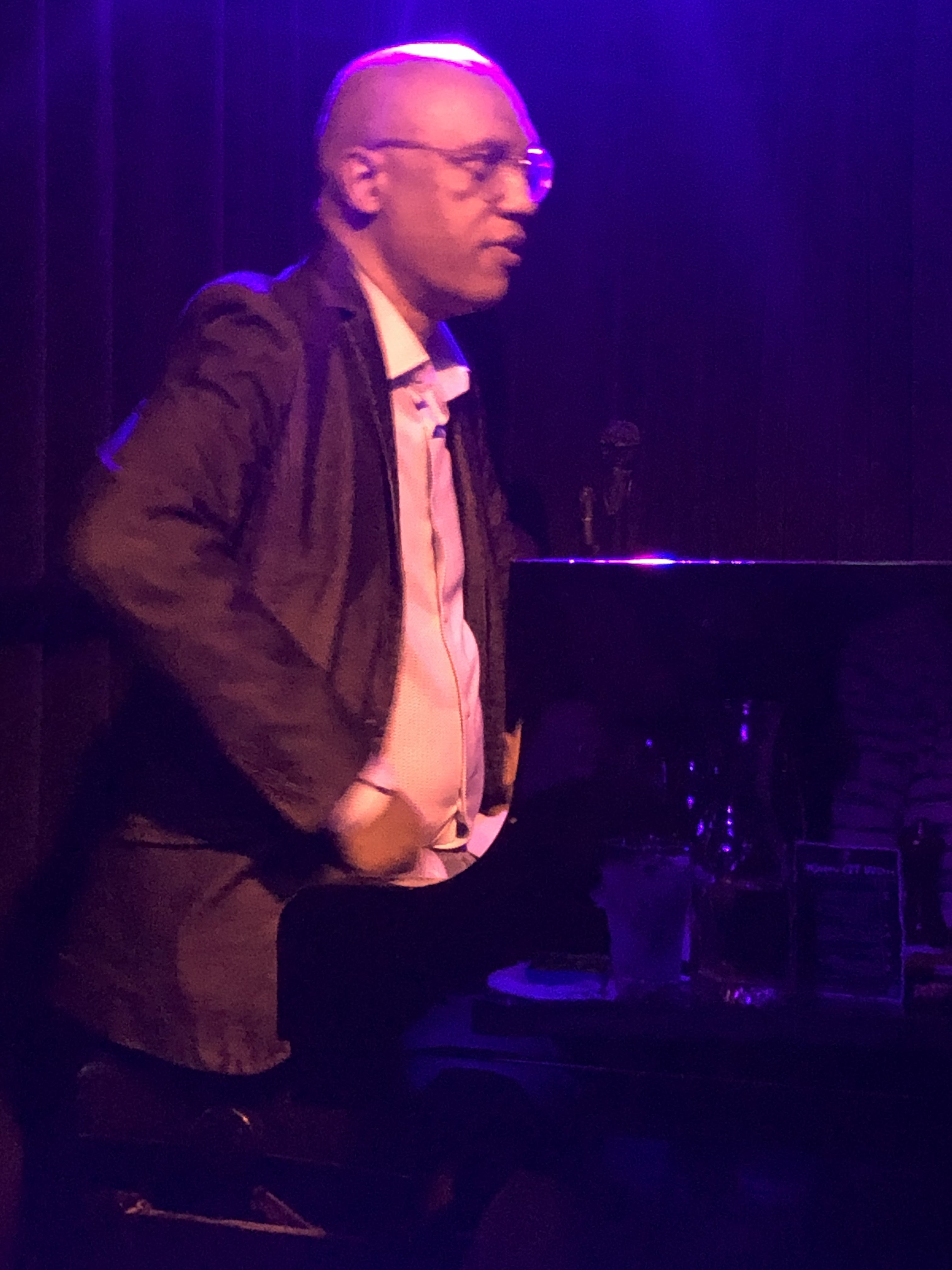
Billy Childs at 1905 in Portland May 4, 2023

I've seen the pianist Billy Childs perform live recently at Portland's 1905 jazz club. He is an elegant musician who is always dressed impeccably and with style and he always brings that same elegance and sophistication to his music. For his Portland gig, Childs brought with him the fiery trumpeter Sean Jones, the bassist Hans Glauswig and the drummer Chris Eumon. More about this at a later date.

BillyChilds with Sean Jones at Portland's 1905 Jazz Club May 4, 2023

I have admired the artist's works over the last several years and his release Rebirth from 2017 was, to my way of thinking, one of the best jazz releases of that year. 


Childs's new releases are always anxiously anticipated, as was his latest The Winds of Change, which was released in March of 2023. The album is a compilation of seven beautiful and inspired vehicles of expression. They include a hallowed and gorgeous version of the late Chick Corea's haunting "Crystal Silence," "Black Angel," a Kenny Barron composition first heard as Freddie Hubbard's title cut from the 1970 album of the same name and five of Childs' own narrative and cinematically inspired musical compositions. 

The pianist/composer assembled a superbly intuitive group for the recording of this album. The excellent bassist Scott Colley and brilliant colorist Brian Blade on drums set the rhythmic pulse. The trumpet chameleon Ambrose Akinmusire is Childs' main front-line foil and collaborator.  The band on The Winds of Change is emotive, flexible, and possesses a telepathic sensitivity to executing Childs' musical demands and the results are spectacular.

On "Crystal Silence," after a beautifully thought-out piano intro, Childs utilizes Akinmusire's plaintive, slurring trumpet sounds to spell out the familiar melody in an expressive, humanistic way. Bassist Colley offers a moving resonant, deep-toned solo of his own and Blade adds the colors of his soft rhythmic brushes to the mix. There was a lot of reverence in the way Childs et al presents this song, a heartfelt dedication to the past composer.

Childs' ballad "I Thought I Know" was played as a trio. The contemplative melody had a swaying feel with Colley offering a moving bass solo and Blade's tight snare accompaniment setting the mood.  "Masters of the Game" Childs reunites with Akinmusire. The two are excellent foils, with Childs' sensitive, classically inspired pianistic thoughts countered by Akinmusire's fluttery, often slurring accents that add excitement and slight disruption to the beautifully inspired formality of Childs' composition.

"The Black Angel" is a dynamic vehicle to include here. The tune invites comparison of the language differences between how Hubbard once played this with Barron, the composer, on the original, and how Akinmusire interprets Childs' vision of the same composition. Childs chooses a more angular, less lilting, more cadenced approach and the trumpeters have two distinct approaches to how they deliver the melody. Hubbard is brighter, lyrical, more athletically dynamic, and precise- softened by Spalding's flute- and Akinmusire's trumpet feels organic, elastic, and more liquid. Childs' playing is dynamic, gorgeously developed with inherent beauty flowing from within, accented precisely by Colley and Blade's intuitive accompaniment. This one is just an example of how in-tune this band is here.

The album includes the captivating, "The End of Innocence" which could easily be seen as a cinematic score. Childs, a lifetime LA resident, claims to have been inspired by some of the great scorers of film like Michel Legrand and Jerry Goldsmith and you see the link. The music is beautifully played by Childs-inspired story-telling piano and his band. Akinmusire's trumpet lingers on long sustained tones that he slurs and screechers to great effect. His playing has an earthy, primal sense sound and what would be more representative of  what Childs is expressing in his "The Ending of Innocence."

Following in the film noir tract and cinematic approaches to music, Childs composed his "The Great Western Loop" with the scenery it evokes in mind. At the Portland gig, Childs spoke of this Pacific Northwest trail several hundred miles long that inspired this song. With a staccato intro, Childs' piano fills the room with a sense of urgency. The group then plays a synchronic serpentine line in unison that demands precision and is executed with razor sharpness. His piano serves up copious lines that flow out of him like an eruption of spring-fed ideas. Blade is particularly propulsive during the statements of repeated lines in unison. The colorful drummer is perhaps the present-day Monet of the era on his kit. 

The album ends with the title cut "The Winds of Change." In my mind, this is the jewel of the album. Childs related that the tune was originally written for the late trumpeter Roy Hargrove and an orchestra. The film influence here seems strongest. I am reminded of Michel LeGrand's work on the theme of The Thomas Crown Affair or perhaps Jerry  Goldmsith's work on the theme to Chinatown that featured Uan Rasey's celebrated trumpet work. Memorable movie music has been permanently tattooed into our cerebellum and rightfully so!

Childs' playing can be so elegant, emotive, and resplendent. The music is a feast of sounds and emotions and I am particularly drawn to the tumultuous tom work by Blade at several apex moments, Akinmusire's superbly emotive trumpet work, Colley's buoyant bass, and Childs' superlative piano and compositional work here. If you are drawn to the majesty that film score work can bring to you, this one is just breathtaking!

Billy Child' The Winds of Change is clearly one of this year's best albums.