Showing posts with label Duke Ellington. Show all posts

Thursday, February 12, 2026

Bassist/Composer Martin Wind Offers Some Beautiful Music on "STARS"


Martin Wind: STARS: Newvelle Records

The bassist Martin Wind has long been on my radar as one of the more inventive and melodic bass players around. I’ve seen him perform live with multi-reedist master Scott Robinson several years back and reviewed several of his past albums that have shown the breadth and depth of this man’s musicality. I had the opportunity to interview Wind back in 2014 with the release of his fabulous album Turn Out the Stars which you can read here

Wind’s latest release Stars is on Newvelle Records, a label that is celebrating its tenth-year anniversary this year. The album is a joyful and sonorous studio album that became available on January 30, 2026, and features Wind’s upright bass paired with a star-studded band that includes the master pianist Kenny Barron, the mellifluous clarinet of Anat Cohen and the creative drum work of Matt Wilson.

Matt Wilson, Anat Cohen, Martin Wind and Kenny Barron (photo credit unknown)

The fifty-eight-year-old Wind was born in Flensburg, Germany. He studied orchestral bass at the Music Conservatory at Cologne and received a Master’s in Jazz Performance and Composition at the Music Conservatory in Cologne.  Wind moved to New York in 1995, won third in the Thelonious Monk Bass Competition in Washington, D.C. and continued studies with Mike Richmond, Jim McNeely, Kenny Werner and Mike Holober to name a few.  The bassist has been a member of the faculty at New York University since 1997 and has been a faculty member of the National Youth Jazz Orchestra in Germany. He continues with   on- going musical relationships with European artists like Belgian guitar ace Philip Catherine, Dutch trumpeter Ack van Rooyen and German guitarist Ulf Meyer. With over fifteen albums that he has released as both a leader and co-leader, it is always worth following the progression of this man’s prolific work.  

Stars opens up with the sauntering “Passing Through,” in some ways the perfect composition that sets the tone and purpose that Wind has in mind when recording this album. The album is reflective, evokes memories from the bassist’s experiences as a musician, and has a quiet sense of elegant melodicism. “Passing Through” is a composition from the bassist/composer Aaron Bell. Bell was a one-time Ellington bassist and an inspiration. The music is deceptively simple, clear and narrative without being obvious. This newly assembled group reveals just how at ease they work together, allowing the music to gently unfold and wrap you with a blanket of joy. Cohen’s clarinet is warm, woody and provocative. Barron’s piano can at times evoke a down and dirty bluesy sense, but the man also has an undeniably elegant feel and a deep well of creativity to draw upon. Wilson’s drum kit is always joyful, like a toy box radiating bliss, and Wind’s warm pizzicato bass lines guide the leisurely shuffle expertly. Clearly this is Wind’s beautiful homage to a felloe player like Bell and a tip of his hat to the Ellingtonian era. Not to mention, this is a hell of a composition that is strangely seldom heard,

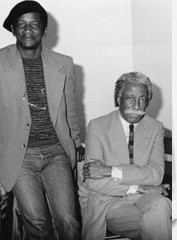
Duke Ellington and Aaron Bell (photo credit unknown)

“Life” is presumably a ballad composed by the leader Wind. It features some beautiful three-way improvisational lines by Cohen, Barron and Wind that weave themselves like sinewy silk threads into a melodic tapestry.

The album continues with “Black Butterfly,” a Duke Ellington composition that is played in a jazz-chamber ballad form. It features the vocal-like sound of Cohen’s resonating clarinet, and the heartbeat-like bass solo by Wind that glows with warmth and elegance. Barron’s accompaniment is superb, as Wilson keeps the pace with subtle ingenuity. The music is reminiscent of a simpler, relaxed, more elegant time.

“Moody” is a gentle, contemplative Wind composition. Lead by Cohen’s expressive clarinet's tubular sound and some dynamic counterpoint bass work by Wind, the music is ethereal. Hanging in the air like a reflective mood, not melancholic but deep in thought and reverend.

Wind gives a nod to the importance of bebop to the canon of music. Here he chooses Bud Powell’s iconic “Wail,” which was first heard on his album The Amazing Bud Powell from 1951. Powell had the lead horns of the powerful tenor of Sonny Rollins and Fats Navarro’s incendiary trumpet to trade ideas on this quick paced gem. Here Martin and Cohen lay out the challenging, circuitous lines of the melody concurrently with impeccable skill, but at a decidedly more relaxed attack. Wind shows that no matter how complex the music may be, it can be effectively entertaining and interesting at any pace if the core of the music’s message is retained by the artists presenting it.  Wind and mates let the music flow with satin smoothness and facility, and the results are rewarding. Kenny Barron’s piano work here is a master class of modern interpretation. Barron is a true descendant that preserves some of the history of jazz music in every note he plays.

Wind opens “The Feel of the Jazz,” another Ellington composition (also credited are Bobby Troup and Geore T. Simon), with an extended, plucky bass entre that hums with joy and creativity. The original release of this song was on Duke Ellington and John Coltrane from 1963 and included the rhythm section of  Aaron Bell on bass and drummer Sam Woodward. When Cohen’s clarinet enters this one, there is a sense of history meeting modernity. Barron’s piano interacts with Cohen’s clarinet as the song progresses and the two pros meld notes so easily at times with ease and familiarity that makes it look effortless.

“Pra Diza e a Deus” is a beautiful ballad composed by the Brazilian composers Edú Lobo and Torquato Neto. It was made popular by Sergio Mendez and Brasil ’66 from their album Look Around from 1967.  The English title of this song is “To Say Goodbye” and anyone who has heard this version can’t forget the sad voice of Sergio Mendes and beguiling sound of singer Lannie Hal or the vocalist Flora Purim’s moving version. For the bassist, this is another homage that recognizes just how much Brazilian music has influenced Wind and added to the jazz canon. Barron’s delicate solo opens this song, before Wind’s aching arco bowing of the bass gorgeously spells out the melody. Wilson drum work opens the rhythm with exquisite restraint, as Barron’s piano expands on the melody. When Cohen’s clarinet enters the mix it’s like her sound takes on the yearning, voice-like element that one remembers from the original. Despite being wordless, these guys transmit the pathos of the sentiment of  saying goodbye to a lover.

The album continues with “Standing at the Window Waving Goodbye,” another Wind composition, that deals with poignant moments of dealing with saying goodbye to someone who is important to you. This reflective, unresolved piece is another example of the music that speaks the most to this bassist as a composer. Cohen’s clarinet seems to float above the music, as Barron’s piano is perfectly supportive. Barron’s solo work always elevates the possibilities of harmonic inventiveness and Wind and Wilson maintain the breezy rhythm.  

Mitchell Parish’s “Stars Fell on Alabama” is a ballad played at a slow gait that has an easy swing to it, and has an obvious tie-back to the album’s theme, Stars. Cohen’s burnished clarinet resonates with sustained warmth, and she navigates the melody with reverence and unadorned emotion. This song brings you back to a time when the pace was more forgiving and a twilight concert offered at a local gazebo could allow you to just sit back and get lost in the music.

My digital release had two bonus songs, the first is a Bill Mays composition “Blues with Two Naturals.” Mays is a pianist/composer that is part of the Martin Wind Quartet. Mays is known for his harmonic humor and on this one he naturalizes the two notes in the key signature, counter to a standard blues form that uses flattened notes.  Kenny Barron, Wind and Wilson make this one all their own.

“Marc’s Moment” is another digital release bonus track that Wind composed and didn’t include on the album. This closer is a joyous, free flowing song that has a medium swing feel to it. Cohen’s clarinet just hovers like a feather, twirling up and gliding down along the thermals as the rhythm section is led by Wind’s booming bass, Barron’s pianistic accompaniment and Wilson’s gossamer drum work.

Martin Wind’s Stars offers the listener some joyful, easy listening music played by a remarkably cohesive band, whose artistry should not be missed.
Wednesday, August 3, 2022

Recollections of past experiences :The Michael Wollny Trio: Ghosts


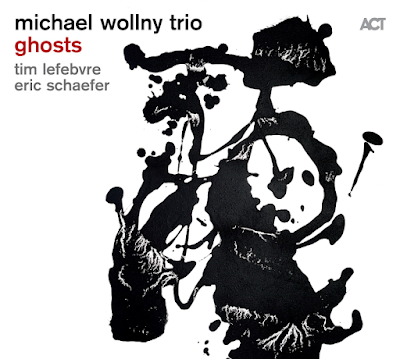
Michael Wollny Trio: Ghosts ACT 9956-2

Michael Wollny and his trio have recently released their latest album, Ghosts, on ACT recordsThe album reunites the German pianist with the progressive American bassist Tim Lefebvre and the spatial percussionist Eric Shaefer. Together these three made quite an impressive debut on their first outing together in the 2013 title Weltentraum. The album set a high-water mark in the pianist’s career and established Wollny with this trio as a creative force that could conjure up a body of music that could excite and intoxicate the listener. Wollny describes the trio’s unique simpatico, "The three of us are aligned in a special, inexplicable way. It‘s hard to describe but the effect is massive."

Tim Lefebdre, Michael Wollny & Eric Shaefer (photo credit Gregor Hohenberg)

Wollny develops inspiration for his musical adventures utilizing off-beat themes. In Weltentraum, the album was based on night songs or dreams. In Ghosts, Wollny describes his concept of how some songs are possessed by spirits, spirits of remembrance. "As an improviser, you often find that it‘s not the compositions themselves you‘re playing, but your own memories of them. And as these memories come back to you in the moment…” On Ghosts, the artist chose a diverse selection of songs, each with a distinct memory for him that personalizes his interpretation of them. There is a logic to the way Wollny cleverly links all these compositions by what he views as their unifying factors. Lost love, forgotten love, loss of simplicity, sentimental recollections, yearning, fragility, sadness, these are the ghosts that linger in the music long after.  The album includes Gershwin’s bittersweet  “I Loves You Porgy,” a traditional Irish folk song “She Moved Through the Fair,” Shubert’s "Erlkönig," Nick Cave & Warren Ellis’ “Hand of God”, Duke Ellington’s “In a Sentimental Way,” Paul Giovanni’s “Willow’s Song,” from the horror movie Wicker Man,  Timber Timbres’ “Beat the Drum Slowly” and “Ghosts” by David Sylvian, along with two of Wollny’s own theme derived compositions “Hauntalogy” and “Monsters Never Breathe.”

The trio offers a dynamism that is quite captivating, with the music making its musical impact in tight, often brief, precisely executed cuts. Wollny‘s piano sets the tone establishing ostinato grooves or fleet arpeggios that carry you with energy and authority. Lefebvre’s bass bellows with facile, vibrant lines that carry the pulse with a sometimes-tempestuous quality; especially impressive is his lead-in to “Hand of God.” Check out the loping lines of Lefebvre’s bass on Wollny’s “Monsters Never Breathe.”  Shaefer’s drums can wrap the sound in a cirrus-like whisp of atmosphere or erupt with a cauldron-like boil of intensity.

Wollny has assembled an excellent trio that can take long familiar compositions and re-imagine them in new and surprising ways. Gershwin’s “I Loves You Porgy” erupts with drive before stating the beautiful melody with passion. There is a poignancy to this song and these three interpret in a contemporary way, creating a drive that never erases the sentiment. Shubert’s "Erlkönig" is modernized by the group into a new century. How would Ellington have imagined his “In a Sentimental Way” being played so barely and in such an expansive, cadenced way? Perhaps the Irish folk song “In a Sentimental Way” retains the most melodicism in the set while still being brought forward in the group’s own inimitable way. Timber Timbre’s “Beat the Drum” features shimmering cymbals by Schaefer and a cadenced piano line by Wollny, as Lefebvre’s bass pulses with a heartbeat consistency.

Take a listen to this album and see if you too are not drawn into the dynamic, entrancing world these three musicians create with Ghosts


Unfortunately, I couldn't find any videos of this new music, but here is the same group from their 2015 performance at the Jazz Baltica. Enjoy!


Monday, February 29, 2016

Atlanta's Jim Alexander Brings His Photographic Jazz & Bues History to Georgia State University

Jim Alexander at GSU

This Thursday February 25, 2016 at the Georgia State University Student Center Art Room, the Atlanta based photographer JimAlexander spoke to a group of about fifty people who came to view some fifty-five of the artist’s photographs, the theme of the exhibit being photographs of jazz and blues performers.

 The spry eighty-one-year-old, beret doffed Mr. Alexander is a noted documentary photographer who was born in 1935 in Waldwick, N J. not far from the then happening city of Patterson, NJ. He started his career as a freelancer in Ridgefield, New Jersey in 1964. His work has been included as part of a Smithsonian exhibition on Duke Ellington, shown at the Sorbonne in Paris, at the Lunds Konsthall gallery in Sweden and at numerous other exhibits and one man shows throughout the Caribbean and the United States. The Georgia State show included photographs that were principally from Mr. Alexander’s work from the late nineteen sixties and early seventies.

The crowd listened intently as Mr. Alexander explained how he got his first camera-a Kodak Brownie box camera that he received as the bounty for winning a ten-dollar bet at a card game while he was in the service back in 1952. From there he started as a freelancer in 1964 and studied photography at the New York Institute of Photography in 1968. In 1970 he was hired by Yale University as a consultant for their Black Environmental Study Team. Many of the photos on exhibit at GSU were from his time in New Haven. CT.

Jim Alexander in front of his picture of blues legend Taj Mahal

It was in 1976 when Mr. Alexander came to Atlanta accepting a position with the Atlanta Office of the Federation of Southern Cooperatives. Alexander later went on to hold the position of "photographer in residence"  at the Atlanta Neighborhood Arts Center and later at Clark College. Mr. Alexander operated his own studio in Atlanta and has continued to teach, mentor and exhibit in many local schools, colleges and for civic organizations. 

Mr. Alexander spoke of his long time association with the late Gordon Parks, a notable Life magazine staff photographer and a director in his own right. It was a conversation that the two had that convinced Alexander to pursue documenting human rights, civil rights, the Black Experience in this country and African American inspired music, most notably jazz and blues. It was seeing how Mr. Parks lost ownership of some of his best work while on staff with Life, that led Alexander to work principally as a freelancer, so that he could always retain the rights to his own negatives.

Jim Alexander and Gordon Parks (credit unknown)
Mr. Alexander was asked which of his photos on display was his favorite. While he claimed difficulty in choosing just one, he ultimately settled on his picture titled "Jazz Jam," a picture that captured a who's who of jazz with four bassists sharing the same stage. The picture includes notables like Charles Mingus, Dizzy Gillispie, Woody Shaw and Ray Brown. He said getting one picture with that much star power is rare and a special occurrence.
Jim Alexander's photo "Jazz Jam" ( used with permission)
It was a testament to Mr. Alexander's inspiration both as an artist and as a teacher to see some of his
former students present at this show, documenting the event for posterity.  If Mr. Alexander has passed on anything to the next generation, it is the need to develop an intuitive eye that can see the importance of what is happening around you in everyday life and memorializing it in the art of photography. The attending audience was a gathering of people who appreciated the work Mr. Alexander has dedicated his life to for the last fifty years. The City of Atlanta should be proud to have this vital octogenarian still working hard to improve our lives with his art and still getting his message out. This transplanted Jersey Boy has truly become one of Atlanta's treasured own.


Tuesday, March 2, 2010

George Mraz and Friends at the Bohemian National Hall


Friday evening 7:30 pm February 26, 2010
Presented by The Dvorak American Heritage Association (DAHA)
at Bohemian National Hall 73rd St, NYC
George Mraz, Acoustic bass; Rich Perry , Tenor Saxophone and Joey Baron, Drums
Photos generously provided by R. Andrew Lepley

A little snow can paralyze the City, but I was pleasantly surprised that despite a white blanket the George Mraz show, scheduled at the Bohemian National Hall on 73rd St, went on as scheduled last Friday evening.

The Dvorak American Heritage Association presented this evening of music at the recently renovated Bohemian National Hall,a splendid memorial of sorts to the Czech classical composer Antonin Dvorak.

One might ask what ties this Czech composer, Antonin Dvorak, to the world of jazz? Dvorak had a residency in New York City for a scant three years from 1892 to 1895 as the director of the National Conservatory of Music. It was here that he wrote his famous Symphony #9 or New World Symphony, as it was known, where he incorporated themes of Negro spirituals and Native American music in what some believe to be his masterpiece. During this time, he briefly taught students Will Marion Cook and Rubin Goldmark. It was Cook who would in turn teach Edward Kennedy “Duke” Ellington and Goldmark who would briefly teach the iconic songwriter George Gershwin. These seemingly disparate influences show the true universality of music as a language that fords all barriers whether those barriers be ethnic, racial or socioeconomic.

On this snow bound evening the bassist George Mraz played one combined set of all original music. Mr. Mraz is a true treasure, having a technical virtuosity that makes him a first call player for many of the great names in jazz. Mr. Mraz’s ease of artistry, his joyful countenance and his smiling, self-effacing demeanor can be misleading. He is a serious musician with serious chops and can swing effortlessly from a four across the bar walking line to a beautifully emotive arco solo as the mood suits him. His tone is both warm and precise.

He was joined by the ever ebullient Joey Baron on drums and the subdued but rich tenor sound of Rich Perry on saxophone.

The trio played a total of ten songs with one short intermission. The set started with the sultry “Wisteria” and moved to a slow, melancholic ballad titled “For B.C.”, which Mr. Mraz said was a dedication to Bradley Cunningham, the former owner of Bradley’s a downtown piano bar at University Place and a late night musician’s hangout. The trio continued with the whimsical “Sponge Magic”,where Perry and Mraz played a duet before George played some of his arco magic, bowing beautifully on his custom Charton bass. Mraz never failed to find electricity in Baron’s antics, with Joey producing a myriad of textured sounds using brushes, sticks, cymbals, rims and when appropriate bare hands. The two of them had a connection that was both telepathic and demonstratively joyful, a highlight of the evening. “Pepper”, a composition dedicated to the late saxophonist Pepper Adams, allowed Perry some room to feature his lyrically rich, mellifluous sound that flows like warmed butter over hot toast.

Typical of Mraz’s penchant to shy away from the spotlight, he almost abandoned the idea of doing a solo bass piece, but with a little prompting from the audience he settled on a short Monrovian folk ballad. He mesmerized the audience and his fellow musicians with the depth of the feelings he could elicit with his sensitive pizzicato technique.

The set continued with the song “Unison” where Mraz played a fluid walking solo. The composition seemingly ended three times before the musicians finally decided to finish in unison. The set continued with a piece Mraz wrote for his daughter “Blues for Sarka” where Baron and Mraz showed an exceptional affinity. A bossa titled “Autumn Kisses” featured a Getzian sounding Perry on perhaps his finest work of the night. The final song of the evening was a composition born from Mraz’s days with guitarist John Abercrombie, titled “Strange” ,with its somewhat dark overtones, Mraz’s skillful use of sliding notes deftly accentuated the feel of the song.

It was a wonderful evening of Czech pride, as Mraz and company performed in the splendor of the Dvorak inspired Bohemian Hall. The bassist George Mraz made clear that he is not only a great jazz bassist but also a Czech national treasure.

An album of this original music has been recorded and will be released in the near future.