Showing posts with label Billy Drummond. Show all posts

Monday, July 21, 2025

Tessa Souter Offers Some Enchanting Music from French Composer Erik Satie and More on "Shadows and Silence"


Tessa Souter-Shadows and Silence- The Erik Satie Project-NOANARA

The chanteuse Tessa Souter released her latest album Shadows and Silence- The Erik Satie Project on the NOANARA label on July 1, 2025. Having been a follower and fan of this stylistic vocalist, this may be the best of her releases to date.

Souter’s theme is the artistry of the classical composer/pianist Erik Satie, whose eccentric and minimalist approach to western music may have been an inspiration to the subsequent modal jazz and ambient music trends. Despite the influence to jazz and ambient genres, there is a great deal of classical, albeit modern, influence on this record.

Souter has the soul of a lyricist, and it is on display in spades on this album. She takes several songs from Satie-Gymnopedic No 1, No 2, Vexations, and No 3, Gnossienne No 1, No 2, and No 3- and retitles them with lyrics. She pens lyrics about love, loss, transience, fluidity, beauty and the futility of thinking you can capture the ever-changing present, and peace. This thoughtful compilation shows respect for the music of an artist whose work was so influential. My first exposure was back in the early seventies, when I fell in love with the Blood, Sweat, & Tears version of their Variations on Theme 1st and 2nd movements from Gymnopedic No 1, as arranged by multi-instrumentalist Dick Halligan and recorded by the jazz/rock band back in 1968.

On Souter’s version of this composition, she renames this lyric version “Rayga’s Song,” in dedication to the birth of bassist Yasushi Nakamura’s son, which happened during a snowfall. She is accompanied by Luis Perdomo’s delicate piano work and Steve Wilson’s soaring soprano saxophone. Bassist Nakamura’s plucky bass solo offers his own poignant comment. Souter’s lyrics and her sincere voice bring the element of hopeful love, to this piece that revels in the promise of a new life into this otherwise haunting piece.

Satie’s Gnossienne No1 was retitled with lyrics as Souter’s “A Song for You” (not to be confused by the Leon Russell song by the same name). On this one Souter tells the story of a disguised lover who hides his true intention and the effects it had on his befallen lover. Drummer Billy Drummond’s beat is hypnotic, Perdomo’s piano is splendid and Nakamura’s bass throbs like a beating heart.

Souter even knits in a song that recalls a Paul Gaugin painting of the same name “Du’O Venons-Nous” based on Satie’s Gymnopedic No3, which has some nice arco work by Nakamura and some airy soprano work by Wilson.

Clearly Souter’s exposure to Satie has been more studious and rigorous then mine. But this is not exclusively a Satie album. Souter finds other excellent pieces that seem to thematically weave into the fabric of this project seamlessly.  The Edith Piaf-inspired “Avec le Temps,” a Leo Ferre composition that Souter sings in French, with both emotion and verve, accompanied by Nakamura’s excellent bow and Perdomo’s crystalline piano.

Souter includes a Rod McKuen song, inspired by Jacques Brel titled “If You Go Away.” She does as an intimate duo with Perdomo in the intro, before she kicks it up a notch for a moment with her vocal energy, as she injects a cabaret feel. She follows with singing in French for a section before the trio takes the music to another level, eventually Souter returns to that intimate duo at the coda.

Jazzers should appreciate the song “Never Broken (ESP)” a collaboration written by vocalist Cassandra Wilson and saxophone/composer, legend Wayne Shorter. Souter is at her most fluid here. The trio percolates with Perdomo getting off on the zigzagging lines he introduces, as Nakamura and Drummond lock in like a fine-tuned timepiece, with Drummond getting a little freedom to offer some nice drum centric features on this one.

Perhaps one of my favorites is bassist Ron Carter’s “Mood,” which Souter’s worded version is called “Musica Universalis.” Instrumentally, this one includes a mesmeric metronomic beat that is laid down by Nakamura and Drummond, before Perdomo adds his own leading piano lines. The real tonal treat comes from Australian born New York-based Nadje Noordhuis’s moody muted trumpet lines as they interweave with Wilson’s sinewy soprano work, that at times almost sounds like a flute. The two show a great deal of magic and symbiosis when playing together. Souter’s vocal spells out the enchanting lyrics “Mood is a feather, just floating wherever, like change in the weather, all clouds in the sky’… “Now waits for no man, it’s gone in a moment, Belonging to no one.”  The lyrics nailing the transience, the fluidity, the beauty and the futility of never being able to keep things more than in the moment. 

Tessa Souter's Shadows and Silence- The Erik Satie Project is a splendid album that you will find yourself revisiting many times. 
Sunday, April 22, 2018

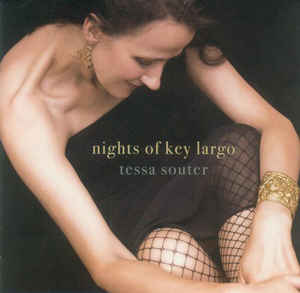
Utterly Enjoyable: Tessa Souter's "Night of Key Largo"

Tessa Souter Nights of Key Largo Venus 


I was recently sent a copy of Nights of Key Largo, an album from the vocalist Tessa Souter. The album was originally released on the Venus label in Japan in 2008 and was re-released here in the United States this year.

Ms. Souter is a London born singer who took to singing late after a successful career as a copy editor, a freelance journalist and a mother. She moved to the US in 1992 and attended the Manhattan School of Music meeting and later being mentored by the late great Mark Murphy for four years. She has also studied with the NEA master vocalist Sheila Jordan.

Ms. Souter’s work is marked by one of the most natural voices in jazz today. Her delivery is clean, honest and emotionally sincere. She has what musicians call great ears and a superb taste when choosing material to cover. She often finds inspiration in re-imagining songs that do not fall into the repertoire that is generally associated with jazz. Some splendid examples of this woman’s musical creativity include her flamenco-fused version of Cream’s “White Room” and her treatment of the Beatles classic “Eleanor Rigby” both from here 2009 album titled Obsession. She extended her musical boundaries venturing into a successful fusion of jazz, pop and classical on her fine 2012 album Beyond the Blue, putting her own lyrics to jazz versions of Beethoven, Rodrigo and Chopin. 

On Nights of Key Largo, Ms.  Souter, along with producers Tetsuo Hara and Todd Barkan, assembled an intuitive group of musicians to accompany her on this outing. The inimitable Kenny Werner on piano and I assume arrangements, bassist extraordinaire Jay Leonhart, guitarist Romaro Lubambo, saxophonist Joel Frahm and drummer Billy Drummond all add significantly to the overall success of this effort.

Souter again finds some hidden gems that other singers seem to miss. There is something for everyone who loves great music on this album. Notable compositions  include Ivan Lins romantic “The Island,” where Ms. Souter’s breezy vocal and Frahm’s mellow tenor wrap you in a sensuous blanket.

Van Morrison’s folk/jazz/blues classic “Moon Dance,” is given to a jaunty treatment featuring Leonhart’s buoyant bass. 

Lubambo’s lush guitar chording is the perfect complement to Souter’s liquid vocal on “So Many Stars.” 

Werner’s beautiful piano accompaniment on Bachrach’s “Look of Love” is just transcendent and Souter knows how to make the most of it with her unadorned approach. 

On the cinematic John Barry theme to James Bond “You Only Live Twice,” Souter’s voice floats over Lubambo’s gentle guitar picking.

The oft neglected Benny Carter composition “Key Largo” features Ms. Souter’s voice at it’s most sultry.  This is adult contemporary at its best. Werner is superlative and Leonhart and Drummond keep the walking time impeccably.

Lubambo’s delicate guitar and Drummond’s shimmering cymbals introduce the Mancini classic “Slow Hot Wind” before Souter comes in with her telling reading of the evocative lyrics, as Frahm offers a sensitive tenor solo.  

The album continues with the lovely “Moon and Sand,” “I’m Glad There is You” -with an exceptionally  swinging solo by Frahm- “All or Nothing at All”, “Morning of the Carnival” -with some beautiful arco work by Leonhart- and ending with John Lennon’s wistful and hopeful “Imagine.”

I've listened to this album several times now and it is utterly enjoyable. If her previous work hasn’t convinced you to pay attention to this fine vocalist than the re-release of this hidden gem Nights of Key Largo should be all you need to sit down, listen and enjoy the compelling sound of Tessa Souter.


Wednesday, May 25, 2016

Trumpeter Jeremy Pelt's # Jive Culture: Hipness meets Maturity

Jeremy Pelt photo by Sally Pritchard
When a new album comes out from an artist that you have listened to and appreciated, it is always a moment of anticipation when you play the first cut and see if it holds up to your expectations. I have been a fan of Jeremy Pelt’s playing for quite some time and when the opening notes of the lead off song “Baswald’s Place,” from Pelt's latest # Jive Cuture, hit my ears I knew I was in for a treat.  Pelt has a beautiful tone and his attack is precise and piquant. The interplay with the superbly swinging Billy Drummond on drums is a lesson in synchronous dynamism and of course the ever present foundation of the swing is laid down to perfection by the inimitable Ron Carter on bass.


Jeremy Pelt's #Jive Culture High Note # HCD7285
It is the opportunity to play with the great bassist Carter that made this date all the more special for Pelt. The mutual respect these two have is on brilliant display on Carter’s “Einbahnstrasse” a down home blues that features a potent solo by Carter and some lyrically responsive trumpet playing by Pelt. The song is the perfect vehicle for the group to simply strut its ability to swing.

On Cole Porter’s “Dream Dancing,” Pelt’s beautifully Chet Baker-like solo floats on Drummond’s steady cymbal-driven beat and Carter’s full bodied, roaming bass lines. Pianist Danny Grissett comps to perfection behind Pelt before taking a gorgeous solo where he elegantly ventures off into his own extrapolation of the melody. It seems that the inclusion of the venerable Carter into the group has elevated the maturity level of all the players on this date, as they each play within the song to great effect.

The Dave Grusin/ Allan Bergman ballad “A Love Like Ours” is perhaps the piece de re.sis.tance of the entire album. This achingly beautiful song features Pelt’s lone voice at his most lyrically emotive, with the band playing behind him in a brilliant display of subtle complimentary playing at its finest. It doesn’t get much better than this.

As if to demarcate a change in approach, Drummond’s solo rolling drums open the second part of this album for almost two minutes before the group gets into the main theme of Pelt’s composition “The Haunting.” Pelt’s trumpet wanders around the core of the melody, often modulating the level of intensity with his horn as the band plays on. Carter is particularly active in his playing, peppering the loose swing provided by Drummond with a variety of accented notes and bends. Grissett plays an equally elusive solo.

The deceptively cadenced “Rhapsody” features a syncopated rhythmic vamp that Drummond and Carter produce in conjunction with the ethereal sounds of Grissett on Fender Rhodes. Pelt uses this throbbing groove to establish a floating, tension-building trumpet solo that escalates the drama in the song. Through a series of increasingly urgent sounds, Pelt creats the illusion of entering into the unknown until the song fades out into oblivion at the coda.


Opening with an unaccompanied solo piano introduction by Grissett that sets the alluring mood of “Akua,” is a slow, sauntering ballad, whose repeating vamp imprints in your brain long after you leave it. The film noir-like theme features Pelt’s poignantly muted trumpet and Grissett’s pensive piano work. Carter’s walking bass meanders with creative two-step in-fills that add to the feel of this sultry song.

The final song of the cd is another Pelt original titled “Desire,” an upbeat, loosely structured romp where the rhythm is turbulently played by Drummond creating a sense of unease. that is punctuated by Carter’s roving bass. Grissett and Pelt are both featured playing on the repeating vamp which is the armature around which they base their improvisational ideas. Grissett ventures off into unpredictable grounds on his solo before returning to the theme. Pelt is equally off to the wilderness with his probing trumpet only occasionally touching on the theme in some remote way before magically resolving back to it before the finale.

With #Jive Culture Jeremy Pelt has achieved that rare plateau where hipness meets maturity in one totally satisfying album.