Showing posts with label Guitar jazz. Show all posts

Thursday, July 10, 2025

A Significant Guitarist of Our Era, Pasquale Grasso Offers "Fervency"


Pasquale Grasso: Fervency- Sony Masterworks

Guitar master Pasquale Grasso released his new trio album Fervency February 7, 2025 on Sony Masterworks. It is no wonder how this man is continuing to excite and wow an increasingly larger band of followers for the depth and artistry of this important musician. 

Grasso is an Italian born in Ariano Irpino, a hillside town in the Campania region of Italy. This area of southern Italy is about 132 miles northwest of where my mother and her family once immigrated. With this common regional heritage in my blood, there is no doubt I have a sense of personal pride in discovering such a talented artist that comes from this area. 

Grasso has been honing his skills since the age of five. He has tremendous facility and control over his instrument, but he also carries within him a deep respect for the tradition. He sites pianists like Bud Powell, Thelonious Monk and Elmo Hope among his influences and was mentored by Barry Harris since the pianist caught him playing in Italy in 1998 and took him under his wing. Be Bop is in his man's veins. Early in his career, Grasso was a student of guitarist Agostino Di Giorgio, an American expat who taught him methods of guitar great Chuck Wayne, who was Di Giorgio's one time teacher.

Looking to expand his technique, Grasso also took classical guitar lessons at the Conservatory of Bologna, under the tutelage of guitarist Walter Zanetti. It is no wonder that  when Grasso moved to New York, the guitar ace Pat Metheny invited the fellow guitarist to jam with him at his own NY apartment, and has become both a mentor and fan. In a 2016 interview published in Vintage Guitar, Metheny recognized Grasso for the talent that he was. "He (Grasso) has somehow captured the essence of that language from piano onto guitar in a way that almost nobody has ever addressed. He’s the most significant new guy I’ve heard in many, many years.” 

Grasso's influences, life connections, along with his inherent abilities, have all been part of the impressive maturation of this young man's playing and style. Based in New York City since 2012, Grasso used his frequent appearances at Greenwich Village haunt Mezzrow to experiment with his approaches to some of the canon's less-well-known classics and develop his own set materials. He has released well-received albums that covered the music of Bud Powell (Solo Bud Powell-2020), Duke Ellington (Pasquale Plays Duke 2021- with young chanteuse Samara Joy and veteran be-bop storyteller Sheila Jordan contributing), Charlie Parker (Be Bop 2022), Dizzy Gillespie and Thelonious Monk.

On Fervency, now thirty-six year old Grasso, is joined by two very accomplished colleagues whom he has worked with for fifteen years, the bassist Ari Roland and the drummer Keith Balla. These guys navigate some obscure and some better known compositions on the album with finesse and skill. Grasso has shown his preference for mining the canon of be-bop music more deeply. He reimagines compositions that others may have left unexplored and he thinks like a pianist. On this album, Grasso has widened the spread of his casting net and brought in some real interesting, often less treaded jewels that are sure to please.

Grasso leads off with one of his idols, pianist Bud Powell, and his blazing "Sub City."  This one features some tight, quick-paced and swinging guitar work by Grasso, a rousing arc bass solo by the impressive Ari Roland, and some Keith Balla brushwork that recalls the exquisite brush mastery of Jeff Hamilton. These guys know how to cook.  


Pasquale Grasso | Come by Mezzrow tonight!!! 10:30PM-1AM Ari Roland bass Keith Balla drums ...
Pasquale Grasso, Ari Roland, Keith Balla (photo credit unknown)

The trio can set speed records for flawless execution at mind blowing velocity if so inclined, but Grasso is always inventing on the fly. You can hear different gems of harmonic inventiveness on his "A Trip to C.C.," a song dedicated to his girlfriend, Miles Davis "Milestones" ,and Ray Noble's always challenging, off to the races "Cherokee."  His lines are swift, never predictable, and he seems umbilically connected to the bebop tradition while bringing it into a new era of modernization. 

Composer/arranger/pianist Tadd Dameron is a favorite of Grasso, and he chooses three of this master's compositions- "If You Could See Me Now," "Lady Bird" and Jahbero." 

Dameron played the sultry "If You Could See Me Now" with an orchestra and the fabulous vocalist Sarah Vaughan on her  Musiccraft record of 1946. Dameron's "Lady Bird" and "Jahbero" were on the 1957 Blue Note release with the pianist's  Septet. It included the brilliant Fats Navarro on trumpet, the thoughtful tenor of Wardell Gary and Allen Eager, Curley Russell's anchoring bass, Chino Ponzo infectious bongos and Kenny Clarke inimitable trap work. It is interesting to juxtapose these recordings from the composer and see how Grasso reinvents them for his guitar.

If you appreciate a good ballad like Dameron's "If You Could See Me Now," it's Grasso's sumptuous guitar that cascades his lines, spelling out the wordless melody with sublime sensitivity, as Roland's bass adds another resonating arco solo to the mix. There is no orchestra to rely on here as Dameron had at his disposal, but these two don't seem to need one. They find enough tonal color between themselves to make this one sing, even without Sassy Sarah's wonderful voice.

"Lady Bird" is just a swinging joy. Roland walks with authority as Balla pops and snaps on his snare. Grasso's sound on his custom French made Trenier guitar, just hums like a idling Ferrari. His fluid single notes, often complimented by his unerring chordal accompaniment and chronometric timing, is just superb. There is no warm Gray tenor here, or Navarro's bright trumpet adding different colors, as in the Dameron original, but Grasso and company never seem wanting for being under-armed. They bring energy and excitement to this modern classic and you can't help but tap your feet. Grasso always finds new ways to harmonize on the melody with invention and promise. Balla is given a short feature on his traps and Roland offers another of his signature arco solos. Well done guys!

"Jahbero" had the Latinizing rhythmic punch of Ponzo's bongos in the original Dameron release, so I was looking forward to seeing how Grasso would address this. To my surprise, Ballo's inventive trap work fit the bill beautifully. Grasso's imagination found a fountainhead of ideas on which to portray this wonderfully vibrant, still modern feeling composition on his guitar. 

The remainder of the album continues to unearth some surprises, like  mentor Barry Harris's "Focus" and "And So I Love You." Another Miles Davis; composition "Little Willie Leaps," which once featured a historic tenor solo by Charlie Parker, a rare Coleman Hawkins treasure "Bean and the Boys" and a Milt Jackson favorite "Bags Groove." 

Grasso's title cut "Fervency" has a unique genesis. Grasso was traveling home from a gig in NY riding a subway car in the wee hours of the morning when he glanced over to see an open dictionary and was inexplicably drawn to the word he was unfamiliar with, "fervency." The meaning turns out to be "a warmth of feeling or devotion." It seemed to strike Grasso as the perfect word that describes his own feelings toward his love of this music that he has made his life's work. The music opens with another delicious arco treat from Roland's and his  1930's vintage Jurek upright bass. The Julliard trained bassist is certainly a bit of a throwback and he likes the warmth of gut strings to produce his resonant arco sound. Some have likened his arco work to that of the great bassist Paul Chambers. Needless to say, Grasso follows this splendid intro with one of his most emotive performances, as his guitar creates a liquid flow that seems to have no limit to its harmonic variations. Besides being a brilliant single note player, the guitarist adds excellent chordal work that creates another dimension to his playing and it is just pure magic. 

If you have never had an opportunity to listen to Pasquale Grasso, you owe yourself to get Fervency and just revel in this man and his bandmate's beautiful artistry. If you can catch him live at one of his upcoming performances all the better. It's not often we get a chance to see such talent in his prime and in person so  don't hesitate, you won't be disappointed.
Wednesday, October 28, 2020

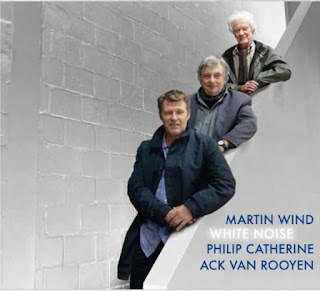
Martin Wind's "White Noise" w Philip Catherine and Ack Van Rooyten : A Sound Oasis.

White Noise Martin Wind, Philip Catherine & Ack Van Rooyen, Laika Records

There is a beautiful warmth and sonorous resonance to the work of bassist Martin Wind. I have heard Wind’s playing musically enrich work performed with saxophonist Scott Robinson, the drummer Matt Wilson, the guitarist Ulf Meyer and the pianists' Bill Cunliffe and Bill Mays. The soloist/accompaniest has composed, played, and recorded on over ten of his own leader /co-leader releases including Get It (2010), the orchestral Turn Out the Stars, Music Written and Inspired by Bill Evans (2014), and Light Blue (2018). 

Flensburg, Germany born Wind graduated from the Cologne Music Conservatory in 1995 where he studied with orchestral bassist Wolfgang Guettler. He placed 3rd in that year’s Thelonious Monk Bass Competition in Washington. At the age of seventeen, Wind was exposed to the work of Belgian guitarist Philip Catherine in a duo with the iconic Danish bassist Niels-Henning Ørstead Pederson on their album The Viking and the Dane’s bass work left a lasting impression. Wind came to the US in 1996 where continued studies at NYU earning a Master’s degree in jazz performance and composition. His bass work has a distinctive orchestral influence. His large, warm sound and inherent sense of rhythm deftly anchor any work that he performs, and he can employ a gorgeous arco technique at will. 

Philip Catherine, Ack Van Rooyen and MArtin Wind

Wind realized his wish to play with the respected guitarist Catherine in 2013 when the duo recorded their first album the duo New Folks. The latest release White Noise is an attempt by Wind to create a “Kind of sound oasis.” His goal “In a world where silence is becoming more and of a luxury, I wanted to create a little acoustic opposite pole.” The album succeeds and it is in no small part due to his two seasoned bandmates. Wind is the youngest of this trio at fifty-two, with Catherine at a sprite seventy-seven and Van Rooyen as the elder master at the age of ninety! 

Wind opens a Kenny Wheeler composition “Canter” with a vibrating arco opening that resonates with overtones and emanates with a visceral yearning. A gorgeous melody, Catherine’s gentle touch, and Van Rooyen’s mellow-toned flugelhorn lead the listener to this magical world of calm and beauty, as Wind sustains the gentle rhythm of a canter. A rewarding respite to another world of tranquility and beauty. 

Cole Porter’s “Everything I Love” captures a nostalgic time when a good song and some swing could take you to a less strenuous time. Van Rooyen's horn is mellow and bubbly, and Catherine’s guitar adds some offbeat licks that surprise. Wind’s bass solo is buoyant, cheerful, and swinging. 

Wind wrote the title song “White Noise” with his bandmates in mind. Catherine utilizes some subtle and effective echo and electronics to create the opening that leads you into this unknown territory. The music has an ethereal ECM feel to it with Van Rooyen's searching horn work floating over the soft accompaniment of his bandmates. Catherine’s guitar work here reminds me of some of guitarist John Abercrombie’s atmospheric outings. Despite being able to lose yourself in the clouds that these guys create, you never lose the beauty of the melody that sustains you throughout. 

Van Heusen and Burke’s standard “But Beautiful” is one of two duo features on the album with Catherine and Wind taking it slow and demonstrating a sense of familiar simpatico. Catherine’s playing is just beautiful and a modicum of artistry.

“The Dream” is a moving ballad that Wind wrote for his first meeting with guitarist Pat Metheny when they played together at Jazz Baltica in 2003. Catherine’s gorgeous strumming and Van Rooyen’s plaintive horn work are at top form and Wind’s plucky bass solo work is superb.

Ack Van Rooyen's composition “Autumn Bugle” is a searching, blues-based ballad that features the Dutchman’s warm tone and Catherine’s sensitive accompaniment. I’ve not heard this artist before, but the man's articulation and expressive emotional delivery are especially noteworthy. In the liner notes Wind called Van Rooyen an angel and the nonagenarian jokingly admits to being maybe an aging angel.

Wind wrote the “Genius and a Saint” for a friend and fellow bassist Bob Bowen who had sadly been the victim of a fatal bicycle accident. There is a somber, deliberate sense to this tune initially. Soon Catherine and Wind change the feel enlivening it with more hopeful approach. Catherine's inventive approach offers strumming his guitar like a mandolin, adds some rapid arpeggios, utilizes some beautiful fingered chording, and includes some modulated volume. Wind buoys the rhythm with a more aggressive pace that energizes the mood behind Catherine's expressive adventures.

Wind opens up with a bellowing bass solo on Styne and Kahn’s poignant standard “I Fall in Love Too Easily.” Van Rooyen's flugelhorn spells out the melody before Catherine’s guitar harmonizes the music with his own improvised ideas to end the set.

Van Rooyen and Catherine have lived through a period of time that has given them a sage's perspective of history's vagaries. With Wind, these gentlemen lend their maturity and sensitivity to this project with this music and their artistry. Martin Wind’s White Noise is a welcomed celebration of music that soothes, entertains, and delights in today’s age of uncertainty and tension.

Thursday, February 17, 2011

The Guitar Heros Exhibit of Legendary Italian Luthiers at the Metroploitan Museum of Art

at the Met February 9th through July 4, 2011

JOHN MONTELEONE AT WORK
This past Saturday, I ventured into New York City to see an exhibit dedicated to master craftsmen who elevated their craft to true art. The Metroplotian Museum of Art on Fifth and 82nd is an iconic building.  With its grandiose entrance, its stately stairs and  its monumental granite facade, the Met  lends instant respectability to anyone who is so fortunate as to have there work exhibited there.


D'ANGELICO
The museum, under the astute direction of associate curator Jayson Kerr Dobney, has created a fabulous exhibit assembling some exquisite examples of the work of several Italian-American luthiers (makers of stringed instruments).  Titled Guitar Heroes, the exhibit traces the history of some artisan craftsmen who, beginning with the wave immigration from Southern Italy in the late 1800's, brought the art of violin and mandolin making  into this country, . Eventually, as tastes changed, they adapted their skills to the construction of arch-top guitars mostly in Manhattan's Little Italy. As a one time guitar player and  a descendant of Italian immigrants; one a cabinet maker and another a skilled stone mason, I have a special affinity for this exhibit and for the justly deserved recognition it bestows on these master craftsmen

Originally hailing from towns whose names are virtually synonymous with instrument making like, Cremora, Venice, Naples and Padua, these artisans had their trade sustained by the early craze for mandolins in the New World. By the 1920's the luthiers found themselves facing a shrinking demand for mandolins. Many turned to violin and eventually arch-top guitar construction to support their shops. One of those who was able to make the transition successfully was the New York City based luthier John D'Angelico. From his shop on Kenmare Street  in lower Manhattan, D'Angelico started to produce his own arch-top guitars based on the the popular Gibson L-5 (made by the Gibson Guitar Co in Kalamazoo Michigan).  The arch-top guitar featured violin-like construction with F holes in the top, a slightly convex top and back and a floating bridge. The design was popular as a rhythm guitar because it projected chords so well and was used in the popular big bands of the time. D'Angelico's attention to detail  was his signature. Hand crafting each guitar, often times customizing details to his customers specifications, he innovated on his guitar making process. He incorporated an Art Deco design into his guitars, producing not only a fine playing but a beautiful looking instrument.

D'Angelico's apprentice was the young James D'Aquisto, who after studying with his mentor,  himself became a master luthier, carrying on the tradition and expanding it in his own artistic way. His signature pieces are hallmarked by his insistence on using only natural and sometimes exotic materials on his guitars, along with his own innovative designs. One of the highlights of the exhibit  is a continuously running  film from 1985 by Fredrick Cohen titled  "The New Yorker Special: Handcrafting a Guitar."   It documents luthier Jimmy D'Aquisto hard at work in his shop, demonstrating the many steps it takes to build one of his fine guitars.
SIDE HOLES ON THE MONTELEONE


Present day master luthier John Monteleone is the last of the three guitar heroes featured at this exhibit. His detailed work incorporating  innovative designs and concepts are on ample display. His beautifully conceived and finely executed masterpieces have all become highly coveted collector pieces and take the art of the luthier to new heights. One of his innovations was the introduction of adjustable side openings in the body of the guitar, allowing the guitarist to hear the sound his is projecting to his audience.
A SIDE BY SIDE COMPARISON OF THE THREE MASTERS D'ANGELICO, D'AQUISTO & MONTELEONE

For any part-time guitarist or accomplished professional  musician this show is a joy. For those who simply love beautiful things, made beautifully this show has its own special appeal.


Steve Miller and Friends Present: Concert at the Grace Rainey Auditorium
featuring the guitars of Jimmy D'Aquisto

Later that evening the museum held a  special concert presentation of some master guitarists playing some of the legendary D'Aquisto guitars, as seen at the exhibit. Held in the beautiful Grace Rainey Auditorium, the full house of patrons was entertained by the buoyant octogenarian Bucky Pizzarelli. Accompanied by the fine guitarist Ed Laub, the  duo played a series of  standards with Bucky using his own D'Aquisto guitar seven string guitar. Bucky is known as the consummate jazz rhythm guitar player,. He is a master of the seven string arch-top guitar and he showed why as he emblazoned his mark on tunes like "Tangerine", Claude Thornhill's "Snowfall" and Django Reinhardt's "Nuages". Over his sixty year career, he has shared the stage with everyone from Goodman to Grappelli


The next performer, one of my favorite guitarists and the performer I was most anxious to see, was the unassuming but superb Jim Hall. Hall is now eighty years old and his appearance was a stark contrast to that of the elder but sprightlier Pizzarelli. The stooped Hall came on stage with the aid of a cane,and was accompanied by the fine bassist Steve LaSpina. Hall's masterful work has graced the albums of giants like Hampton Hawes, Sonny Rollins, Bill Evans and Paul Desmond to name just a few. His subtlety and harmonic language has set the standard for many guitarist who have been influenced by his amazing body of work. Modern day masters like Bill Frisell and Pat Metheny cite him as a major influence. Despite his frail appearance his playing is undiminished, the essence of unassuming excellence.

Mr. Hall spoke in a quiet voice without the aid of the microphone and his guitar was poorly miked, so unfortunately there was some distinct fall off in the quality of sound during his performance. Jim was playing a D'Aquisto guitar that was made for him by the famous luthier. Mr. Hall  admitted that he has not played it much since  it became such a rare collector's item after the master craftsman's death. What we could hear was classic Jim Hall on his unusual take of the standard "All the Things You Are", his tasteful subtlety on the beautiful bossa"Beija Flor" and a 16 bar blues tune he called "Careful". Mr. LaSpina, who complimented the guitarist perfectly, was featured on  "Beija Flor". Check out the Jim Hall trio with Mr. LaSpina on bass and Joey Baron on drums on this video I found and I'll let the playing speak for itself.


The third performer of the night was the masterful Howard Alden.  Alden plays a seven string guitar and is extremely accomplished. His ability to play alternating bass lines and lead lines almost concurrently reminded me of the technique developed by the great Joe Pass. Alden wowed the crowd with his versions of "My Shining Hour", Duke Ellington's "The Single Petal of a Rose", Billy Strayhorn's  
"Lotus Blossom" , "Lap Piano" from the guitar virtuoso George Van Eps and  Django Reinhardt's  "Tears". For those who have not seen Mr. Alden before he is an impressive artist.

The finale of the event was guitarist Steve Miller and his band, playing his own custom made solid bodied James D'Aqiuisto guitar with Howard Alden sitting in. Mr. Miller related his own special story about his one time friend Mr. D'Aquisto and spoke of his own personal guitar collection of over 400 guitars.
He played a repertoire that was slightly jazz based. He covered a T. Bone Walker tune "Tell Me What's The Reason You Keep On". He offered a clever amalgam of Ma Rainey's "See See Rider Blues" sung to the music of Miles Davis's "All Blues" and  sang an evocative version of "Nature Boy", where Mr. Miller  demonstrated that  he could still can hold a tune with the best of them.  On the cool bossa "Lazy Afternoon" his voice took on a Michael Franks kind of removed cool sound to it. He ended the evening with his signature song the uplifting "Fly Like an Eagle".


The Met should be applauded for presenting such a well conceived and beautifully executed evening of music and a fabulous exhibit of  craftsmanship that aspires to and achieves high art.. The exhibit runs from February 9 - July 4, 2011. My advise, don't miss it.

Sunday, August 22, 2010

Review of Frank Vignola's "Gypsy Jazz" Trio " Live" at the Rowayton United Methodist Church, Rowayton, CT August 15, 2010

It was a rainy Sunday afternoon and the bandstand at Pickney Park was covered in tarps. This was supposed to be the site of the Rowayton Civic Association’s  free Music in the park series, featuring master guitarist Frank Vignola and his trio, in a what was billed as an evening of gypsy jazz. The rain frightened off what should have been a nice crowd as it was unclear to many if the concert would go on. As it turns out the show  was unceremoniously displaced into the compact auditorium of the Rowayton United Methodist Church across the street from the park.

In this most intimate of settings, those who came were treated to an up close and personal concert from guitarist Frank Vignola, guitarist Vinny Raniolo and bassist Gary Mazzaroppi. Frank is a notable player  having spent five years as a member of the venerable Les Paul’s trio. His guitar work crosses genres and has been heard on recordings with the likes of Wynton Marsalis, Donald Fagen ,Queen Latifa and even with the pop queen Madonna.

100 Years of DjangoThe present trio recently released an album of music inspired by one of Frank’s guitar heroes, the great Django Reinhardt, aptly titled “100 years of Django”. It was mostly this music that was to be featured.

In the stained glass lit setting of the church, the three musicians were dressed formally in jackets and ties, a surreal juxtaposition to the rain diminished audience of approximately twenty-five, who came for the most part in shorts and tee shirts.

Frank is a smooth, precise, flat pick player who has an amazing facility to run arpeggios up and down his fret board in an effortless display of virtuosity. While he plays true to the gypsy style, his improvisations are infused with a decidedly blues based influence.

He started the program with Hoagie Carmichael’s
“Stardust” which he later referred to as perhaps one of the greatest American songs ever written. True or not the trio performed it in ala the Quintete of the Hot Club of Paris style that set the stage of what was to come.

FRANK VIGNOLA PLAYS "STARDUST"

He followed this with renditions of “Twilight Time” and then quickened the pace doing a double-time version of “Moonlight Serenade”. The trio plays with the well-oiled efficiency of a finely tuned machine; Frank taking the lead, Raniola and Mazzaroppi providing rhythmic pulse, with Mazzaroppi occasionally providing some pizzicato bass soling. As the group went into Richard Rodgers' “It Might As Well Be Spring” Frank suddenly stopped, as one of the audience obliviously came strolling in with a couple of boxes of steaming hot pizza. Frank joked about wanting a slice but it was clear this rude interruption was a distraction.The digressions unfortunately continued as a member of the audience allowed one of their children with a toy guitar to accompany Frank on stage. Cute at first, Frank and his trio were gracious beyond belief. As a father of four boys himself, he patiently encouraged the young boy to strum with them on a tune. The hapless parents should have extended the musicians the courtesy of sitting their son down after one song so as not to distract from the remaining performance, instead the side show lasted through several songs. At one point, talking in the rear was so distracting that a fellow musician had to go back to tell the people to quiet down. Embarrassingly it seems that even in wealthy enclaves like Rowayton too many people are oblivious to their own disrespectful behavior.

Despite these interruptions the trio were professional and undaunted. They chose a series of songs that were likely more identifiable to the audience, including the Beatles' “ Here There and Everywhere", “Killing Me Softly” and “Dust in the Wind”. A rousing rendition of Brahms' “Hungarian Dance #5” led into the whimsical “Tico, Tico” with a brief side journey through Led Zepplin’s “Stairway to Heaven”

As you can tell by the diversity of the music this group can play to an audience. Because of the informal nature of the setting and the compactness of the audience Frank entertained some requests. My personal favorites were his rendition of the classic “Stella by Starlight”, which he played in a way that reminded me of Joe Pass’s style and their wonderful version of Cole Porter’s “ Night and Day”. Frank performed a couple of Henry Mancini tunes, the wistful “Moon River” and the playful “Theme to the Pink Panther”. The trio wowed the audience with their tremendous facility on a furiously paced “Flight of the Bumblebee”.

 FRANK VIGNOLA "FLIGHT OF THE BUMBLE BEE "

Despite the distractions and the poor rain-influenced showing it was a wonderful opportunity to see Frank Vignola and his trio up close and personal. The Rowayton Civic Association and their generous sponsors should be commended for providing free access to talented musical performers like the Frank Vignola Trio. Frank is a tremendous player and from what I witnessed a most gracious person. Hopefully next time he is in Connecticut he will be playing in front of a larger and more appreciative audience.He deserves it.