Showing posts with label Bob Mintzer. Show all posts

Thursday, June 18, 2020

"Blue Soul" : Dave Stryker with Bob Mintzer and the WDR Big Band

Dave Stryker with Bob Mintzer and the WDR Big Band Blue Soul  Strikezone 8820

If you are a fan of dynamic music played by an inspired guitarist/composer, a masterful saxophonist/arranger and a formidable European Big Band that just really brings it to the table, then you will love Dave Stryker’s latest Blue Soul

Dave Stryker is one of the leading guitarists on the scene with a distinctive guitar sound that meshes the jazz tradition of Wes Montgomery and the Funk and Soul of Grant Green. The man can play and as a ubiquitous producer he is often recording with his own trio of stalwart bandmates, Jared Gold on organ and McClenty Hunter on drums, and recently included Steve Nelson or Stefon Harris on vibes and Mayra Casales on percussion.

This most recent release comes as a fresh breath of air in these stressful times, offering spirit, joy, great arrangements, and top-notch talent on this swinging gem. Stryker and saxophone/arranger Bob Mintzer, of the Yellowjackets' fame, has come together with the WDR Big Band and created a most enjoyable jaunt through some fabulous music. The nine songs are well chosen and include “What’s Going On” and “Trouble Man,” from the Marvin Gaye repertoire, Jimmy Webb’s prized “Wichita Lineman,” Prince’s “When Doves Cry” and Stanley Turrentine’s “Stan’s Shuffle” all worth the price of admission. Mintzer adds his own composition “Aha,” and Stryker includes his compositions “Came to Believe,” the funky “Blues Strut,” and one of my favorites “Shadowboxing.” 

The music pulses and explodes and there are great solo performances by Stryker on guitar throughout, Mintzer on saxophone wails impressively on “Aha,” “Blues Strut,” and “Stan’s Strut” and there are notable contributions from organist Billy Test, especially on “Trouble Man”  and "Blues Strut."  Altoists Karolina Strassmeyer and Johan Horlen and tenorist Paul Heller all add featured solos. Trombonist Andy Hunter shines on “Wichita Lineman” and drummer Hans Dekker, besides masterfully anchoring this band, is given some space to creatively spice up Stryker’s “Shadowboxing” at the coda. The WDR Big Band hails from Cologne in Germany and was formed in 1946. I have heard this group fronted by some of the best musicians in jazz and they always deliver with professionalism and vigor.

Dave Stryker has been on a creative roll with his successful series of Eight Track recordings-simply tapping some of Soul, Pop and Rock music ’s best era- reimangined these songs into some modern compositions that retain the original’s appeal. Blue Soul, now utilizing the expanded aural canvas that a big band like the WDR Big Band provides, under Mintzer and Stryker with Jarred Gold’s deft arrangements, can be simply too good to miss.  Grab this one and have a blast.


Friday, February 24, 2017

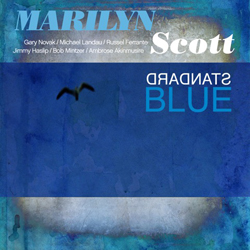
The Beguiling Voice of Marilyn Scott on "Standard Blue"


The California based singer Marilyn Scott has one of those soft, sultry, beguiling voices that just sends me to another place. In many respects, she reminds me of Julie London with her controlled, simmering delivery that is not about vocal range or gymnastics, but more about heartfelt interpretation of a song’s sentiment. She has been singing since she was eleven years old and credits seeing  Big Mama Thorton play at Newport Beach when she was 15 years old as a life changing experience. It was the blues that spoke to this young woman and for over forty years she has been following that muse. Over the years, Ms. Scott’s voice has been heard backing up Tower of Power and John Mayhall’s Bluesbreakers.

She has been produced by such musical luminaries as Bob James, Bobby Womack and George Duke. Her musical collaborations with Russell Ferrante and Jimmy Haslip of the Yellowjackets has extended her blues roots and help shape a distinctive jazz sensibility to her vocals.

Her latest album is titled Standard Blue with the word standard spelled in reverse mirror image just to let you know there is nothing standard about her treatment of these songs. The band is made up of a superb rhythm section with Russell Ferrante on keyboards, Jimmy Haslip on electric bass, Michael Landau on electric guitar and Gary Novak on drums.  Saxophonist Bob Mintzer and trumpeter Ambrose Akinmusire are also featured on one song, the Kurt Weil/Ogden Nash classic “Speak Low.”  The song list is made up predominantly of songs that were written between 1932-1956, songs that speak to Ms. Scott and “…have in common the reality of the blues.”

Ms.  Scott opens the music with the well-worn “Willow Weep for Me,” but one would be hard pressed to find another version quite as compelling. Mr. Ferrante’s floating arrangement is cloud-like, Ms. Scott’s voice like a siren’s call of sensual loss and pathos. Meanwhile powerhouse drummer Novak is the model of restraint as Landau’s guitar sings with echoed poignancy. Beautiful.
The more orchestrated “Speak Low” features Haslip’s pulsing bass and the bass clarinet and trumpet of Bob Mintzer and Ambrose Akinmusire respectively. The Mintzer arranged intro is unique, running counterpoint to the song’s melody line. Scott navigates the unusually tricky mix with an assured confidence, never losing the song’s core feel. Ferrante adds a short piano solo before Mintzer counters with his own woody, bass clarinet solo.  Landau’s tasty guitar licks are never far from the mix.

Scott and company obviously have a thing for Billy Strayhorn and Duke Ellington as she has included three songs by the songwriters, “A Flower is A Lovesome Thing,” Day Dream” and “I’ve Got It Bad and That A’int Good.” On Stray’s lamenting “A Flower is a Lovesome Thing” Landau’s guitar cries out on a beautifully realized solo of sublime sensitivity. Scott’s voice has those rarest of qualities, true of all great storytellers, earnestness.  

“Never Let Me Go” is played in a buoyant shuffle by Novak and Haslip with Ferrante’s keyboards painting a dreamy soundscape over which Scott’s voice pleads.

“Day Dream” is one of my favorites on the album. Ms.  Scott’s slow, smoky delivery draws you in like a bee to a fragrant blossom. Mr. Ferrante’s arrangements are lush with electronic orchestration. Mr. Landau’s guitar weeps with emotion.

“Blue Prelude” is a Gordon Jenkins song that is right in Ms. Scott’s blues wheelhouse. Her understated delivery has a cool, Michael Frank’s-like removed feel that works into the changes of the song with a laid-back assuredness. At the apex of the song she decides to assert herself, stabbing at the lyrics with authority, matching her voice pointedly with Novak’s synchronous drums. This one is a keeper.


Unfortunately, the album tails off starting with “I Wouldn’t Change It,” which is the only Scott/Ferrante composition on the album. Ms. Scott sings this in a more pop adult contemporary vein losing some of her blues bite-not my cup of tea. The set ends with a disco-esque “East of the Sun,” a lumpy “I’ve Got it Bad And That A’int Good” and a pseudo honky-tonk “The Joint is Jumpin’.” 

Ms. Scott’s Standard Blue, backed by an all-star band, offers some compelling renditions of blues-based, jazz standards sung by a unique songstress that knows how to bring new life to old stalwarts.


Wednesday, February 5, 2014

Dewa Budjana's "Joged Kahyangan" or "Dancing Heaven"

Dewa Budjana; Joged Kahyangan
MonnJune Rcords MJR059
The route from pop music star to jazz master has been a long developing trend in the music of guitarist Dewa Budjana( pronounced Dew a Bu dzana) . As the lead guitarist and songwriter for the pop/rock group Gigi for the last twenty years, a wildly popular band in Indonesia, Budjana’s music has been heard by millions of adoring fans. But Budjana’s music is the distillation of many diverse influences outside of the world of rock and pop, including the fusion music of Mahavishnu and Soft Machine, and the Indonesian music rooted in his heritage and the Balinesian Hindu religion.

On Joged Kahyangan (which translates into “Dancing Heaven”) Dewa is joined with a talented group of  American, west coast based musicians including the saxophonist Bob Mintzer, the bassist Jimmy Johnson, the keyboard artist Larry Goldings and the drummer Peter Erskine. Together they who play eight compositions, all original music by Budjana. It was the guitarist’s initial email contact with drummer Erskine back in 2002 that led to a recording titled Samsara and a continued relationship. Erskine, the one time Weather Report drummer saw in Budjana a unique and creative sound that could be further developed and explored.  

At fifty years old Budjana’s music has matured, as evidenced by some of the sophisticated themes he has written for this cd.  From the opening title “Foggy Cloud,” written while in the East Javanese Mountains, you get the sense that Budjana’s music is strongly tied to memorable melodies. The ostinato phrasing is used as a structure upon which he builds tension employing various tones and textures on his guitar. On this song Budjana’s sound ranges from the smoothly slurred, studio precise lines of a Larry Carlton, to the power driven lines of early Mahavishnu, to the expansive atmospherics’ of early  Pat Metheny. The band superbly drives the rhythmic energy with taut precision and inventive soloing, especially by keyboardist Larry Goldings, whose is a fountainhead of taste and subtlety.

The title song “Joged Kahyangan” is an uplifting aural dance using a fascinating mixture of eastern and western musical styles. A Balinesian minuet if you will. Bassist Jimmy Johnson’s spritely solo on electric bass is a miniature delight.  Bob Mintzer on bass clarinet and Budjana on acoustic guitar trade elegant dance steps in magical time, as Goldings’ synthesizer work conjure a mystical backdrop. This one flows so smoothly that it requires multiple listening to appreciate all the nuances.

“Dang Hyang Story”, inspired by Budjana’s Hindu faith,  is the most purely fusion sounding composition using an exotic Middle Eastern sounding head that breaks into a more melodic core. The complex serpentine lines are done in precise unison by Mintzer on tenor, Budjana on searing electric guitar and Goldings on synthesizer. It features some rhythmically complex drum work by the impressive Peter Erskine who seems at ease with the eastern influence imbedded in Dewa's music. When he solos, Dewa’s guitar takes on a heavy fusion tone, a ripping sound that is reminiscent of early Alan Holdsworth. The composition is a powerful driven but yet strangely hopeful song, a marvelous mix of both energy and beauty.

The ballad “As You Leave My Nest” is a bit too soppy for me. Vocalist Janis Siegel lends her considerable talents to this pop oriented ballad with some soaring vocals that have an ethereal texture.

“Majik Blue” again uses a series of repeating, descending lines as the basis for the composition. Mintzer takes up soprano saxophone and Goldings trades his piano and keyboard for what sounds like a B3 organ for part of the song. Budjana sets his guitar into piercing mode and Johnson plays a brief but potent solo in a song that sounds like a tip of the hat to Weather Report. The complex repeating lines are expertly matched by the entire band in a show of precision and solidarity.

“Erskoman,” a composition dedicated to the drummer Peter Erskine, is a groove based song that has all its participants in exquisite form. Budjana’s guitar is perhaps most musical here with a pleasant, single line tone that he occasionally juxtaposes at the breaks into powerful chording and octave work. Goldings is a delight on his B3 organ, the perfect instrument on this swinging groove. Erskine lets loose with a series of syncopated breaks that demonstrates his formidable rhythmic prowess. Budjana returns with his synthesized sounding guitar pulsing out inventive lines that defy categorization or predictability. The music was mostly recorded in one or two takes. As this track ends, the running microphone catches the band acknowledging what any listener can easily surmise, this was a good take.

“Guru Mandala” is perhaps the funkiest of the songs on the cd, with Erskine’s driving back beat prominent. Budjana plays some expressive lines on what sounds like an acoustic guitar, but for the most part the song sticks to a simple repeating melodic line that fades into a eastern chant-like coda.


“Bora’s Ballad” is an instrumental version of the previous song “As You Leave My Nest” with Erskine’s barely perceptible brush work and Golding’s hushed organ work. The song offers a peaceful conclusion to an otherwise stirring album. Budjana has a delicate side to his playing, a side that is both pretty and sensitive, but that can at times border on overtly sentimental as it does here. 

Dewa Budjana has impressive skills both as a player and as a composer. On Joged Kahyangan he manages to skillfully mix the music of his native Indonesia with pop, jazz, fusion and rock into an impressive amalgam that is unique to him and worth watching as it continues to develop.


Wednesday, April 21, 2010

With "Due Reverence" Ralph Bowen's Latest Release

Artist: Ralph Bowen


Due Reverence 
There are many fine musicians who have found a home in academia, plying their trade by teaching and inspiring the latest crop of up and coming jazzers, occasionally coming out to play for the general public as a sideman or leader. Many seem to possess technical acuity that is almost mind-boggling, along with a healthy respect for those who have laid the groundwork before them. Ralph Bowen is one such educator who should definitely get out and play more often for all of our benefit. He has been an associate professor of jazz studies at Rutgers, the State University of New Jersey since 1990. Along the way he has played with Horace Silver and Andy Bey as well as a myriad of other artists. On his latest Positone release, “Due Reverence” he continues where he left off from his last fine album “Dedicated”, both in thematic content and band personnel.  He is once again joined by the formidable piano less rhythm section of Adam Rodgers on guitar, John Patitucci on bass and Antonio Sanchez on drums, with trumpeter Sean Jones joining him on the front line for one song , the powerful “Mr. Scott”.

Bowen’s masterful control, unerring tone and intelligent compositional talent are clearly impressive. The album’s five carefully crafted tunes run just a mere 43 minutes long, but there is never a lapse in the quality or execution. Each song is dedicated to a musician who in someway was influential to Bowen. The lead off song “Less is More” -a dedication to the guitarist Ted Dunbar- is introduced by Spartan guitar lines from Rodgers, a force on guitar that is clearly coming into his own. After the brief intro, we are lead into a beautiful duet, impeccably executed on arco bass line by John Patitucci accompanying a soaring Bowen on tonally flawless tenor. The main theme is a familiar refrain, again briefly stated, before Bowen climbs to his upper register with an ease and conviction that is purposeful and resolute.  On  “This One’s for Bob” – a dedication to saxophonist Bob Mintzer-Bowen rips out of the gate with a waterfall of bop oriented

crescendos that  seem to flow from his horn like a geyser of saturated steam. Rodgers shows off some daunting speed and agility, as Sanchez’s oblique drumming carries the quick pace with an exuberance and grace that is a highlight. Bowen’s execution of the complex vamp is nothing short of breathtaking in its precision.

The bouncy “Phil-osphy” is a dedication to Canadian clarinetist and educator Phil Nimons. Bowen’s saxophone has wonderful buoyancy that glides over the changes in a most unselfconscious unpredictable way. Adam Rodgers' angular solos are quite fluid and inventive, but it is his def t accompaniment that has grown most impressively. Patitucci is clearly in his element on this tune, offering as grooving a bass solo as I have heard in a long time. Its just swings with a palpable passion, inspiring Sanchez’s to his own highly crafted syncopated solo. As the song returns to Bowen climbing up the chart at the coda, it is his leadership that rings out.

One the most memorable song of the album is the fiery “ Mr. Scott” with the addition to the front line of the incendiary trumpet of Sean Jones. Mr. Scott refers to James Scott another unsung educator that taught flute at Rutgers, Indiana and University of North Texas and pioneered breathing techniques on woodwinds. Here Bowen’s tone is pure and flowing. The cascade of notes he is able to pour from his horn demonstrates exceptional breath control. Sean Jones brings a high-energy, angular voice to the music that retains a compatible fluidity and inventive direction that contrasts nicely with Bowen’s own more sensuous voice . Sanchez and Patitucci move the music perfectly, creating a constant state of restlessness on which Bowen’s tenor can offer a forceful direction and a bit of a respite.

Third Stone From the SunThe final selection of the cd “Points Encountered” –dedicated to flautist, innovator Robert Dick, who was once described as the Jimi Hendrix of flute- features an extended solo by Rodgers, that takes us on a circuitous route up and down ascending and descending alleys of notes that he explores with no seemingly particular direction in mind. Bowen ends with a brilliantly executed, controlled flutter that fades into nothingness.

After two top notch releases “Dedicated” and now “Due Reverence”, Bowen is bound to become a better-known name to mainstream jazz fans who appreciate a dedicated artist of formidable ability and uncompromising taste.

Tracks: Less is More; This One’s For Bob; Phil-osophy; Mr. Scott;  Points Encountered
 
Musicians: Ralph Bowen (tenor saxophone); Sean Jones (trumpet); Adam Rodgers( guitar); John Patitucci (bass); Antonio Sanchez (drums).

Recorded:  Systems Two, Brooklyn, NY  2010

All Compositions by Ralph Bowen