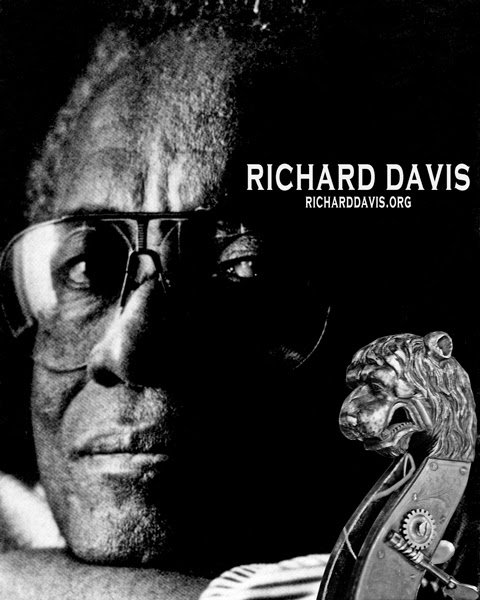
Even if you are not a jazz fan, you have undoubtedly heard the deep, warm sound of Richard Davis' bass.
In the late sixties and into the seventies he worked as an in demand studio musician and was featured on landmark albums by some of the most identifiable artists of the time. He was on at least three albums by pop diva Barbara Streisand including My Name is Barbara (1965) and Color Me Barbara (1966). He was the bassist on Van Morrison's stream of consciousness album Astral Weeks (1968), he made an appearance on Paul Simon's There Goes Rhyming Simon (1973) and worked on three of Janis Ian's albums Stars ( 1974), Between the Lines (1975) and Aftertones (1976). He was the probing bottom sound on Bruce Springsteen's "Meeting Across the River" from Born to Run (1975). How many Bill Evans fans recall him as one of two bassists on the meeting of Stan Getz & Bill Evans from 1973? He worked with the jazz singers Sarah Vaughan(with whom he toured and recorded with on at least six of her albums), Chris Connor, Joe Williams and Etta Jones.Perhaps Davis' most impressive work was as a crucial contributing member of groups led by the more progressive musicians of the time including Eric Dolphy, Andrew Hill , Sun Ra, Elvin Jones and Rahsaan Roland Kirk.
Davis's bass was a sought after sound and he worked with a veritable who's who of saxophonists
including Ben Webster, Lucky Thompson, Sonny Stitt, Phil Woods, Joe Henderson, Lou Donaldson, Sam Rivers, Clifford Jordan, the aforementioned Dolphy and Kirk and the altoist/arranger Oliver Nelson to name just a few. His only regret is not getting to play with John Coltrane or Theolonius Monk, although Coltrane showed some interest in playing with him, but his friend Jimmy Garrison was already playing bass in the saxophonist's later quartet.
If that wasn't enough the classically trained bassist played in symphonic orchestras under the direction of Igor Stravinsky and Leonard Bernstein among others.
In this part two of my three part interview with Mr. Davis we explore the lineage and future of the bass in jazz, his career, the people he played with, his take on the classical bass and his impressions about teaching at the University of Wisconsin where he has been a professor of classical bass since 1977.
NOJ: To continue where we left off , in the pantheon of jazz bass players, is this list a
fair chronology of who you think evolved the bass through their own
innovations, from where it was in the early 1900's to where it is today? I’m thinking of Page, Stewart, Blanton, Pettiford, Brown,
LaFaro , Chambers, Ron Carter and yourself ? After that then
where is it going.
RD: I agree with what you said as far as the lineage
NOJ: And then who? Stanley Clarke, Marcus Miller and Victor
Wooten etc.
RD: Victor Wooten, Stanley Clarke and Marcus Miller, those
guys are playing crazy stuff. Don’t leave out Jaco Pastorious.
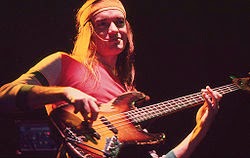 |
| Jaco Pastorius |
NOJ: Oh no, your right Jaco definitely deserves to be in
there. They are all so technically proficient and play with tremendous speed,
but sometimes I feel like they lack the poignancy that guys like you bring to
the bass. Can there be a joining of this high speed proficiency with
corresponding poignancy?
RD: I see. Well I’d rather leave that question alone.
NOJ: Let’s go back to your own musical chronology. You
started in Chicago and you were playing with the great Ahmad Jamal, when you
were switched spots with another bass player and summoned to New York to play
with Don Shirley in 1952 is that right?
RD: That is right.
NOJ: I read somewhere that Shirley also studied psychology
and that he did in the field experiments with his audience, checking to see if
his use of certain chord patterns or notes could elicit certain responses. Did
you experience that with him?
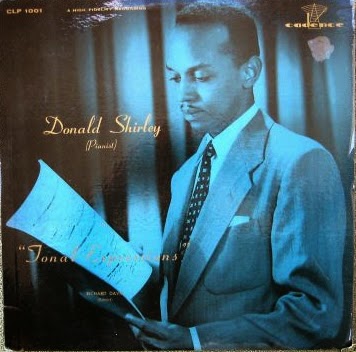 |
| Don Shirley Tonal Expressions 1955 |
From the Album liner notes on Don Shirley's Tonal Expressions 1955 by Al "JazzBo" Collins:
"One of the favored standards, "My Funny Valentine" receives especially good interpretation by Don Shirley with fine bowing by Richard Davis. He conveys more of the Pagliacci tragedy of this melody than we have ever heard before. The beauty and the sadness are real. The tonal effects are particularly effective here with the bowing laying a nice background for the piano notes to be dropped upon."
RD: This is the first time I am hearing about this.
NOJ: I read about Shirley and he apparently studied
psychology and was interested in the effects of certain musical chords on
people. I was wondering if you could shed some light on this information from
firsthand experience?
RD: I have no idea about that.
NOJ: I thought it was coincidental that you played with
Shirley and you also mentioned playing with Sunny Blount or Sun Ra, as he was
later called. You told a very funny story about playing with him one time at a
Calmut City burlesque house. He told you he could make a drunk in the audience
stand up and listen just by playing certain chords and then it proceeded to do
just that. It is sort of coincidental or
where these guys connected?
RD: I saw Sun Ra do this but I never saw Shirley do anything
like this. Sun Ra could do anything.
NOJ: Pretty wild. What was the most impressive thing about
Sun Ra?
RD; Highly spiritual, a world of wisdom and just a fantastic
musician.
NOJ: Do you think his music was too far out there for most
people to accept?
 |
| Sonny Blount aka Sun Ra |
RD: No. He did in and
out. He did far out and far in.
NOJ: Did Don Shirley, who apparently composed classical
pieces, have any influence on you pursuing classical bass?
RD: No he did not have any influence on me, and I don’t know
about his composing classical pieces. He approached whatever pieces he was
playing, standards, in you might call it a euro-classical manner.I don’t know
anything about his composing. I stayed with him for three years. I don’t think
he had any influence on my playing, I just got an opportunity to play these
bass lines.
NOJ: Which classical Bassist did you most admire and why?
RD: Well the first bassist I heard on a recording was the
conductor of the Boston Symphony, his name
was Serge Koussevitzky. Fifteen years after he stopped playing the bass,
they asked him to do a recording. He consented to do the recording and I heard
about it in a magazine and I heard the recording and he plays three of his own
compositions.
NOJ: You have always maintained a dual identity as both a
jazz and a classical player. Do you think had the opportunities been more
forthcoming you would have preferred to have played Euro based classical music
for a profession?
RD: No I would have preferred to play jazz, but I can play
both and that is why I’m teaching now because I teach both.
NOJ: It’s pretty heartwarming to hear how well your students
appreciate your teaching and mentoring them at the University of Wisconsin
where you teach.
RD: Where did you see that?
NOJ: It’s pretty amazing what you can get off the internet
if you look, Richard.
RD: I developed a super program for young bassists around
the country. The Richard Davis Foundation for Young Bassists.
NOJ: That is pretty great. When you left Don Shirley you
went to the University of Sarah Vaughan. How was it different playing for Ms.
Vaughan?
RD: I had some intermittent gigs before that. I worked with
Charlie Ventura for a while and then the Sauter- Finnegan Band. Just some gigs
around New York and then I got the call to work with Sarah Vaughan
NOJ: Now how did you get the gig to work with Sarah?
RD: I don’t quite know, but I think the drummer Roy Haynes
might have had something to do with that. I’ve always wanted to ask him that
question, but I never remember to ask him, because he used to watch me play
with Ahmad Jamal. When he was in Chicago with Sarah Vaughan he would hang out. I
remember sitting at the bar with him when he would come out. So I imagine that
is my connection with Sarah Vaughan was through him.
NOJ: what was the most impressive thing about Ms Vaughn as a
musician that you learned playing with her for five years?
RD: First of all she had a keen sense of harmony. She had a
keen sense of improvisational skills on the harmony and she had a piano player
, Jimmy Jones, who knew how to play expressive harmony behind her.
NOJ The guitarist Jack Wilkins told me that accompanying a
singer is more about dynamics and pace than playing instrumentally with a band.
I have seen some film of you playing with Sarah and you look happy as hell. Did
you find playing with Vaughan a little restrictive after a while?
RD: Well it’s very true. With her you felt very comfortable
and free and relaxed because that is what she looked for. It’s fine until I
feel the need to move on. I just felt
eventually it was time to move on to do other things, because I couldn’t do it
with her, it wasn’t that kind of a group.
NOJ: Well I have listened to some of your later recordings and you certainly have done some interesting and different things with some cutting edge people. You were in New York and met Eric Dolphy on a subway
platform. He asked you if you were
playing Saturday and that was the beginning of a beautiful partnership. What
was so special about Eric and why do you think his music was so difficult for
the mainstream at the time?
RD: Why it was good for me is that he was playing things
that I could hear in my ear. That is what I was looking for when I got off the
road with Sarah Vaughan. I was looking for something that could satisfy my urge
to play with different chordal structures, different interpretations and he was
the answer. He was the answer.
NOJ: You guys played
together on Out to Lunch. In some respects your association with Eric was
like a parallel to the late Charlie Haden’s association with Ornette Coleman.
He was doing The Shape of Jazz to Come during that period and you guys were
doing Out to Lunch. What was going on with the music at this time? It was
like exploding in a different direction.
RD: It sure was. People still ask me about that recording.
NOJ: Not that music needs to be categorized, but what was
going on at that time to have moved the music in this direction? Were the musicians just searching for
something different?
RD: Well it could be on parallel with society at that time.
Society was looking for something different civil rights, freedom. James Brown
was singing a lot of things about “I’m Black and I’m Proud” and this thing was
not militant it was about love.
NOJ: It was a little radical.
RD: Some of the people that heard it like the militant Black
Panthers heard in a different way. Eric
was all about love. Eric Dolphy was all about love and so was James Brown. Eric
was all about love. James Brown was all about love. It was the sixties.
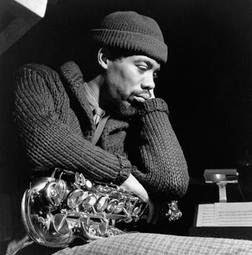 |
| Eric Dolphy |
NOJ: In that group you also had Tony Williams on drums,
Freddie Hubbard on Trumpet and Bobby Hutcherson on vibes? What was it like to
play with these guys especially young Williams?
RD: Like a dream come true.
NOJ: Did everyone look to Eric as a leader or was it a more
of cooperative effort?
RD: Well to be honest with you going back fifty years or so
it is difficult to go back and see that day, it is not easy.
NOJ: Was Eric a commanding presence?
RD: No he was just like one of the guts. Nothing like I’m
the leader or like that you know. It was his music. Most combo situations work
as a cooperative situation.
NOJ: You also played with Eric at the Five Spot Residency
with Mal Waldron on piano, Booker Ervin on trumpet and Ed Blackwell on drums.
How was this group different than the one that recorded for Blue Note?
RD: I don’t even recall Booker Ervin being on that job.
NOJ: You were also an instrumental part of Andrew Hill’s
“Point of Departure” recording in 1964 with Eric, Tony Williams, Kenny Dorham
and Joe Henderson. How was Hill’s music different from Dolphy’s previous outings?
RD: When I played with him I didn’t really realize that
Andrew was a genius at the time, he was just another musician. As a leader
Andrew had no leadership ego. He would just pass out the music and you would
play it, no whipping you into shape or anything like that.
NOJ: What was different about his approach?
RD: I don’t think he had an approach; he just left you alone
to do what you had to do.
NOJ: You went from touring Europe with Sarah Vaughan in 1958
where the music was all standrads to ten
years later veritably leading a very
loose almost wing it session on Van Morrison’s Astral Weeks album which was an
experiment in stream of consciousness lyrics and unstructured music. Did you
take what Morrison was doing at the time seriously or did you think it was just
another gig?
RD: The A&R people that produced that session were
people that I had worked with for a long time. They just told me that they were
having somebody coming in from Ireland or Scotland or somewhere and I had to
get together a group to do their thing.
NOJ: Were you expected to lead the musicians in the studio?
RD: I might have been expected to get the musicians together,
but like I said before no body had to lead these guys. We weren't even
introduced to Van Morrison. He came in sat in the booth and started to sing.
NOJ: You also did
some studio work for other very famous pop/rock albums of the ear. You played
on important albums by Janis Ian and Laura Nyro, Barbara Streisand, Frank
Sinatra, Paul Simon and Bruce Springsteen.
Where you specifically requested to play bass by these artists?
RD: Laura Nyro and Janis Ian must have asked for me. (For
Streisand)I was the bass player for arranger/conductor Peter Matz, who arranged
her first four or six albums, and he liked my bass. Bruce Springsteen had heard
my bass on the Van Morrison album and he said he wanted that bass player on his
album ( Davis played bass on “Meeting Across the River” from Springsteen’s
Born to Run album with trumpeter Randy
Brecker).
NOJ: You also played in symphony orchestras conducted by
Gunther Schuller, Igor Stravinsky and Leonard Bernstein to name a few. When you
play classical bass is there any room for artistic freedom or is the music
rigidly player?
RD: Just for your artistry on the instrument, but you are
really interpreting, taking your direction from the conductor. You have a
hundred people assembled so you take direction from the conductor who puts you
into focus. You have no individuality.
NOJ: You have been an educator at University of Wisconsin in
Madison since 1977. What made you leave New York?
RD: I just decided that I wanted to start teaching some
younger people what I had learned.
NOJ: How did you find Wisconsin?
RD: Cold.( Laughing)
NOJ: Were they receptive to you as a black educator in a
relatively predominantly white state?
RD: Wisconsin has a reputation for being a racial state. I
think eventually some people feared me because I was black. They thought I was
aloof, but I had to protect myself.. .Wisconsin is very racist.
NOJ: I take it you were a bit of a pioneer there?
RD: What do mean by a pioneer?
NOJ: Somebody that went ahead of other people and blazed the
way. I take it by now there is much more diversity and integration in the
school system?
RD: It’s still the same, nothing has changed.
NOJ: Well, that’s disheartening.
RD: I’m still working on diversity. I have some allies. I
have lots of allies and I have a lot of people who don’t even realize that it
exists there.
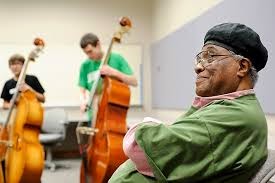 |
| Educator Professor Davis a U of W |
NOJ: Has affirmative action helped Wisconsin integrate more
people of color into the educational system?
RD: When you look at the numbers there is still three
percent Black and 8 % people of color and I don’t know what they are doing
about that.
NOJ: You are an avid horseman your whole life. How does the
rhythm of riding relate to the rhythms of music?
RD: Well rhythm, tempo and pacing is part of riding the
horse. You have rhythm in the horse, there is tempo in a horse and a certain
gait of space and how you are going to cover that space , especially when you
are jumping with a horse. I was just watching some old video when you called.
NOJ You have been on over three thousand recordings in
almost all genres of music. Is there a particular soft spot in your heart for
any particular type of music?
RD: Jazz is closest to my heart.
NOJ: Your last album was in 2008. What album are you most
proud of and why?
Rd: I guess the album I am most proud of was Philosophy of the Spiritual ( from 1971). The
way that Bill Lee assembled that, he made the arrangements and he always
thought I had a specific bow technique and he utilized that and I had a chance
to play all those beautiful melodies, I remember "Dear Old Stockholm," Bill saw
that and he emphasized that and made the arrangements for that.
NOJ: In the nineteen sixties do you think you took a
militant stance against racism?
RD: No I didn't take a militant stance, because militancy
defeats the purpose. I didn't take any particular stance, I just thought it was
something that I didn't like. I didn't go parading around.
NOJ: In the jazz music world what white musicians did you
feel were blind to color?
RD: Benny Goodman was one, Stan Getz was one, Dave Brubeck
was one. Of course Duke Ellington was like a social worker.
NOJ: As an active
educator you must be current on the contemporary bass players out there. Does
anyone in particular seem to be holding the mantle of jazz bass a little bit
higher?
RD: Yeah, Christian McBride, Kenny Davis and I can’t think of anyone else right now, oh Esperanza Spalding.
NOJ: There are more and more women playing bass these days. Besides Esperanza there is Linda Oh, Tal Wilkenfeld, Iris Ornig and Meshell Ndegeocello to name a few.
RD: That’s good!
 |
| Bassist Esperanza Spalding |
NOJ: I am sure you have taught some really incredible female bass players. With the continuously shrinking audiences for both jazz and classical music ,do you think it is going to be able to survive in this age where everything is so quickly changing?
RD: I certainly hope it survives, but who is to know? I don’t know.
NOJ: With such a paucity of venues for upcoming musicians to
play at, what is your advice for those musicians who want to make the music
their life?
RD: Well my teacher told me to get a degree in education. If
the gigs aren't there you can always teach.
To read part one of this interview click
here. Part three of this interview will be more on Mr. Davis' views on education and race relations in this country.