Showing posts with label free jazz. Show all posts

Saturday, November 16, 2024

The Tomasz Stanko Quartet from a 2004 Concert in Munich, Germany: "September Night"


Tomasz Stanko Quartet: September Night: ECM Recorded Sept 2004

The Polish trumpeter Tomasz Stanko created his own approach to the sound of his instrument. Inspired by the Polish modern pianist and film scorer Krzysztof Komeda, the saxophonist Ornette Coleman and the American trumpeter Miles Davis' sparse approach to the trumpet. The more is less style allowed Stanko to add elements of drama, Slavic melancholy, sadness and a metaphysical, free-style sense of pain into his expressive music. He had a distinctive tone. There was never any doubt of who you were hearing when you listened to Tomasz Stanko. His music had an identity,  a tattoo-like imprimatur all his own. 

Tomasz Stanko was born on July 11, 1941 in the city of Rzeszów, Poland. He attended the State Higher Music School in Kraków, where he had a classical music education and studied violin, piano and trumpet. Despite his classical training, Stanko was attracted to the expression and freedom of jazz music. Following his muse, he founded a quartet with a fellow secondary school student and received some critical recognition. In 1963 at the age of twenty-one, Stanko was asked to join the quartet of the progressive and influential pianist Krzysztof Komeda. Komeda was renowned for his free approach to piano as well as his formidable film scoring talents. Komeda scored over forty films, including all of Roman Polanski's, from his first in 1958 to the last one being the score to Rosemary's Baby, before the pianist's untimely death due to an accident in 1968. Stanko's four year stint with Komeda was artistically expansive.

In 1973 Stanko became one of the early Polish musicians who embraced the use of electronics and experimented with synthetic sounds in music, but by the nineteen nineties the artist returned to his acoustical format. In 1980 Stanko released a solo album recorded at the Taj Mahal and the Buddhist Karla Caves in India. Besides his Polish musician based groups, in the eighties and beyond Stanko collaborated with a rainbow of jazz luminaries. These included bassists Dave Holland, Arild Andersen, Palle Danielsson, Thomas Morgan and Gary Peacock, multi-reedist John Surman and Tomasz Szukalski, pianists Cecil Taylor, David Virelles and Bobo Stensen, guitarists Terje Rypdal and Jakob Bro, drummers Jon Christensen, Gerald Cleaver and Tony Oxley, in various formations. In all these diverse combinations and as a solo artist it was always the frail humanity, the  and expressive emotion that came through so clearly from Stanko's plaintive horn.

Stanko's perceptive use of romanticism, melancholy, developed melodic patterns and his evocative trumpet tone provide the listener with a uniquely penetrating music that reaches the soul. 
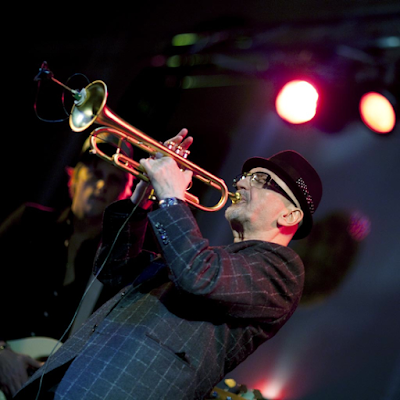
            Tomasz Stanko photo credit John Broughton

Perhaps the most symbiotic group of the bunch was the quartet Stanko formed  in 1993 with then sixteen-year-old drummer Michal Miśkiewicz and his two friends pianist Marcin Wasilewski and bassist Slawomir Kurkiewicz. This quartet was first  recorded work on the Stanko album Balladyne from 1994 on GOWI Records. The group became a working band for Stanko over the years and they released three other albums on ECM, Soul of Things (2002), Suspended Night (2004), and Lontano (2006) all studio albums.

The Tomasz Stanko Quartet ( photo credit unknown)


In June of this year, ECM decided to release September Night, a live recording from a Stanko and this quartet concert recorded in September 9, 2004 in Munich.  To any fan of Stanko and his music, it is certainly of interest to get a chance to look back and capture this soulful group in its most fluid situation, in front of a live an appreciative crowd. The album shows just how much this group had matured under the leadership of Stanko. Particularly noted is how much the quartet telepathically functioned with a heightened acuity to each other's ideas and responded accordingly.

The album has seven compositions six of which are by Stanko with only "Kaetano" credited to the group in total. The songs run from five and half minutes in length to almost eleven minutes. The opener "Hermento" starts with a pedal point bass line by Kurkiewicz as Stanko's searching horn enters the fray. Wasilewski's piano creates the barest of melodies upon which Miśkiewicz adds rolling percussive accents. Stanko creates the mood and you just find it enchanting.

"Song for Sarah" opens with Wasilewski's gentle piano lines that almost whisper out the melody. Stanko's horn has a film noir quality to it and the piano and trumpet dance with an elegant dialogue. Stanko goes silent as the trio show their own musical sympatico as a fully whole entity that can create their own beauty.  Stanko's plaintive horn always seems to bring a human voice-like quality to the music.

Kurkiewicz's plucky bass opens "Euforila" with tonally rich exploratory lines before he settles into a quick paced ostinato line that sets the music up for its throbbing pulse. Wasilewski and Miśkiewicz enter the swelling rhythm before Stanko's fluttering trumpet takes flight with repeating lines that raise the tension. Stanko and Wasilewski state a sparse melody before the pianist takes center stage with his own elastic solo that is beautiful and has elements of free jazz to it. Stanko's trumpet returns with his own sense of urgency to his horn as his backing trio create their own cauldron of excitement. Miśkiewicz finishes the composition with a roiling drum solo that leads to the group restating the brief melody at the coda.

Stanko's stark trumpet opens up "Elegant Piece" accompanied minimally by probing piano lines and roiling tom work. The music blooms into a beautifully  meandering trumpet stated melody. Stanko adds brief flutters, staggered stabs and piercing high register darts to low toned slurs create a tonal potpourri of aural delight that never losses it's elegance. Wasilewski's piano solo is particularly notable, filled with emotion, facility and harmonic creativity that is accented by uncanny angular sense of time and space. He plays his instrument with confidence and yet  chooses to never use speed or flair over expressiveness and taste. The music runs for over ten minutes and gives the team a real chance to stretch out within the concept of elegance and to demonstrate their individual strengths.

The group composed "Kaetano" and features a Latin-inspired rhythm that features a vibrant bass line by Kurkiewicz, some shimmering cymbal work by Miśkiewicz and a Wasilewski piano solo that bustles with inventiveness and melodicism. It's one of Stanko's most energetic and boisterous trumpet solos of the set. The group seems to be reveling in the vibe that they create.

"Celina" has Stanko stating the theme work with sensitive piano accompaniment and rolling tom work in the background. The trumpeter modulates back and forth establishing mood and tension. At the two minute thirty-four-second mark Kurkiewicz starts another ostinato bass line that builds under its own repetitive groove. Stanko's trumpet is like a clarion, an at times shrill warning  that can revert to an emotional gasp or a melancholic cry. Wasilewski's piano solo flows with a modernist approach that has a propulsion all its own, as the rhythm section maintains the heartbeat on the music. 

The final piece on the album is "Theatrical." The music develops like a theatrical story slowly, carefully building interest and being led into revelation. Stanko effectively utilizes changing rhythmic speeds to orchestrate his musical story. From a sauntering opening, the music is introduced as a simple melody with Stanko's trumpet leading the way. Suddenly, he blares a line that changes the pace abruptly. His trumpet erupts once again introducing another shift with shrieks and slurs slowly building the motion, increasing the pace, until he and his group again change direction. He returns to a slow descending pattern on his horn, a reduction of volume, intensity and pace that deflates, fading away to the disappearing coda.

Sadly, Tomasz Stanko transitioned from this world into the next on July 29, 2018, so we will no longer have this moving artist around to add to his musical canon, but it comforting to know that with retro releases like September Night we can continue to rediscover some previously unreleased music from this master. The trio of Wasilewski, Kurkiewicz, and Miśkiewicz continue on without him as a unit. They continue to grow on their own creative path but they will always be inspired by their association with their impressive mentor.


Thursday, August 19, 2021

Slither, Funk, Fusion & Blues from Dave Holland's Exciting Guitar Trio "Another Land"

Another Land Dave Holland, Kevin Eubanks, and Obed Calvaire, Edition Records 


For the last fifty years, the bassist Dave Holland has been at the forefront of traditional, modern, avant-garde/free, and fusion jazz. Born in 1946 in Staffordshire, England, by the age of twenty, Holland was a fixture as a reliable and gifted bassist at London’s Ronnie Scott’s. He was seen there by Miles Davis and Philly Joe Jones and was fortuitously enlisted by the trumpeter to replace the departing bassist Ron Carter in his progressive quintet of the late sixties. During his stay he was recorded on Davis’ Filles de Kilimanjaro (1968), In A Silent Way (1969), and Bitches Brew (1970). With this exposure came opportunities, but this immensely talented bassist did not settle into a predictable or safe career pattern.

Holland had a two-year stint with the Davis’ quintet, at that time including keyboardist Chick Corea, drummer Tony Williams (later Jack DeJohnette), and saxophonist Wayne Shorter. The bassist joined a short but potent progressive, openly free-swinging group titled Circle with Corea, reedman/composer Anthony Braxton, and drummer Barry Altschul. Corea departed the band, but Holland’s relationship with Braxton created lasting relationships with other progressive musicians including Canadian trumpeter Kenny Wheeler and saxophonist Sam Rivers. Holland composed and recorded his first release as a leader, the impressive Conference of the Birds on ECM with Rivers, Braxton and Altschul. All Music’s Steve Huey called this record “…one of the all-time avant-garde jazz classics” and Rolling Stone noted, “… it only gets more impressive as time passes.” 

In the early seventies, Holland joined forces with guitarist John Abercrombie and drummer Jack DeJohnette forming GatewayThe group had plenty of fire, and could also have a more pensive, ethereal approach to music.

Holland’s collaborations found him crossing paths with a who’s who of the music world. Besides those listed above, he has played with Stan Getz, Kenny Barron, Thelonious Monk, Joe Lovano, Pat Metheny, Roy Haynes, John Surman, John McLaughlin, Herbie Hancock, John Scofield, and Dave Liebman to name just a few. Throughout his career he has constantly expanded his palette to create exciting music, utilizing changing formats ranging the gamut from solo to big band forms to follow his musical muse.

I was fortunate to last see Holland and his impressive world music-inspired trio Crosscurrents at Emory back in 2017. This trio included Holland, saxophonist Chris Potter, and percussion master Zakir Hussain. In my opinion, the east meets west album Good Hope was one of 2019's best recordings.

Holland's latest release came out in March of this year, again on Edition Records, and is titled Another Land. This music is a powerful musical statement. it is a confirmation of the musical breadth and depth of Holland as an artist who can never be pigeonholed or labeled by a specific genre or style. This offering reunites Holland with the excellent, in some ways underappreciated, guitarist Kevin Eubanks and the stalwart drummer Obed Calvaire. Respected reviewer, Will Layman, said in Pop Matters, Another Land was “…the best new Holland recording in a long time.” Whether you are hip to Holland’s body of work or not, Another Land is one smokin’ album and is sure to delight.

Kevin Eubanks, Dave Holland and Obed Calvaire (photo credit unknown)

Another Land resurrects the fusion guitar trio format that Holland previously helped create with Gateway. Here, Holland is a more seasoned player who allows the compositions to speak for him. He still plays with impressive verve and allows his bandmates, especially Eubanks, yards of room to create, but there is a real cohesiveness on this album. The guitar is often out front here, but the bass and drums are equal co-conspirators that perform more organically, allowing the music to naturally unfold and blossom.

Kevin Eubanks first recorded with Holland back in 1990 on Extensions with Steve Coleman on alto and Marvin “Smitty” Smith on drums. The album was Downbeat’s 1990 Album of the Year.  Eubanks would go on to establish a more noticeable name for himself as the personable leader of the Tonight Show Band from 1995 to 2010. Eubanks has since released several albums like Zen Food and The Messenger where his extraordinary, uniquely sinewy guitar playing is testimony to his status as one of this era's best guitarists. 

On Another Land, “Grave Walker,” opens with an infectious electric bass line joined by the interweaving playing of Eubanks' slippery, serpentine guitar and anchored by Calvaire’s responsive but subtle drum work. There is a funky, rhythmic flow that anchors the music and forms an armature on which Eubanks explores and expands. Holland’s rich bass solo is always a treat to hear as it throbs, and sways, with Calvaire expertly propulsive.

The title cut, “Another Land,” has its own infectious bassline. Holland's double bass resonates, the rhythmic grab he establishes is a signature part of the bassist’s modus operandi. Eubanks overdubs his delicate acoustic with his sleek electric guitar lines that mesh gloriously. Eubank’s taste is gorgeous and restrained, stunningly sensitive, and superb. Holland's solo is a sonic splendor that combines creative ideas with wonderful tonal acuity. About halfway through the duo creating a dream-like landscape, Calvaire’s brushwork is heard ever so unobtrusively. This song can simply hypnotize you into a Zen-like state, a musical meditation.

“Gentle Warrior” is driven by a Holland ostinato bass line that morphs into a more robust melody line. Eubanks and Calvaire walk a conjoined line of sympathetic interaction until Holland produces a rousing double bass solo that throbs like a heart on adrenaline. Eubank’s guitar solo is explosive, modulating, a little frantic, and at times Hendrix-like, but always retains that watery, slinky sound that is all-Eubanks. Supporting the music with a subdued but driving accompaniment throughout, Calvaire at the coda provides his own cadenced drum feature that is, syncopated and inventive by this superb trap master.

There is a lot in this album to relish. The fusion-like “20-20” opens with a deeply resonating bowed bass from Holland and a gentle guitar accompaniment. The music then erupts into a heavy, almost metal-like theme. Holland plays some generous solos on double bass that are expansive and energized. Eubanks’ mastery of his guitar is impressive. He can wail, serpentinely modulate or embellish with delicately fingered filigree notes to the music. These three artists are so well matched with talent and can trace each other’s serpentine lines with effortless aplomb.

The gorgeous “Quiet Time” features Kevin Eubanks’solo guitar and is a testament to the guitarist’s ability to embellish on a beautiful theme unaccompanied. He can capture the listener unaccompanied, like many of the greats, with his tasteful virtuosity. Guitar lovers will cherish this masterful display of the man's sensitive side.

The rocker of this album is “Mashup,” a fusion, rock-driven, atomization. Calvaire’s drums dance and Holland’s electric bass punctuates with what sounds like a Stanley Clarke-like attack. Eubanks shreds in the most outer limits guitar work of the album. Eubanks has a wellspring of ideas and they all unfold with rapid-fire accuracy and magical slickness. Calvaire's fusillade of drum work at the coda is like a force of nature eruption.

“Passing Time” is a slow-paced, soulful saunter that leads off with a catchy, signature Holland bass line. All of Holland's compositions utilize unique and at times complex changes that simply raise the level of the songs to so much more than just catchy grooves. The trio uses the armature of the music and expands it to a vehicle of pure improvisational creation. Eubanks Latin-inspired guitar work sends the listener to another place and Holland’s solo is a lesson on how many rhythmic techniques on the bass strings can be used to be expressive.

The opening of “The Village” is a study on how creative musicians can evoke an aural scene by skillfully mixing sounds, not unlike a fine painter who mixes an array of colors on his palette to achieve his desired effect. Holland sets the feel with his ostinato bass lines, and Calvaire accentuates with his skillful rim and skin playing. Eubanks expertly modulates on his guitar and the three go off into the daylight toward the Village. Eventually, Eubanks’ guitar lines punch into the opening ahead with authority, before Holland’s bass seems to lead the group into a calmer clearing ahead. The music elevates the tension with Eubanks’ willy guitar lines and harshly accentuated chording. The music then raises the excitement with a series of climbing arpeggios and an explosive drum eruption by Calvaire at the coda.

This excellent album ends with “Bring It Back Home.” What better way than to end with a funky, blues-tinged shuffle that lowers the temperature of the set and introduces an overall feeling of contentment at returning home. A sonorant double bass in the hands of a master like Holland is the perfect vehicle to give this an authentic blues feel. Eubanks’ slithery guitar is a whole new level of funk and grit and the guitarist never ceases to find his own way of expression and surprise. Calvaire is like a reliable pacemaker, all though capable of volcanic flares, on this one stays the course in this classic groove. Amen. 


Sunday, October 25, 2020

Jeff Cosgrove's "History Get's Ahead of The Story": The Music of William Parker


Jeff Cosgrove's History Gets Ahead of The Story Grizzley Music 

My familiarity with the work of the prolific free-jazz bassist and composer William Parker is admittedly limited. When I heard some of Parker’s compositions recently assembled and so enthusiastically played by drummer Jeff Cosgrove and his bandmates, organist John Medeski and saxophonist Jeff Lederer on his latest cd History Gets Ahead of the Story, I was both impressed and intrigued. I had to find out more about this bassist who The Village Voice once claimed as “the most consistently brilliant free jazz bassist of all time.”

Double bassist William Parker is now sixty-eight years old and has had a career of many creatively inspired musical endeavors. The double bassist/composer has recorded over forty albums as a leader and a countless number of important collaborations with other artists. Parker’s fierce attack and unfailing pulse, whether using his arco or pizzicato technique, is a constant source of grounding stability. His exploratory expressiveness and willingness to promote a collaborative approach keeps his music both fresh and interesting.

Parker studied with such bass luminaries as Richard Davis, Jimmy Garrison and Wilbur Ware. Over his career, he has contributed his artistry to the music of pianists Cecil Taylor, Craig Taborn, and Mathew Shipp. He has worked with the trumpeter Don Cherry and saxophonists Dave S. Ware, Anthony Braxton and Peter Brotzmann to name a few. Parker created an impressive repertoire of original music and has penned several books. His artistic breadth is diverse and inclusive, utilizing crossbreeding aspects of spiritualism, world music, dance, opera, blues, gospel, soul, jazz, free jazz, and poetry as elements into some of his inventive musical creations.

Jeff Cosgrove (photo credit unknown)

The apt textualist, Jeff Cosgrove, a generational disciple of the Paul Motian’s school of percussion, has played with bassist Parker in a contemporary trio with the pianist Mathew Shipp. Their first album was Alternating Current from 2014 and the last album from the trio was Near Disaster from Feb 2019. With this history in mind, it was only fitting that Cosgrove would choose seven compositions from Parker’s repertoire to both pay homage to the bassist/composer’s influence and to use these songs as a vehicle to explore the possibilities.  To my delight, Parker’s music not only provides inspiration to these adventurous musicians, but the band skillfully manages to somewhat make it their own.

Jeff Lederer ( photo credit unknown)

The group is notably without a bass and the only bottom anchor here is provided sparingly by Medeski’s left foot on the B3.  Song’s like the bluesy opener “O’neals Porch” seems to be tailored to raise the spirits with Medeski’s probing organ,  Lederer’s frolicking saxophone, and Cosgrove’s delicate percussive pace.

The gospel-inspired “Corn Meal Dance” employs a churchly sound from Medeski’s organ and a roiling rhythmic treatment from Cosgrove. Lederer, whose saxophone prowess is a marvel, seems to wail like a possessed preacher wailing to the heavens from his pulpit.

John Medeski ( photo credit unknown)

"Gospel Flowers” is one of two Lederer compositions on the album. This blues-based song has a memorable, lightly swinging melody. Medeski always seems able to find a way to liberate his B3 playing from expected pathways, often bringing excitement to the musical journey. The music elevates you, as Cosgrove’s subtle and textured accompaniment maintains your altitude. Lederer rides the airways with a strong powerful tone and mellifluous sonority, as he also accents the music with more piercing dissonance that claws back to some of Parker’s free jazz roots.

“Little Bird” is a playful musical spar originally on William Parker’s Petit Oiseau from 2008, and here features Lederer on flute, Medeski on keys, and Cosgrove on drums. The music is joyous, invigorating and a testament to these three gentlemen's ability to create a musical conversation that just captivates the listener. Cosgrove offers a short solo that demonstrates his astute percussive inventiveness. There is a Dolphy like feel to Lederer’s flute work here that seems to be a tip of the hat to the music’s history.

 “Ghost,” the only composition on this album by Cosgrove, creates an otherworld-like mood. Here using a modulating organ, splashing cymbals, soft toms and a resonant clarinet, the band creatively conjures up the presence of a looming specter.

Parker’s “Moon” is just a delight. The music is jaunty and joyful. Lederer plays a soprano lead that grabs you with its prance-like feel and brash proclamations. Medeski’s organ lightly keeps the rhythmic drive going as Cosgrove lays down a roiling flow of percussive accents.

“Things Fall Apart” is a free-flowing exchange that has no perceivable melody and is an improvisational banter between the three musicians.

“Wood Flute Song” comes from Parker’s 2005 album Sound Unity and Cosgrove open with a short drum introduction. Lederer and Medeski enter in, one with a muted left-footed bass line and the other with a robust clarinet.  When Medeski takes a solo on the organ he is accompanied by circular drum work by Cosgrove giving the music a buoyant and enlivened flow.

Lederer’s gorgeous “Purcell’s Lament” opens with an impassioned Soprano intro that is accented by Cosgrove’s delicate cymbals and toms. Medeski’s swelling organ adds to the ballad’s moving feel. The music seems to bloom in front of you like a flower that opens on an inviting spring morning. Lederer can evoke spirituality in his playing that reminds me of some of Pharoah Sander’s work of time past.

The album ends with Parker’s jaunty “Harlem” from his 2005 Sound Unity. Medeski, Lederer and Cosgrove coordinate brilliantly, tracing each other’s lines -tenor, organ and drums-like a synchronized swim team’s motion at an Olympic competition. There is a beauty as to how well these three moves in each other’s space.  The three separate instruments are handily utilized to operate as one breathing entity, three minds meeting as one impressive expression of the music. Take the time to hear this work and to enjoy the inventive music of William Parker.


Thursday, November 30, 2017

The Indefatigable Spirit of Roswell Rudd Rings Through on "Embrace"

Roswell Rudd:  Embrace 

It may be hard to imagine that an eclectic trombonist like Roswell Rudd, whose is often associated with free and avant-garde jazz, comes from a very traditionalist background. His fascination with listening to his father’s seventy-eight rpm recordings of Jelly Roll Morton, Louis Armstrong and Duke Ellington gave him the music bug at a very early age. As a youth, Rudd first started playing a mellophone, then switched to a French horn before finally landing on his instrument of choice, the trombone. Both his instrument and his temperament were well suited to the boisterous, razzle-dazzle of Dixieland music early in his career. Later, while attending Yale University, he befriended another like-minded spirit in the bassist Buell Neidlinger. Together they played what he has called “Chicago style” Dixieland jazz in a group called Eli’s Chosen Six. Rudd has said that the group was modeled after Eddie Condon’s band and that they played a popular revivalist jazz specifically aimed at partying college students. With the help of another Yale alumnus, the recently departed record producer George Avakian, the group recorded an album in 1955.

Coincidentally, there was a revolution going on in the jazz world with the arrival of bebop. Rudd didn’t immediately take to this innovation, but there was a rising fascination with this technically challenging music, and it was to become the new wave. Rudd recognized that there was a genius going on in what Gillespie, Parker, Roach and Monk were doing, but the music didn’t swing enough for the trombonist, whose tastes at the time ran more to the work of Roy Eldridge and Coleman Hawkins.

Roswell Rudd at the Falcon in Marlboro NY ( photo credit unknown)
After making his way to New York, Mr. Rudd credits a short stint with the pianist Herbie Nichols as a turning point in his career; transforming his sound and using a more modern approach to the instrument. By the early nineteen sixties, it was his association with Neidlinger and his friend the saxophonist Steve Lacy that led Rudd into an alternative musical direction. Rudd, Lacy and Neidlinger along with the pianist Cecil Taylor, the saxophonists Archie Shepp and John Tichai, the trumpeter Bill Dixon and the bandleader Sun Ra, among others, established what came to be known as the “free jazz” movement. Predictably, Rudd dislikes the label considering it redundant, as jazz is essentially itself “free” by its very nature. The music retained the concept of collective improvisation that Rudd readily identified with from his Dixieland roots. It eschewed structured chord form for free melodic improvisation and at times employed harsh dissonance. Consequently, the musicians who practiced it found it difficult to get work or develop anything but a niche following. Frustrated by being shut out of the established jazz venues, in 1964 the musicians, led principally by Taylor and Dixon, fearlessly decided to self-produce a series of concerts called the October Revolution in jazz. In this way, the music could be heard by the public who would ultimately decide its artistic value on its own merits.

No matter how “out” Rudd’s music became, he always possessed a warm earthy tone, an innate sense of swing and a dedication to harmony. But it is his Chaplin-esque humor-an identity in his sound that retains an enthusiasm and a joyous humanity- that truly identifies the man and his music. He credits his listening to Spike Jones, and the bandleader’s sense of musical parody, as a key influencing factor in the way he plays. There is always a sense of tongue-in-cheek slapstick in his playing as he skillfully employs deliberate slurs, plunger-wahs and growling effects that effectively make his horn an extension of the human voice. He is a serious musician who doesn’t take himself too seriously.

Under the moniker "The Olders," he recently released a single “Awesome and Gruesome,” which he co-wrote with his long-time partner Verna Gillis. It is a perfect example of Rudd’s unfailing humor and irrepressible good nature even in the face of his own illness.  On the video Rudd, who is now eighty-two, and Ms. Gillis rap about his personal battle with prostate cancer, a decidedly gruesome part of life. Instead of dwelling on the disabling aspects and his own mortality, Rudd and Gillis confront the disease head on, continue their fight with admirably frank openness and employ creativity to accentuate the awesomeness of life.


His most recent album Embrace with the pianist Lafayette Harris, the double bassist Ken Filiano and the vocalist Fay Victor is likewise a celebration. Mr. Rudd’s joy at being alive comes through loud and clear through his horn and his spirit.

The selections all have something appropriate about their inclusion; the Ellington/Strayhorn composition “Something to Live For,” the Mingus classic ode to Lester Young “Goodbye Pork Pie Hat,” the 1929 song “Can’t We Be Friends,” Ray Noble’s “I Hadn’t Anyone Till You,” the Burton Lane and Alan Jay Lerner song “Too Late Now,” the traditional ballad “House of the Rising Sun,” Gillis’ “I Look in the Mirror” and Monk’s Pannonica.” While the drum-less ensemble is remarkably attuned to Mr. Rudd’s musical sensibilities, it is the gorgeously resplendent piano of Mr. Harris that lays the groundwork for the magical interplay between Ms. Victor’s voice, Mr. Filiano’s bass and Mr. Rudd’s trombone.

The rapturous sound of Rudd’s blare on the opening track is emotionally powerful. Ms. Victor’s soulful voice renders the lyrics with the pathos she has absorbed from Mr. Rudd’s preceding solo and creates her own moaning retort. Harris and Filiano open the Mingus classic with Victor scatting over a repeating vamp. Rudd plays the melody line with his usual boisterous roar before Victor belts out the Rahsaan Roland Kirk penned lyrics in a facile athletic style. On the show-like “Can’t We Be Friends” the Victor-Rudd combo trade licks. Rudd’s muted bone honed to a sharp edginess responding to Victor’s equally cutting call out. Harris and Filiano both provide buoyant solos that prance along to the beat.

Roswell Rudd and Fay Victor at the Falcon in Marlboro NY ( photo credit unknown)
In the vocalist Victor, Rudd has found his equal in terms of stylistic approach to a lyric, harmony and melody. The two have an affinity that makes for a palpable rapport that is seldom seen between an instrumentalist and a vocalist. The music is easily transported along without a drummer as Harris and Filiano elastically keep the pace moving with skillful aplomb.  On “Too Late Now,” after double bassist Filiano opens with a beautiful two-minute arco introduction, Harris’s piano shimmers with a crystalline quality, as he invites in the melody with his own creative invention. The two instrumentalists work together for a couple of measures before Rudd’s blaring, but tender trombone enters with his own melodic statement. Rudd’s is so adept at wringing out emotional content with every slide, slur and growl. Victor is the last voice to enter on this piece. She delivers her lyrical content with an emotional verve that equals Rudd’s own, especially as the two mimic each other’s voice at the coda.

The traditional ballad “House of the Rising Sun,” is played in a bellowing arco-style by bassist Filiano as Victor sings the familiar lyrics over Harris’ piano. Rudd’s raspy trombone growls his own harmony with Victor vocalizing her own moans in response. Filiano switches to a frolicking pizzicato style that carries the tune forward jauntily, until Victor vocalizes a desperate cry at the end on a fading note by Rudd. On Verna Gillis’ perky “I Look in the Mirror” Victor sings and scats the upbeat lyrics as Harris and Filiano carry the rhythm.  

The finale is an endearing rendition of Monk’s “Pannonica,” an ode to the pianist’s longtime patroness the Baroness Pannonica de Koenigswarter and a song that Rudd has long featured in his repertoire. The slow, deliberate pace allows Victor and Rudd the opportunity to express their own nuanced reading of the sentiment of the lyrics, which equates the Baroness to a butterfly. Rudd’s solo is brimming, and Harris’s piano solo is a highlight of expressiveness. Victor is at her most lyrical with this love letter to the Baroness from Monk.


As the album title implies, Embrace is just that, a musical embrace by a master instrumentalist and his intuitive group of equally talented musicians. With his own mortality staring at him in the face, I am sure he recorded this album with a certain sense of sublime resignation, but his indefatigable spirit shines through on every note. When I originally started this review, it was to accompany an interview with Mr. Rudd that I was very much looking forward to, unfortunately his press representative informed me that he has now entered hospice care and is not giving any more interviews. Our prayers and good wishes go out to Mr. Rudd and Ms. Gillis.

Wednesday, August 2, 2017

Denny Zeitlin and George Marsh take you on an Electro/Acoustic "Expedition"

Denny Zeitlin & George Marsh Expedition Duo Electro-Acoustic Improvisations
There is a wonderfully free-flowing spirit to the new Denny Zeitlin & George Marsh CD Expedition. The music percolates like water from a newly tapped spring. It has an organic slipstream feel to it that comes from these two brilliant musicians capturing themselves exploring totally “in the moment” improvisations. Script-less forays into the possibilities; Zeitlin’s electro-acoustic keyboard artistry paired with Marsh’s intuitively complimentary percussive accentuation.

As the pianist writes in his liner notes, he has been toying and exploring with electronic instrumentation, integrating it into jazz, classical, funk, rock and free-form since the late sixties. Although considered by many to be one of the finest jazz pianists of his generation, Zeitlin is no stranger to the world of the synthesizer and electronic sounds.  His pioneer work with the then state of the art Prophet analog synthesizer, can be heard on his music for the 1978 film Invasion of the Body Snatchers, (the composer’s only film score) which incorporated his dramatic symphony orchestra score with electronic sounds.

Here is a taste of that evocatively eerie soundtrack:

After an over thirty-year hiatus, Zeitlin’s fascination with the instrumentation and the technological improvements that have been made in the equipment, piqued his curiosity again. His fascination with orchestral arrangements was driven by his desire to have control over the expansive palette of tones, colors and textures that an orchestra can provide, and was realized to some degree in his1978 film score. But what if with the new technology, one could more easily control all those tones, colors, textures and sounds, by yourself, from a set of keyboards, some hardware and a computer? Zeitlin did just that in 2013. With an upgrade of equipment, he recorded his solo electro/acoustic recording titled Both/And. Then in a nod to minimal collaboration, Zeitlin rejoined with drummer/percussionist George Marsh, an alumnus of his old trio days, and the two released Riding the Moment, a duo electro/acoustic recording in 2015. 

Expedition is a continuation of that collaboration. The two seem to have developed such an intuitive sense of where each other is going that they overcome the obstacle of having to perform this “spontaneous composition,” as Zeitlin calls it, from the isolation of two separate recording booths with no visual contact.

There is no description of this music that can do it justice. You should just sit back and listen to it unfold and see where it takes you. Some of the songs like “Shards of Blue” or the beautiful “One Song” have a form that you can recognize; the briefest of melodies that you can follow. But for the most part listening to Expedition is like immersing yourself into another dimensional experience. 

Zeitlin conjures a treasure trove of exotic sounds; sounds that elicit haunting Gregorian chant-like voices, alien harpsichords, robotic oscillations, tin-can vibraphones, space-born calliopes, Pan flutes, ogre-like bass lines, majestic pipe organs and muted plectral sounds. But as always, his starkly beautiful piano anchors the music to this world in a brilliantly humanistic way. Like two minds fused at the cerebral cortex, Marsh and Zeitlin seem to be able to intuit each other’s thoughts; Marsh gently prodding the pianist ever so slightly. The percussionist offering shimmering cymbals, softly brushed snares, roiling rolls and a general sense of rhythmic surety that propels this music.

The music at its very best evokes a sense of wonder and delight. It also has a spiritual side to it, especially when Zeitlin’s poignant piano comes into play, the sound of human spirit juxtaposed so touchingly against the mechanistic, electronic swirls that he creates around it. 

Click on the link below to hear one of the songs from the album titled “Geysers”

https://soundcloud.com/sunnysiderecords/denny-zeitlin-george-marsh-geysers


Friday, September 25, 2015

Graffiti: JD Allen's Art of the Saxophone Jazz Trio


JD Allen's Graffiti Savant SCD 2147

Forty-three year old tenor saxophonist J.D. Allen is a man on the rise. He was named as Downbeat’s Rising Star in 2011 and has matured nicely in the succeeding  four years. Witness his latest creation Graffiti ,  a tour de force of purpose and inventiveness. With this album Mr. Allen has developed a much clearer vision for himself and his sound. Together with the propulsive drums of Rudy Royston and the rooted bass of Greg August, the music sounds like it harkens back to the past while pointing us forward to  the next step in the evolution of the jazz saxophone trio. The album is both a celebration of form and measured free improvisation.


JD Allen (photo credit unknown)

From the opening salvo of Royston’s exploding drums to the clarion voice of Mr. Allen’s tenor on “Naked,” Allen does indeed bare his musical soul. His fluent grasp of the language  makes for an immediately visceral connection with the listener, a free form cry that one can still relate to by virtue of its recognizable form.
“Jawn Henry” is an inspirational tune based on the folktale of John Henry the Steel Driving’ Man.  On this song Mr. August’s plucky  bass provides a low register respite from the dynamic dueling of Mr. Allen and Mr. Royston. The two seem to be musically bent on recreating the man versus machine theme of the folk tale’s legendary duel of strength and they do so effectively.

Allen composed all of the songs on this album and described his intention for each one in the liner notes. On “Third Eye” he writes  “The saxophone and bass play rubato while the drums have the option of playing against type.”  To this end we find Mr. August establishing the heartbeat of the song  . Mr. Royston playing against the tempo, as he so often does, with Mr. Allen left to find his own ground either with the tempo or as a counterpoint to what Mr. Royston is doing. Through it all Mr. Allen returns  to a plaintive call that seems to unify the whole for the listener.

The song “Graffiti,” as the title suggests, is a potpourri of color, rhythm and texture much like the radical, free form of wall art the name implies.  With the short repeated line from Allen’s saxophone as the only basis, Royston pulses, bobs and weaves like a fighter in the ring. August reaches for some grounding  beat for the group to hold onto and Allen explores the color palette, disciplined but carefree. Allen’s tenor has an implied sense of earnestness that is not something that can be contrived.

My favorite piece is the loping “G-dspeed , B, Morris“ perhaps because its melody is memorable and  heartfelt. August is particularly effective in anchoring the tune’s march-like cadence as Mr. Allen plays between the bass lines with an easy swagger that is laid back and mellow.  It is a dedication to the late Butch Morris who originated Conduction, a form of structured free form  improvisation  that allowed the musical conductor to direct an improvising group through the use of his baton and actions. Perhaps this association with Mr. Morris is the guiding light that has allowed Mr. Allen to create this delicate balance between the form and the formless, a  balance he navigates so expertly on this album? 

Butch Morris (photo credit unknown)
The economical “Little Mack” is buoyed by the walking bass line of Mr. August who keeps the pace of this blues right where it should be. Mr. Royston lays back on this one,  punctuating the air here and there with a rim shot or a splash of his cymbal as Mr. Allen  swoons over the melody with succinct clarity. 

On “Sonny Boy”  Mr. August’s bass is again the lead, repeating a motif that allows Mr. Allen to play an ascending and descending line harmonically over the top.   

On the liner notes Mr. Allen says about “Indigo (Blue Like)” Sometimes I feel like the most avant garde thing a jazz musician could do today is to try to straight up and down swing.”  My sentiments exactly. Swing he does with Mr. August and Mr. Royston keeping the tempo as Mr. Allen rides above it, simmering in a slow burn on his saxophone. His sound is uncluttered, heartfelt and swinging

“Disambiguation”  is another take on the aforementioned “Jawn Henry,” a seemingly endless source of  inspiration for Mr. Allen. This time he does so with an openness of form that uses only the barest implication of the original melody to inspire the ensemble improvisation Allen is trying to achieve. Royston and August are free to roam the periphery of the melody finding their own way. This leaves Mr. Allen in the role of foil, responding to the free form dynamic created by his band mates.  Clearly there is trust with this triumvirate of musicians, co creators of this ensemble sound.

With Graffiti Mr. Allen and company have created a body of music  that leaves a lasting impression  and hopefully promises more to come.