Showing posts with label jazz review. Show all posts

Friday, July 7, 2023

Baritone Sax Ace Claire Daly offers a trip back to 52nd Street on Vu Vu for Frances w George Garzone


Baritone saxophonist Claire Daly released her latest album VuVu for Frances on July 7, 2023. It is a dual saxophone session that makes you feel like you have been transported by a time machine to a night, sometime in the past, represented by the light-filled cover photograph of a vibrant night of jazz on the scene of 52nd Street in New York. 52nd Street between 5th Avenue and 7th Avenue – known for both its clubs and bustling street life – was an active entertainment district northeast of Times Square for thirty years between the late 1930s and the 1960s. Daly, along with her cohort tenor titan George Garzone, take us through a splendid aural remembrance of that time, that feel, that glamour and that sound.  The band is composed of Daly and Garzone on the front line, with veteran musical artists Jon Davis on piano, Dave Hofstra on bass, and David F. Gibson on drums.

The album is a homage of sorts to Frances, purportedly Frances Ballantyne, a longtime New Yorker friend of Daly, who is now over ninety years of age. In her prime, Frances was a spirited patron of the many clubs that offered a diverse selection of entertainment in all of its permutations. She could see top-notch comedy or racy Burlesque at places like Leon and Eddies and the showier Club Samoa. Some places featured Dixieland and swing could be danced to at clubs like Kelly’s Stable and “21”. The Onyx, the Three Deuces, and the original Birdland, which was on Broadway just south of 52nd Street, specialized in more progressive music like bebop and later R & B. The degradation of the area was spurred on by real estate development pressures, illicit drug use, prostitution and Father Time led “The Street” to its eventual demise.  

On Vu Vu for Frances, Daly is concentrating on the music and the jazz scene. A scene where you could hear the vibe, the energy, the Vu Vu wafting onto the street like a kind of tempting ambrosia luring you into the clubs. That music, that street made Frances a lifelong fan. It also inspired Daly and the band members, who have all met Frances over the years at some of their gigs, to play for her. A personal Valentine.

Daly has a long relationship and friendship with Garzone and the two seem to be perfect foils to bring these songs to life. The thirteen songs are standards, but the key to this effort is to deliver them authentically to the spirit of this music and to the time when it flourished. Daly certainly made good on that goal. The album swings open with Daly’s big brassy bari sound on ”All the Way” stating the melody and is then smoothly countered by Garzone’s sultry tenor. These two bring great personality to the music and the rhythm section keeps it swinging with a nice piano solo by Davis to boot. I can just imagine Frances dancing to this one.

The album is filled with gems like the brash Charles Llyod tune “Sweet Georgia Bright” which finds Daly blasting some expressive lines that just percolate with fury and Garzone offers his own enthusiastic response. “Fools Rush In” is a slower, romantically languishing piece that offers some nice burlesque-like backing work by David F. Gibson on drums, a Basie Band veteran, and some deep walking bass lines by Dave Hofstra. 

Off to the races on “People Will Say We’re in Love” a Rodgers and Hammerstein song from the musical “Oklahoma” with Garzone staring this one off before Daly comes in with one of her more exuberant solos. Just the perfect inspiration for Garzone to come up with his own inventive counter, and Gibson and Hofstra get to play their own rhythmic duel with verve.

Not to be without its humor, Daly enters with her boisterous baritone interpretation of the old Rogers and Hammerstein ditty from the soundtrack of Sound of the Music, “The Lonely Goatherd.” The band is juiced by this one and the music inspires a section that features some wild mouse-like playing first pushed on by a Davis solo with Gibson and Hofstra percolating. Garzone then starts a wild session of screeching and free-blowing tenor answered with equally boisterous responses by Daly’s raucous baritone all prodded on by fiercely driven explosive drum work by Gibson. 

The sultry Ellington/Bigard song “Mood Indigo” is a joy as it takes you back to another era. Although the original recording featured clarinet work by Jimmy Hamilton leading the music, here sans the clarinet are Daly/Garzone/Davis/Hofstra and Gibson taking on the personalities of Harry Carney/Paul Gonzalez/ Ellington/Wendell Marshall and Sonny Greer from the Ellington band at the time.

The remainder of the album features Ellington’s “Warm Valley” joined with “What Am I Here For.” We have a surprising Daly vocal on little-known Steve Kuhn composition called “Hold Out Your Hand.” There is Charlie Parker/Miles Davis's bebop composition titled “Half-Nelson.”  The Hagen/Rodgers evocative classic “Harlem Nocturne” is another Frances favorite and opens with Daly’s slow, expressive baritone stating the melody. The pace quickens at the chorus and then becomes a splendid piano feature by Jon Davis, whose cascading lines are simply gorgeous. Bandleader Ray Nobles’ “The Very Thought of You” is another old-time favorite and Daly and bassist Hofstra on bow open this one in a uniquely moving way. “The Saga of Harrison Crabfeathers” is another Steve Kuhn/Seila Jordan song and features the only electric piano by Davis on the album and is probably the most post-bop, contemporary song on this album. Daly and Garzone rise to this untraveled song’s verve and give it a modern feel that may almost be too contemporary for Frances’ taste.  The finale is Rogers and Hart musical song “Manhattan” from the 1925 revue “Garrick Gaieties” and has been sung by everyone from Ella Fitzgerald and Mel Trome to The Supremes. This one swings, with some nice solo work by Davis, Garzone, and Daly, and the rhythm section of Hofstra and Gibson keeping the time impeccably.

Take Claire Daly’s Vu Vu for Frances out for a spin for yourself and get ready to feel like you’ve been transported to Frances Ballantyne’s world of music and the lights on 52nd Street.

Friday, September 10, 2021

Eberhard : An Orchestral Homage by Lyle Mays

Lyle Mays : Eberhard Self Produced

The pianist/composer Lyle Mays, shockingly to many of us, transitioned on February 10, 2020. His niece Aubrey Johnson, a talented jazz vocalist, said only that his untimely passing was the result of
 “…a long battle with a recurring illness.”  No further clarification of Mays’ medical condition has ever been revealed publicly.

Lyle Mays Photo credit  Wayne Scott Jones

During his closing days, Mays devoted himself to honing, polishing, and completing a musical project that had consumed him over the years, a recordable dedication to one of his early inspirations, the progressive double bassist Eberhard Weber. Mays first started playing the armature of this composition back in 2009 at a festival in his home state of Wisconsin. The German bassist had suffered a stroke in 2007, and so Mays’ first public performance of this piece was as much a healing, a musical encouragement to Weber to recover, as it was a homage to the man, his work, and its influence. Sadly, Weber’s medical setback was more permanent than originally hoped for. The now eighty-one-year-old bassist has never played again. 

Mays came to national prominence for his work as the collaborator and co-composer of the Pat Metheny Group.  During that period Mays always left his unmistakable imprimatur on some of the group’s most endearing records. The artist won ten Grammy Awards and was nominated twenty-three times over the years.  Despite his importance to the success of the PMG, Mays was satisfied to work his musical and technological magic, mostly avoid the spotlight and be satisfied to play the sidekick to Metheny, his Doc Holiday to Pat’s Wyatt Earp at their musical OK Corral. Throughout his life he was always fascinated with technology, chess, architecture and mu

Mays was playing piano and organ from a young age. He attended North Texas State University (later University of North Texas) and won his first nomination as the composer/arranger for his work on the album Lab ’75 with the school’s One O’clock Lab Band.


North Texas State University Lab'75

While still a student, Mays performed at the Wichita Jazz Festival in 1975 and it is interesting to look at the festival’s performer list from that year as this event proved to be pivotal to Mays' future career. Exploring a musician’s trajectory is always of interest and timely intersections with other musicians often lead to life-changing paths.


From WJF 25 years of Great Jazz Compilation by Gary Hess

Mays’ Student Quartet included bassist Marc Johnson, drummer Steve Houghton, and woodwind player Pete Brewer.

It was unpredictable the way new connections casually made at venues like the WJF could be so important to a young musician’s future. For the bassist, Marc Johnson stars somehow cross each other’s paths and the festival likely served as an informal entre to the pianist Bill Evans. Johnson was eventually chosen to replace a departing Gomez in Evans’ last trio with drummer Joe LaBarbera, and he did so from 1978 until Evans’ death in 1980. No doubt a life-changing experience for the bassist. Johnson went on to a stellar career as one of jazz’s most respected bassists. He remained associated with his classmate Mays for years with his sonorous double bass heard on six of the keyboardist’s recordings as a leader including  The Ludwigsburg Concert from 2015. 

Drummer Steve Houghton continued his career as a respected sideman, eventually turning to academia, becoming a respected associate professor of percussion at Indiana University among other institutions. Woodwind artist Pete Brewer would continue his career as a successful freelance musician.

If you look at the artist roster for the 1975 Wichita Jazz Festival, the lineup had s a plethora of great drummers that included Max Roach, Ed Soph, Mickey Roker, and Bob Moses (with Burton), but you will also see other important acts including Woody Herman’s Young Herd, Bill Evans Trio, and Gary Burton’s group which included the young guitarist, Pat Metheny. Woody Herman, the legendary bandleader, and clarinetist must have liked what he saw of the Lyle Mays Quartet in Wichita. Shortly thereafter Mays, Brewer, and Houghton were recruited to become new members of Herman’s traveling Thundering Herd later in 1975. Mays was to be the keyboardist for Herman for eight months into 1976 until another Wichita twist of fate would change his path again. Mays and the Metheny first met at the Wichita festival in 1975. They mutually found that they had musically compatible goals. Metheny would leave Burton and Mays left Herman and the two decided to start a new group.  The group would record and release their first collaboration Watercolors in 1977 under Metheny’s name. The collaboration would be a rich one and it would last for most of twenty-eight years through their last recording together as the Pat Metheny Group This Way Up in 2005. By that time, traveling and presumably, health issues induced Mays to call it quits.

Watercolors ECM 1977

Watercolors would be Mays' first opportunity to work with the progressive European bassist Eberhard Weber. Metheny had worked with Weber while he was with vibraphonist Gary Burton on his albums Ring from 1974 and Passengers from 1976.  Mays again played with Weber on the bassist’s album Later That Evening from 1982. There is little doubt that the German’s playing influenced both these young American pioneers.

Despite being strongly influenced by his classical training, a musical history that he shared with Mays, Weber created his own minimalist, ostinato-based, ethereal, and melancholic approach to his work. He was most likely influenced by the avant-garde composers Steve Reich and Terry Riley. By the early seventies, Weber designed and preferred a five-string-electric bass that extended the instrument’s range, adding more depth and drama to his playing. He was never a boisterous performer who commanded attention. Instead, he wanted his music to speak for itself.  Like the free-jazz movement that went off in one direction that veered away from traditional hard bop jazz, or even the frenetic fusion of the early seventies, Weber’s music was a detour that embraced a gentler, more thoughtful approach. There is no doubt Weber’s musical approach, almost chamber-like, was a serious signpost that caught Mays’ attention.

Eberhard is a thirteen-minute opus of pure Mays’ magic. It is a splendid piece of mostly through-composed music. Mays explores elements of classical, jazz, chamber, minimalism, vocalization, and cinematic musical qualities. Typical of Mays’ work, the piece has a tonal depth and emotional reach that displays the man’s expansive concept of what music should be. While the work is a homage to Weber, the music is pure Mays.

Mallett artist Wade Culbreath opens the piece with a repeating tonal movement that creates an almost other-worldly atmosphere upon which Mays solemn pianistic probing floats. Jimmy Johnson’s electric bass bellows beautifully with authority and poignancy in what I have read is a fully composed part. Mays’ niece, the vocalist Aubrey Johnson, enters the scene with a feathery vocalization that has angelic elements as she vocally traces the music lines emphatically. At one point, Mays’ piano has a very bluesy crossed with Americana feel to it that has always been part of his style. Steve Rodby’s beautiful double bass anchors the time with its fluid bottom tone. Bob Sheppard’s flute is introduced for another tonal factor that adds to the orchestration along with some electronic synthesizing effects that seem to be a identifiable part of Mays’ signature style. A quartet of cellos seamlessly adds to the pallet of tonal possibilities. Mallett, piano, flute, bass, and drum interact swelling with energy, and Bill Frisell’s twangy guitar voice briefly makes its appearance. The separate voices of Johnson and Rosana and Gary Eckert almost conjoin. They meld like three pieces of gold transforming into one brilliant ingot by the heat of a scorching crucible that is Mays' music. Jimmy Branly’s drum work erupts like percolating lava, and Alex Acuna adds perceptive percussive accents that just increase the temperature of the rhythmic brew that Mays compositionally constructs. Culbreath and Johnson beautifully match each other’s notes like two empathetic savants.  Mays introduces a jazz septet that gets into a fiery vibe section that is the apex of the piece. The section includes some perceptive organ work by Mitchel Forman, with Mays on piano, the explosive Branly on drums, subtle Acuna on percussion, Steve Rodby’s strong acoustic bass, and the multi-reed master Bob Sheppard’s tenor saxophone. 

Sheppard’s improvised solo runs for a little over two and half minutes and starts at about the 8:24 minute mark. It is a masterwork of controlled passion powered by a internal sweltering fire that he can call on at any time as is needed. Mays’ orchestrates the music to the summit and then allows Culbreath’s gorgeous, resonant mallet work and some of his own synth accents to melt the piece away, like a fading crimson sunset, turns the sky into a brilliant pastel haze.

The more I listen to this, the more I aurally observe the nuances of his orchestration, the more I realize how much we will miss Lyle Mays and his beautiful world of sonic colors. Eberhard could certainly be positioned as Lyle Mays epitaph, his crown jewel, but while it certainly is his last recorded work, I am sure that Mr. Weber will listen to this piece, love it and it will certainly put a bittersweet smile on his face.  This work should excite those of us who have loved Mays'work for so long, to go back and revisit the body of this exceptional artist's life work. If we do this, we will undoubtedly honor this man’s legacy in the fashion he intended it to be listened to, with joy.

Wednesday, May 5, 2021

Taking the higher path "Upstream" by Alex Sipiagin

ALEX SIPIAGIN'S UPSTREAM:  Posi-Tone PR-219

The Russian trumpeter Alex Sipiagin releases a new album titled Upstream, on May 7th and this fine offering is propulsive, modernly melodic, and superbly played.

Sipiagin contributes five impressive compositions for this record and his bandmates add three others along with one gorgeous Wayne Shorter ballad for good measure. Posi-Tone producer Marc Free continues to reveal an uncanny talent to identify distinctive players and match them up with like-minded musicians to great success. On Upstream, Sipiagin is joined by pianist Art Hirahara, bassist Boris Kozlov and drummer Rudy Royston and together these guys can elevate your heart rate with excitement, dazzle your mind with their taste or pull at your heartstrings with poignancy.  

Trumpet legend Randy Brecker said "...there is a full spectrum of many moods and emotions on this great album..." "...one of his best many excellent albums."

This album is simply a joy, and if you're like me, it will be on auto replay on your both headphones and your iPhone.

Alex Sipiagin is one of those first-call trumpet players that if you do not recognize his name, you have certainly heard his work before. Since his arrival from his native Russia in 1991, Sipiagin’s distinctive, precise and melodic sensibilities have been heard in the orchestra’s trumpet sections for Gil Evans, Swiss Composer George Gruntz’s Concert Jazz Band, bassist Dave Holland’s Octet and Big Bands, Michael Brecker’s award-winning Quindectet and Conrad Herwig’s Latin Side Orchestras. Alex has been a member of the great Mingus Big Band since 1996, and I last saw him in that great band almost two years ago at the Jazz Standard.

Despite being often seen as a first-call orchestra trumpet section voice, Alex has worked extensively as a leader, with seventeen other releases since 1998. He is a founding member of the group Opus 5, which includes Seamus Blake (s), David Kikoski (p), Boris Kozlov (b) and Donald Edwards(dr).

The title Upstream refers to Alex’s desire to maintain “intensity and desire” in his artistic life. Consequently, he likes to go against the current and swim upstream of the fray. This album is Sipiagin’s artistic representation of that never-ending search. 

The opener “Call” is the artist’s expression of an overflow of emotions that sometimes just happens as if by a force of nature outside of your control. An explosion of expression as Sipiagin’s trumpet is like a clarion call that bubbles with emotive and powerful bursts. The group responds with equal energy and well-controlled sympathetic kineticism. 

The pianist Art Hirahara’s beautiful “Echo Canyon” allows the listener’s elevated pulse to take a breath for a moment. The music has a more pensive feel, with Sipiagin using the warmer sound of Flugelhorn to great effect, playing out front of his bandmate’s sensitive accompaniment. Hirahara’s piano solo is splendid and Sipiagin reaches some gorgeous high register notes that just soar. 

Alex’s “Sight” has a switchback, complex pattern that is brilliantly executed by this formidable rhythm section. Hirahara plays on what sounds like a Rhodes piano and offers an airy solo. Sipiagin’s trumpet is focused, precise, and always melodic. Sipiagin’s compositions musically inspire and are advanced both harmonically and melodically and yet executed with aplomb and taste. 

Another of the leader’s compositions is the scorching “SipaTham” which is an acronym of the first letters of Alex and his wife Mellissa Tham’s last names. There is a volcanic eruption of expression in these songs. Like “Sight”, “SipaTham” were both created when artistic creativity was being quarantined from all normal outside world activity by the pandemic. Sipiagin successfully used the time to compose and it shows how his energy was being redirected into this amazing music. His bandmates undoubtedly felt that being able to tap into this music’s energy would be cathartic for them when this was finally recorded, and it shows. Alex’s playing is on fire, and the group is on a mission. Hirahara and Kozlov are in beautiful sync and Rudy Royston’s drum work is particularly propulsive and takes you to a new level of involvement. This one is special.

Boris Kozlov is a top-notch bassist who I have had the privilege of seeing play in several different settings. Here Alex takes Boris’ composition “Magic Square” on a fusion take that features Hirahara’s searching Rhodes, Kozlov’s electric bass, and Sipiagin’s tart muted trumpet. Royston’s drum work is spectacular and erupts with a flurry of syncopation that overflows like an overheated cauldron.

Sipiagin’s “Rain” is a sensitive ballad that was inspired by waiting for a loved one to be released from a hospital while it was relentlessly raining. It is these moments, being unprepared and being subjected to live’s uncertainties, that can provide inspiration. Sipiagin’s trumpet is played beautifully on this and you can feel his release of angst, the sincerity in his expression of thanks, and the mastery of his command that allows him to gorgeously express those feelings.

“Shura” is another Kozlov composition that is played in 6/8 as requested by Alex and was written in humor and named for the trumpeter by his nickname. I can’t get enough of Alex’s facility and clear tone. Many people play the trumpet well, but few with such authority and joy. Royston’s drums fill up the song copiously, especially at the coda, and Kozlov and Hirahara accompany brilliantly.

Wayne Shorter’s “Miyako” is a gorgeous ballad and Sipiagin’s flugelhorn simply needs to be heard to be appreciated. Kozlov’s bass solo is fluid and eloquent. Royston’s cymbal and tom work are impressive. 

The title song “Upstream” returns to the energy level previously offered in the  Sipiagin compositions covered earlier n this album. According to the artist’s notes, some of the melodies in “Upstream” were inspired by a Russian folk song. The folk song was in turn inspired by a painting by Ilya Repin titled “Barge Haulers on the Volga,” which depicts exhausted workers depleted by the strenuous work and the heat of the sun. 

"Upstream" is a quick-moving song featuring Sipiagin’s declarative trumpet, Hirahara’s melodic Rhodes, Kozlov’s probing bass, and Royston’s roiling drum work. The heat rises-the energy level is driven into overdrive activity-lead by Sipiagin’s piercing high register work. Royston’s drum solo is like a whirlwind of percussion inventiveness and worth the price of admission.

Wednesday, October 28, 2020

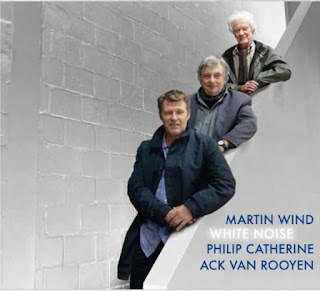
Martin Wind's "White Noise" w Philip Catherine and Ack Van Rooyten : A Sound Oasis.

White Noise Martin Wind, Philip Catherine & Ack Van Rooyen, Laika Records

There is a beautiful warmth and sonorous resonance to the work of bassist Martin Wind. I have heard Wind’s playing musically enrich work performed with saxophonist Scott Robinson, the drummer Matt Wilson, the guitarist Ulf Meyer and the pianists' Bill Cunliffe and Bill Mays. The soloist/accompaniest has composed, played, and recorded on over ten of his own leader /co-leader releases including Get It (2010), the orchestral Turn Out the Stars, Music Written and Inspired by Bill Evans (2014), and Light Blue (2018). 

Flensburg, Germany born Wind graduated from the Cologne Music Conservatory in 1995 where he studied with orchestral bassist Wolfgang Guettler. He placed 3rd in that year’s Thelonious Monk Bass Competition in Washington. At the age of seventeen, Wind was exposed to the work of Belgian guitarist Philip Catherine in a duo with the iconic Danish bassist Niels-Henning Ørstead Pederson on their album The Viking and the Dane’s bass work left a lasting impression. Wind came to the US in 1996 where continued studies at NYU earning a Master’s degree in jazz performance and composition. His bass work has a distinctive orchestral influence. His large, warm sound and inherent sense of rhythm deftly anchor any work that he performs, and he can employ a gorgeous arco technique at will. 

Philip Catherine, Ack Van Rooyen and MArtin Wind

Wind realized his wish to play with the respected guitarist Catherine in 2013 when the duo recorded their first album the duo New Folks. The latest release White Noise is an attempt by Wind to create a “Kind of sound oasis.” His goal “In a world where silence is becoming more and of a luxury, I wanted to create a little acoustic opposite pole.” The album succeeds and it is in no small part due to his two seasoned bandmates. Wind is the youngest of this trio at fifty-two, with Catherine at a sprite seventy-seven and Van Rooyen as the elder master at the age of ninety! 

Wind opens a Kenny Wheeler composition “Canter” with a vibrating arco opening that resonates with overtones and emanates with a visceral yearning. A gorgeous melody, Catherine’s gentle touch, and Van Rooyen’s mellow-toned flugelhorn lead the listener to this magical world of calm and beauty, as Wind sustains the gentle rhythm of a canter. A rewarding respite to another world of tranquility and beauty. 

Cole Porter’s “Everything I Love” captures a nostalgic time when a good song and some swing could take you to a less strenuous time. Van Rooyen's horn is mellow and bubbly, and Catherine’s guitar adds some offbeat licks that surprise. Wind’s bass solo is buoyant, cheerful, and swinging. 

Wind wrote the title song “White Noise” with his bandmates in mind. Catherine utilizes some subtle and effective echo and electronics to create the opening that leads you into this unknown territory. The music has an ethereal ECM feel to it with Van Rooyen's searching horn work floating over the soft accompaniment of his bandmates. Catherine’s guitar work here reminds me of some of guitarist John Abercrombie’s atmospheric outings. Despite being able to lose yourself in the clouds that these guys create, you never lose the beauty of the melody that sustains you throughout. 

Van Heusen and Burke’s standard “But Beautiful” is one of two duo features on the album with Catherine and Wind taking it slow and demonstrating a sense of familiar simpatico. Catherine’s playing is just beautiful and a modicum of artistry.

“The Dream” is a moving ballad that Wind wrote for his first meeting with guitarist Pat Metheny when they played together at Jazz Baltica in 2003. Catherine’s gorgeous strumming and Van Rooyen’s plaintive horn work are at top form and Wind’s plucky bass solo work is superb.

Ack Van Rooyen's composition “Autumn Bugle” is a searching, blues-based ballad that features the Dutchman’s warm tone and Catherine’s sensitive accompaniment. I’ve not heard this artist before, but the man's articulation and expressive emotional delivery are especially noteworthy. In the liner notes Wind called Van Rooyen an angel and the nonagenarian jokingly admits to being maybe an aging angel.

Wind wrote the “Genius and a Saint” for a friend and fellow bassist Bob Bowen who had sadly been the victim of a fatal bicycle accident. There is a somber, deliberate sense to this tune initially. Soon Catherine and Wind change the feel enlivening it with more hopeful approach. Catherine's inventive approach offers strumming his guitar like a mandolin, adds some rapid arpeggios, utilizes some beautiful fingered chording, and includes some modulated volume. Wind buoys the rhythm with a more aggressive pace that energizes the mood behind Catherine's expressive adventures.

Wind opens up with a bellowing bass solo on Styne and Kahn’s poignant standard “I Fall in Love Too Easily.” Van Rooyen's flugelhorn spells out the melody before Catherine’s guitar harmonizes the music with his own improvised ideas to end the set.

Van Rooyen and Catherine have lived through a period of time that has given them a sage's perspective of history's vagaries. With Wind, these gentlemen lend their maturity and sensitivity to this project with this music and their artistry. Martin Wind’s White Noise is a welcomed celebration of music that soothes, entertains, and delights in today’s age of uncertainty and tension.

Sunday, October 25, 2020

Jeff Cosgrove's "History Get's Ahead of The Story": The Music of William Parker


Jeff Cosgrove's History Gets Ahead of The Story Grizzley Music 

My familiarity with the work of the prolific free-jazz bassist and composer William Parker is admittedly limited. When I heard some of Parker’s compositions recently assembled and so enthusiastically played by drummer Jeff Cosgrove and his bandmates, organist John Medeski and saxophonist Jeff Lederer on his latest cd History Gets Ahead of the Story, I was both impressed and intrigued. I had to find out more about this bassist who The Village Voice once claimed as “the most consistently brilliant free jazz bassist of all time.”

Double bassist William Parker is now sixty-eight years old and has had a career of many creatively inspired musical endeavors. The double bassist/composer has recorded over forty albums as a leader and a countless number of important collaborations with other artists. Parker’s fierce attack and unfailing pulse, whether using his arco or pizzicato technique, is a constant source of grounding stability. His exploratory expressiveness and willingness to promote a collaborative approach keeps his music both fresh and interesting.

Parker studied with such bass luminaries as Richard Davis, Jimmy Garrison and Wilbur Ware. Over his career, he has contributed his artistry to the music of pianists Cecil Taylor, Craig Taborn, and Mathew Shipp. He has worked with the trumpeter Don Cherry and saxophonists Dave S. Ware, Anthony Braxton and Peter Brotzmann to name a few. Parker created an impressive repertoire of original music and has penned several books. His artistic breadth is diverse and inclusive, utilizing crossbreeding aspects of spiritualism, world music, dance, opera, blues, gospel, soul, jazz, free jazz, and poetry as elements into some of his inventive musical creations.

Jeff Cosgrove (photo credit unknown)

The apt textualist, Jeff Cosgrove, a generational disciple of the Paul Motian’s school of percussion, has played with bassist Parker in a contemporary trio with the pianist Mathew Shipp. Their first album was Alternating Current from 2014 and the last album from the trio was Near Disaster from Feb 2019. With this history in mind, it was only fitting that Cosgrove would choose seven compositions from Parker’s repertoire to both pay homage to the bassist/composer’s influence and to use these songs as a vehicle to explore the possibilities.  To my delight, Parker’s music not only provides inspiration to these adventurous musicians, but the band skillfully manages to somewhat make it their own.

Jeff Lederer ( photo credit unknown)

The group is notably without a bass and the only bottom anchor here is provided sparingly by Medeski’s left foot on the B3.  Song’s like the bluesy opener “O’neals Porch” seems to be tailored to raise the spirits with Medeski’s probing organ,  Lederer’s frolicking saxophone, and Cosgrove’s delicate percussive pace.

The gospel-inspired “Corn Meal Dance” employs a churchly sound from Medeski’s organ and a roiling rhythmic treatment from Cosgrove. Lederer, whose saxophone prowess is a marvel, seems to wail like a possessed preacher wailing to the heavens from his pulpit.

John Medeski ( photo credit unknown)

"Gospel Flowers” is one of two Lederer compositions on the album. This blues-based song has a memorable, lightly swinging melody. Medeski always seems able to find a way to liberate his B3 playing from expected pathways, often bringing excitement to the musical journey. The music elevates you, as Cosgrove’s subtle and textured accompaniment maintains your altitude. Lederer rides the airways with a strong powerful tone and mellifluous sonority, as he also accents the music with more piercing dissonance that claws back to some of Parker’s free jazz roots.

“Little Bird” is a playful musical spar originally on William Parker’s Petit Oiseau from 2008, and here features Lederer on flute, Medeski on keys, and Cosgrove on drums. The music is joyous, invigorating and a testament to these three gentlemen's ability to create a musical conversation that just captivates the listener. Cosgrove offers a short solo that demonstrates his astute percussive inventiveness. There is a Dolphy like feel to Lederer’s flute work here that seems to be a tip of the hat to the music’s history.

 “Ghost,” the only composition on this album by Cosgrove, creates an otherworld-like mood. Here using a modulating organ, splashing cymbals, soft toms and a resonant clarinet, the band creatively conjures up the presence of a looming specter.

Parker’s “Moon” is just a delight. The music is jaunty and joyful. Lederer plays a soprano lead that grabs you with its prance-like feel and brash proclamations. Medeski’s organ lightly keeps the rhythmic drive going as Cosgrove lays down a roiling flow of percussive accents.

“Things Fall Apart” is a free-flowing exchange that has no perceivable melody and is an improvisational banter between the three musicians.

“Wood Flute Song” comes from Parker’s 2005 album Sound Unity and Cosgrove open with a short drum introduction. Lederer and Medeski enter in, one with a muted left-footed bass line and the other with a robust clarinet.  When Medeski takes a solo on the organ he is accompanied by circular drum work by Cosgrove giving the music a buoyant and enlivened flow.

Lederer’s gorgeous “Purcell’s Lament” opens with an impassioned Soprano intro that is accented by Cosgrove’s delicate cymbals and toms. Medeski’s swelling organ adds to the ballad’s moving feel. The music seems to bloom in front of you like a flower that opens on an inviting spring morning. Lederer can evoke spirituality in his playing that reminds me of some of Pharoah Sander’s work of time past.

The album ends with Parker’s jaunty “Harlem” from his 2005 Sound Unity. Medeski, Lederer and Cosgrove coordinate brilliantly, tracing each other’s lines -tenor, organ and drums-like a synchronized swim team’s motion at an Olympic competition. There is a beauty as to how well these three moves in each other’s space.  The three separate instruments are handily utilized to operate as one breathing entity, three minds meeting as one impressive expression of the music. Take the time to hear this work and to enjoy the inventive music of William Parker.


Thursday, September 24, 2020

The Joy of Live Music : Marvin Stamm and Mike Holober Quartet "Live at Maureen's Jazz Cellar"


                                       Live @ Maureen's Jazz Cellar Marvin Stamm, Mike Holober, Mike McGuirk and Dennis Mackrel 

It is always a pleasure when a group of musicians possesses that “special sauce," that complementary talent, awareness, and ability to align their individual efforts and perform as one beautifully purposeful unit. It is even more conducive to success when you get a chance to play/record in a welcoming, intimate setting in front of a knowledgeable and appreciative audience. This happened this past December, pre-Covid, in the unassuming jazz venue Maureen’s Jazz Cellar, located on the west side bank of the Hudson River, in the town of Nyack, NY.

The group is comprised of the trumpeter/flugelhornist Marvin Stamm, the pianist Mike Holober, upright bassist Mike McGuirk and the drummer Dennis Mackrel. They brought their alchemy and recorded this new album simply titled Live @ Maureen’s Jazz Cellar. The music recorded, is a collection of five thoughtful and modernly navigated jazz gems from composers like  Horace Silver, Bill Evans, Bronislau Kaper and Jerome Kern, and includes two gorgeous originals written by the pianist, Mike Holober.

Dennis Mackrel, Mike McGuirk, Mike Holober, and Marvin Stamm

My exposure to the trumpeter/flugelhornist Marvin Stamm goes back to the early eighties when I first saw him playing as a guest artist with the house band- drummer Billy LaVorgna and the English pianist Derek Smith- at a little now-defunct club called the Foxes Liar in Hackensack, N.J. Stamm always impressed me with his fluid facility, his sensuous tone, especially on the flugelhorn, and his unerring melodic and harmonic sense. Years later I heard him with pianist Billy Mays’ The Inventions Trio, which included cellist Alisa Horn on a marvelous album titled Fantasy from 2007. This was a musical hybrid, a chamber/jazz crossover, that brought out Stamm’s facile expressiveness, utilizing a classically inspired approach that meshed beautifully with the Mays' piano and Horn's cello.

I discovered the pianist/composer/arranger Mike Holober in 2010, when I attended some big band performances that he conducted with the Westchester Jazz Orchestra. Besides iconic guest artists, the dynamic big band included Marvin Stamm in the trumpet section among a group of NYC's notable section musicians. Apparently, Stamm and Holober’s work together on the WJO sparked a friendship and the two became close collaborators. Holober’s growing stature as a big band composer/big band arranger was recently acknowledged when his Gotham Jazz Orchestra’s release Hiding Out, which was nominated for a Grammy in 2019.

When similar minds, like Stamm and Holober, collaborate over a sustained period and the chemistry is right, a musical empathy develops and a complimentary creative approach to music becomes almost second nature. The two went about enlisting solid and intuitively responsive rhythm section partners to form a working quartet. The drummer Dennis Mackrel and the bassist Mike McGuirk are under the radar journeymen musicians that fit superbly, expanding the conversational possibilities of this potent group.

In the opening cut, listen to how Holober’s smart intro to Horace Silver’s “Out of the Night Came You,” sets the table beautifully before the group slips into the swinging melody. Stamm’s flugelhorn has a warm, welcoming tone and he plays with a fluid inventiveness that surprises and holds your attention. The group never loses the drive carried by McGuirk’s plump bass lines and Mackrel’s sure rhythmic propulsion.

Bassist McGuirk opens with an intriguing pizzicato solo bass lead-in to Bronislau Kaper’s exotic-sounding “Invitation.”  Stamm takes this haunting melody to a new level of sensitivity. It is simply magical to listen to this master horn player take you down the rabbit hole of harmonic possibilities. Holober is similarly engaging with his own explorations of the composition’s captivating moods. McGuirk offers a fleet journey on a poignant bass solo and the music is advanced by a swirling, rhythmic drive by the trap master Mackrel. Almost fifteen minutes of marvelously played music that by itself is worth the price of admission.

On Holober original “Dear Virginia,” a pensive, touching ballad that features some of the pianist’s most expressive work, the interaction between the pianist and both Stamm and McGuirk’s artful contributions, raise cooperative playing to a new level.

“Morning Hope,” another Holober original, musically builds from tranquility to expectation. Mackrel’s subtle drum work is like a symphony of rhythms, perfectly suited to accompany whoever is soloing, while always steadfastly propelling the music forward. Holober raises the level with a rewarding and touching solo. 

A rousing rhythmic treatment on Jerome Kern’s jewel “All the Things You Are” keeps this well-worn song fresh and interesting. Solos by Holober, Stamm, and McGuirk are all top-notch and raised again by an impressive drum solo featuring Mackrel’s graceful skills.

Holober’s opening to Horace Silver’s tranquil “Peace” is masterful and moving. His piano work is elegant in songs like this, songs with a message that deserves a player who can be creative and still maintain the composer’s intention. Stamm’s impressionistic flugelhorn lines follow exploring the genuine pathos that flows through this music. His horn also offers a yearning hopefulness to the message that peace can in fact be attained, which in today’s day is a powerful aspiration. 

The set ends with the more rambunctious Bill Evans’ funky “Funkallero,” one of the few times Evans took up the electric piano.  Mackrel’s drums set the pace with a boisterous drum entrance. The members robustly trade ideas with an overall feel of gusto. Maintaining the song's drive, Holober plays with an aggressive attack, Stamm’s horn is at his most excitable and jubilant, McGuirk gives a plucky bass solo and Mackrel lets loose with his own punctuated drum highlight. The crowd at Maureen’s are left with unfettered appreciation, offering enthusiastic applause.

If you, like me, miss that “live” experience then get Live @ Maureen's Jazz Cellar and play it till your heart's delight, its the next best thing to being there.

 Follow this link to hear the group play "invitation"

https://youtu.be/Eh3oaStfGVQ

Thursday, July 30, 2020

John Di Martino: "Passion Flower: The Music of Billy Strayhorn"

John di Martino Passion Flower: The Music of Billy Strayhorn Sunnyside SSC 4114
When a talented and seasoned musician like the exceptional pianist/composer/arranger John Di Martino takes a moment to create a new album under his leadership, it deserves attention. DiMartino’s latest release is titled Passion Flower, a thoughtful compilation of the music of Billy Strayhorn. 

John’s playing incorporates superb sensitivity, admirable facility, and an assured poise that allows him to extract the best qualities of the soul and spirit of these fine compositions.  Di Martino sums up his approach to playing, I “surrender to the ecstasy of making music… if I can feel that joy then I can also transfer that joy to the audience!” 

Strayhorn’s work is a cache of gems. With John’s imagination and his attuned band of tenorist Eric Alexander, bassist Boris Kozlov, drummer Lewis Nash and vocalist Raul Midón, these memorable compositions are reimagined and revitalized in new and surprisingly delightful ways.

The sixty-one-year-old Di Martino hails originally from Philadelphia, “The City of Brotherly Love,” like so many other notable jazz artists of the last half a century. His piano playing has been influenced by a diverse group of iconic pianists including Bill Evans, Herbie Hancock, Hank Jones and Horace Silver. He mastered his craft by studying with the enigmatic pianist/educator Lennie Tristano, pianist Jimmie Amadie, a Woody Herman alumnus, and with noted pianist and arranger Don Sebesky.  

Di Martino made his way to New York in 1988 after honing his skills for years as the keyboard player for a house band of a casino in Atlantic City. This “showtime” experience exposed him to a myriad of musical styles, genres, and international influences.

Di Martino’s musical skills permit him to “shapeshift,” - seamlessly adapting his playing to the requirements of the music at hand. No wonder he developed such chameleon abilities as he has found himself playing and arranging for such diverse talents as Houston Person, James Moody, Kenny Burrell, Jack Sheldon, David “Fat Head” Newman, George Mraz and Joe Lovano. 

Over the years he has become a sought after accompanist and arranger for such proven vocalists as Billy Eckstein, Giacomo Gates, Janis Siegel, Grady Tate, Gloria Lynn, and Freddy Cole. His inherent street-wise affinity for Latin music was refined by his stint with Panamanian flutist Marisco Smith. He later toured with Latin percussionist and bandleader Ray Barretto’s New World Spirit Big Band for several years. and continues that love for Latin music, continuing his present work with the distinguished clarinetist master Paquito D’Rivera.


Billy Strayhorn photo credit unknown

On the new cd, Passion Fruit, the music of Billy Strayhorn is a unifying theme, but Di Martino and his bandmates always seem to present the music in new and exciting ways. Take the opening “Johnny Come Lately” which is launched by a strutting bass line by Boris Koslov before the group enters the pace with a jaunty swing that is infectious. Di Martino’s piano skills are immediately on display as he probs the ascending and descending spirit of this melody. Tenor master Eric Alexander adds his own signature warm tone and the trap master Lewis Nash creates a swirl of inventive percussive enthusiasm. You cannot help but get drawn in by this band’s enthusiasm for the music.

Billy Strayhorn reportedly wrote his sophisticated masterpiece “Lush Life” at the age of sixteen, an almost unimaginable feat. The song is coveted for its lyrical maturity and musical complexity. Strayhorn originally debuted it with vocalist Kay Davis at Carnegie Hall in 1948. The composition challenges the vocalist with quick changes. It commands the singer to precisely execute slides and leaps, all the while maintaining a debonair, sagacious sensibility of forlorn. Notably successful recordings of this song have included a version by baritone Johnny Hartman, collaborating with saxophonist John Coltrane and a superb take recorded by chanteuse Sarah Vaughan. But even an iconic vocalist like Frank Sinatra, working to record this song with the great Nelson Riddle in 1958, was unsatisfied with his attempts to successfully navigate the complex changes and abandoned recording the song, never to make it part of his repertoire.

A sought after accompanist for countless vocalists of all types, John di Martino has developed his own inherent sixth sense of what makes a vocalist suited to render a specific composition. Here, his sensitive duet with the emotive vocalist Raul Midón is a stunningly effective treatment of this pensive Strayhorn classic. Di Martino’s yearning piano- expressive, complimentary but never overwhelming- creates the perfect tableaux for Midón’s expressive voice. Together they bring to life Strayhorn’s disheartening words and one would be hard-pressed to find a more genuinely moving rendition of this beautiful composition. Easily, this alone is worth the price of admission.

“Rain Check” opens with a slick, tight-brushed snare entry by Nash and features some mellifluous tenor work by Alexander that swells and ebbs with the changes. Di Martino’s piano solos always firmly guide you through the stated melody, but he can add short familiar musical ideas tangentially that he weaves into the music flawlessly.


John Di Martino photo by The Cuban Bridge
“Star-Crossed Lovers” is a gorgeous slow-paced composition that is played with delicate restraint as an expressive vehicle for both Alexander and Di Martino. Alexander’s tenor, at his best, is tonally burnished, emotively strong but purposefully subdued for emphasis. Di Martino’s piano is warm and shimmers with a beauty and sensitivity that radiates from his ability to find that joy in the music he is always looking for.

“Isfahan” is one of my favorite Strayhorn compositions. I have heard tenor master Joe Henderson play this one to great effect. Di Martino utilizes Alexander’s precise and gorgeous intonation and Kozlov’s plucky bass to make this one special. Di Martino creates an inventive solo that works so well over the strong walking bass lines and Nash’s subtle snare and cymbal driven pace. The group trades solos and the interaction of these simpatico musicians is a treat.

The remaining album is a cornucopia of expertly played Strayhorn classics. The slow languishing “Chelsea Bridge” delights and the imaginative “Daydream” is lively and uplifting. Drummer Lewis Nash creates a precise cadenced pulse for the exotic “Passion Flower,” with Alexander’s deep-throated tenor being featured as the lead voice. Di Martino’s piano and the rhythm section are predominantly adding deft accompaniment, judicially applied aural accents to the music, as Alexander is given the stage to subtly explore harmonic ideas on his saxophone. When Di Martino solos, he carves himself out a brief musical path, a flurry of gorgeous lines that seem to just dance with the melody.

“U.M.M.G.” is a more obscure composition that is one of the more energetically driven paces on the album. The cd also includes the Ellington Orchestra’s memorable “Take the A Train” and the middle eastern-inspired “Absinthe,” with some of Di Martino’s most inventive improvisations and Alexander stretching out. 

“A Flower is a Lovesome Thing” is one of Strayhorn’s more romantic compositions, as is the final cut “Lotus Blossom.” It’s great to hear John take the time to feature himself as a soloist on these gorgeous songs. Di Martino has a mastery of his keyboard with a skilled touch and an inventive harmonic grasp of how to make the songs draw out the best of the composer’s intentions.

“Blood Count” was the last composition written by Strayhorn at a time when the composer discovered that he was struck with terminal cancer.  The music drips of melancholy, almost desperation and was written specifically to be played by Ellington altoist Johnny Hodges. Perhaps one of the most memorable renditions of this music was recorded later by tenor saxophonist Stan Getz, who made the song one of the signature pieces of his repertoire. 

Di Martino smarty employs Alexander’s Getzian tone to bring out the sheer forlornness that the music evokes, and the tenorist plays with impressive emotion and depth.  Pairing these two musicians on this aching composition is a testimony to their affinity. Hopefully, this collaboration will be explored in the near future. The performance is one of the cd’s highlights, with Di Martino and Alexander together, artfully extracting some of the essences of Strayhorn’s most empathetic music. 


Tuesday, June 21, 2016

Warren Wolf's "Convergence" : Converging on Excellence

Warren Wolf


The title of vibraphonist/multi-instrumentalist Warren Wolf is “Convergence,” a coordinated coming together of forces toward a single goal. In this case the forces are the formidable musicians that have come to take part in Wolf’s vision of music.  The core band is made up of Wolf on vibes, marimba and piano on one cut; Christian McBride on bass; Jeff “Tain” Watts on drums and pianist Brad Mehldau along with two songs that feature John Scofield’s soulful guitar work. Co-producer McBride wanted to bring the young lion of vibraphone into the spotlight and test his mettle by pairing him with this group of no nonsense talent. Wolf more than rose to the occasion, with the result a recording that combines grit, funk, swing, soul and outright beauty into one of the most satisfying albums of the year.

Warren Wolf's Convergence MAC 1105


The fun begins right from the opening bars of Wolf’s funky cha-cha shuffle “Soul Sister,” the perfect vehicle for Scofield’s twisted electric blues guitar as McBride and Watts drive the groove. Wolf’s melodic vibes have a sensuous smoothness to them, that cover you like silky lotion. 


On his “Four Stars from Heaven” the interplay with Mehldau is particularly insightful. The pianists signature angular sound darts perfectly with the intuitive rhythm section of McBride and Watts. Mehldau is a master of building tension in his solo. Wolf feeds off the inspiration and juxtaposes his own solo with a marvelously relaxed approach, building tension in a series of cascading arpeggios that get increasingly faster.  He brings the band back together for another Mehldau solo that rollicks as Watts creates a tumult of sounds on his toms, snare and cymbals before the band fades into the dreamy sounds of Wolf’s vibes at the coda.

Wolf reduces the band to a duo for” King of Two Fives” where he a McBride play off each other in a delightfully swinging conversation. McBride is a master of his instrument and hearing him play with such seemingly effortless facility is a pure joy. Wolf’s unobtrusive vibes are the perfect accompaniment during the bassist’s forays, lending beautiful sustained harmonies to the music.

Dave Samuel’s “New Beginning” utilizes another duo, this time Wolf and Mehldau. The beautiful sensitivity both players reveal recalls Bill Evan’s “Blue in Green” in part. Mehldau’s solo is Evanesque in his approach enhancing the connection to the old standard. These two have a great chemistry and the conversational quality and utter beauty of their musical dialogue is quite moving, reminiscent of the work of Corea and Burton did on their famed “Crystal Silence.”

The pulsing “Cell Phone” features the quartet again, with McBride’s relentless bass line and Watts polyrhythmic drum work surging the piece forward. Wolf’s blurred vibe tones and Mehldau’s staccato piano jabs all make for a frenetic frenzy of a piece, emblematic of Wolf’s aversion to cell phones that ring constantly.

“Montana” is a Bobby Hutcherson composition that is the epitome of a “chill” tune. Wolf employs the trio on this one, a subtle bass line and traps. The vibraphonist creates the dreamy landscape by overdubbing his own vibe accompaniment to his single note solo work on Marimba over the top with the effect being quite enchanting. Lay back on your lounge chair and enjoy this one with a tall one and you sure to relax.
The full ensemble is back for “Havoc,” a fusion tune written by Wolf but inspired by guitarist’s Scofield’s “Trim.” The group hard charges as Wolf and Scofield trade licks in a test of spontaneous creativity. The ensemble is tight as they whirl through some complex, serpentine passages at both the beginning and the end. Like oil and vinegar go together, Scofield’s guitar ekes out his nasty pungent sound and Wolf replies with his own tasty viscous flow of notes.

One of my favorite song’s of the early seventies was bassist Gene Perla’s “Transgiversation” that I first heard on Elvin Jones’ classic Merry Go Round from 1971. The title according to that album’s liner notes means “…something like the act of changing one’s mind continually, of being a renegade.” On it two monster Fender Rhodes players Chick Corea and Jan Hammer played opposite each other trading licks to this wonderful fast paced melody as Perla’s bass held the beat and Elvin played exquisite brushes. Here Wolf, McBride and Watts play this swinger to perfection. Wolf’s vibes mimic the Rhodes sound perfectly. McBride takes an auspicious solo that wasn’t present in the Jones/ Perla original, but is fabulously swinging and Watts keeps the pace pushing in true Jones-style. Wolf doesn’t have another lead foil to do battle with, but no matter, his endless creativity is amply up to the task of making this an awe inspiring rendition that put a smile on my face. See for yourself.


Stevie Wonder’s “Knocks Me Off My Feet” is a slow sensual ballad that features Wolf as the multi-instrumentalist. This time he overdubs a piano accompaniment and his marimba solo work on top of his vibes as McBride and Watts provide subtle rhythmic support.

The spiritually sound of Wolf’s warm marimba kicks off his “A Prayer For the Christian Man” with its deliberate back and forth sway accentuated by McBride’s plucky bass. The dirge-like song takes its inspiration from John Coltrane’s “Alabama” and Wolf’s deeply moving mallet work is as reflective as you’ll find. The Coltrane inspiration is carried on by a stirring Elvin Jones-like poly-rhythmic burst at the end by the formidable Jeff “Tain” Watts.

The finale is all solo Wolf, playing the delicate hollow sounding Marimba, first on sensitive rendition of Hoagy Carmichael’s “Stardust” joined in medley with a utterly fantastically whimsical version of the classical piece, Chopin’s Minute Waltz.


Warren Wolf’s music on this album ranges from the burning to the sublime and does it all with an easy aplomb. The excellence of Convergence marks Wolf as a major player on the contemporary music scene whose time has come.

Saturday, November 8, 2014

A River Runs Through the Manhattan School of Music's Borden Auditorium


The MSM Jazz Philharmonic and Conductor Justin DiCioccio

On Friday November 7, 2014, the Manhattan School of Music School’s  Jazz Philharmonic Orchestra, under the able direction of maestro Justin DiCioccio, produced  a river of sound that washed through the school’s Borden auditorium to a packed house of music lovers.

The occasion was the  World premiere of University of South Florida’s distinguished professor Chuck Owen’s  masterful suite River Runs in its
entirety. The 2013 recording was among the nominees for the 2014 Grammy Awards in the categories of Best Instrumental Composition for Bound Away,and Best Instrumental Arrangement for Side Hikes: A Ridge Away. Both compositions are part  five-movement concerto, combining a full symphony orchestra with a jazz ensemble and jazz soloists on violin, guitar and saxophone. The soloists were the tenor saxophone firebrand Donny McCaslin, the sensitive violinist Sara Caswell and the masterful guitarist Jack Wilkins.

The music is an exhilarating compositional tour de force, combining the multiple musical voices, colors and timbres that a full orchestra can command with the individual jazz expressions of the featured solo instruments of electric guitar, tenor saxophone and violin.

On this night maestro DiCioccio was exuberant in his direction of the music, as his orchestra produced brilliant tones and waves of sound that swept over the audience in the music’s ebbs and flow. The music was conceived by Mr. Owen as a representation of multiple adventure trips he has taken canoeing and rafting down various rivers in this country. Each movement is a musical depiction of various aspects of these trips. 

The opening composition “Prologue: Dawn’s at River’s Edge” is an impressionistic  piece, all about the anticipation of waking up to nature in the early morning ready to embark on another challenging journey down the mysterious waters that lie ahead.

The Grammy nominated “Movement I: Bound Away” is a musical recollection of the shimmering light reflected off the rippling pools of the Greenbrier and New Rivers of West Virginia. The trip meanders through a gorge where the thunderous sound of the approaching rapids is the clarion call that Owens' music recreates.

“Movement II :Dark Waters , Slow Waters” is a representation of Owen's time on the Hillsborough River in Florida, A river edged with drooping cypress and lined with murky pools of ominous swampy waters. The music becomes much more tranquil as you go on a more languishing journey through the humid, moss covered banks of the Everglades. There is a sense of foreboding in this piece, an ominous feel of not really knowing what to expect around the next bend of the route.

“Movement III : Chutes and Wave Trains” is a depiction of Owen's time on the Chatooga River as he makes his way down through Georgia and South Carolina. The music compresses and swells at times, similar to the way the water is compressed when funneled through a restrictive chute carved out of the architecture of the river banks; building up pressure and speed, only to be released on the other side of the obstruction, into the opening calm.

“Movement IV: Side Hikes- A Ridge Away” This Grammy nominated composition is inspired from Owen's trips to the Green River in Utah and the Colorado River in Colorado,  and was also adapted from the CD Ridgelines, a recording made by the saxophonist Jack Wilkins ( no relation to the guest guitarist) who was the featured saxophonist on the original recording. The unifying factor in both pieces is the concept of reaching a nearby ridge for an overview of your surroundings. Finally reaching the ridge you see many other ridges in your horizon, many never to be experienced, always just a “Ridge Away” from your reach. The composition appropriately creates a wistful  sense of longing for the next great adventure.

“Movement V: Perhaps the Better Claim: The River  of No Return” With a line borrowed from Robert Frost’s haunting poem “A Road Not Taken”, Owen's chooses this title for a musical trip down Idaho’s Salmon River, a river known for its fierce rapids, its deep canyon, its treacherous terrain and its stunning scenery. The musical depiction sent the occupants of this auditorium-on-pontoons into a swirling and satisfying conclusion.

The music was masterfully played by the MSM’s Jazz Philharmonic, who conquered the suite's demanding musical nuances, creating the atmosphere that so brilliantly depicts the natural musical sounds of the river rafting experience.

The soloists were in top form. Ms. Caswell was particularly poignant when her violin was featured as a soloist and at times in counterpoint to her two fellow soloists. Saxophonist McCaslin is a firebrand of a player. He always brings a sense of energy and excitement to his work. He was particularly effective producing a "waves of sound” deluge that flowed from his horn much like the rapids of Owen's compositions. Guitarist Jack Wilkins was playing a Fender Telecaster through an amp and the sound was unfortunately somewhat muted from where I sat. Wilkins is one of those players whose technique is precise and immaculately clean; a consummate player whose melodic solos, (the ones I was I was able to hear clearly), were fluid, fleet and precise. His interplay with McCaslin was particularly noteworthy as the two fed off of each other brilliantly. 

Mr. Owen was in the audience for this performance and in speaking to him briefly afterwards he was obviously gratified to see his music performed so admirably.


To be able to imitate the sounds of nature; to be able to magically reproduce the rapturous feeling one can get from communing in the woods on such an endeavor as white river rafting or hiking is an extraordinary achievement.  I related to this album when I first reviewed it back in July of 2013 ( click here for a link to that review.) Now having seen it performed live by the MSM Jazz Philharmonic it only reinforces my original convictions. If you get a chance to see this work performed live and you enjoy commuting with nature you will not be disappointed with this brilliant piece of music.