Showing posts with label jazz bass. Show all posts

Thursday, February 12, 2026

Bassist/Composer Martin Wind Offers Some Beautiful Music on "STARS"


Martin Wind: STARS: Newvelle Records

The bassist Martin Wind has long been on my radar as one of the more inventive and melodic bass players around. I’ve seen him perform live with multi-reedist master Scott Robinson several years back and reviewed several of his past albums that have shown the breadth and depth of this man’s musicality. I had the opportunity to interview Wind back in 2014 with the release of his fabulous album Turn Out the Stars which you can read here

Wind’s latest release Stars is on Newvelle Records, a label that is celebrating its tenth-year anniversary this year. The album is a joyful and sonorous studio album that became available on January 30, 2026, and features Wind’s upright bass paired with a star-studded band that includes the master pianist Kenny Barron, the mellifluous clarinet of Anat Cohen and the creative drum work of Matt Wilson.

Matt Wilson, Anat Cohen, Martin Wind and Kenny Barron (photo credit unknown)

The fifty-eight-year-old Wind was born in Flensburg, Germany. He studied orchestral bass at the Music Conservatory at Cologne and received a Master’s in Jazz Performance and Composition at the Music Conservatory in Cologne.  Wind moved to New York in 1995, won third in the Thelonious Monk Bass Competition in Washington, D.C. and continued studies with Mike Richmond, Jim McNeely, Kenny Werner and Mike Holober to name a few.  The bassist has been a member of the faculty at New York University since 1997 and has been a faculty member of the National Youth Jazz Orchestra in Germany. He continues with   on- going musical relationships with European artists like Belgian guitar ace Philip Catherine, Dutch trumpeter Ack van Rooyen and German guitarist Ulf Meyer. With over fifteen albums that he has released as both a leader and co-leader, it is always worth following the progression of this man’s prolific work.  

Stars opens up with the sauntering “Passing Through,” in some ways the perfect composition that sets the tone and purpose that Wind has in mind when recording this album. The album is reflective, evokes memories from the bassist’s experiences as a musician, and has a quiet sense of elegant melodicism. “Passing Through” is a composition from the bassist/composer Aaron Bell. Bell was a one-time Ellington bassist and an inspiration. The music is deceptively simple, clear and narrative without being obvious. This newly assembled group reveals just how at ease they work together, allowing the music to gently unfold and wrap you with a blanket of joy. Cohen’s clarinet is warm, woody and provocative. Barron’s piano can at times evoke a down and dirty bluesy sense, but the man also has an undeniably elegant feel and a deep well of creativity to draw upon. Wilson’s drum kit is always joyful, like a toy box radiating bliss, and Wind’s warm pizzicato bass lines guide the leisurely shuffle expertly. Clearly this is Wind’s beautiful homage to a felloe player like Bell and a tip of his hat to the Ellingtonian era. Not to mention, this is a hell of a composition that is strangely seldom heard,

Duke Ellington and Aaron Bell (photo credit unknown)

“Life” is presumably a ballad composed by the leader Wind. It features some beautiful three-way improvisational lines by Cohen, Barron and Wind that weave themselves like sinewy silk threads into a melodic tapestry.

The album continues with “Black Butterfly,” a Duke Ellington composition that is played in a jazz-chamber ballad form. It features the vocal-like sound of Cohen’s resonating clarinet, and the heartbeat-like bass solo by Wind that glows with warmth and elegance. Barron’s accompaniment is superb, as Wilson keeps the pace with subtle ingenuity. The music is reminiscent of a simpler, relaxed, more elegant time.

“Moody” is a gentle, contemplative Wind composition. Lead by Cohen’s expressive clarinet's tubular sound and some dynamic counterpoint bass work by Wind, the music is ethereal. Hanging in the air like a reflective mood, not melancholic but deep in thought and reverend.

Wind gives a nod to the importance of bebop to the canon of music. Here he chooses Bud Powell’s iconic “Wail,” which was first heard on his album The Amazing Bud Powell from 1951. Powell had the lead horns of the powerful tenor of Sonny Rollins and Fats Navarro’s incendiary trumpet to trade ideas on this quick paced gem. Here Martin and Cohen lay out the challenging, circuitous lines of the melody concurrently with impeccable skill, but at a decidedly more relaxed attack. Wind shows that no matter how complex the music may be, it can be effectively entertaining and interesting at any pace if the core of the music’s message is retained by the artists presenting it.  Wind and mates let the music flow with satin smoothness and facility, and the results are rewarding. Kenny Barron’s piano work here is a master class of modern interpretation. Barron is a true descendant that preserves some of the history of jazz music in every note he plays.

Wind opens “The Feel of the Jazz,” another Ellington composition (also credited are Bobby Troup and Geore T. Simon), with an extended, plucky bass entre that hums with joy and creativity. The original release of this song was on Duke Ellington and John Coltrane from 1963 and included the rhythm section of  Aaron Bell on bass and drummer Sam Woodward. When Cohen’s clarinet enters this one, there is a sense of history meeting modernity. Barron’s piano interacts with Cohen’s clarinet as the song progresses and the two pros meld notes so easily at times with ease and familiarity that makes it look effortless.

“Pra Diza e a Deus” is a beautiful ballad composed by the Brazilian composers Edú Lobo and Torquato Neto. It was made popular by Sergio Mendez and Brasil ’66 from their album Look Around from 1967.  The English title of this song is “To Say Goodbye” and anyone who has heard this version can’t forget the sad voice of Sergio Mendes and beguiling sound of singer Lannie Hal or the vocalist Flora Purim’s moving version. For the bassist, this is another homage that recognizes just how much Brazilian music has influenced Wind and added to the jazz canon. Barron’s delicate solo opens this song, before Wind’s aching arco bowing of the bass gorgeously spells out the melody. Wilson drum work opens the rhythm with exquisite restraint, as Barron’s piano expands on the melody. When Cohen’s clarinet enters the mix it’s like her sound takes on the yearning, voice-like element that one remembers from the original. Despite being wordless, these guys transmit the pathos of the sentiment of  saying goodbye to a lover.

The album continues with “Standing at the Window Waving Goodbye,” another Wind composition, that deals with poignant moments of dealing with saying goodbye to someone who is important to you. This reflective, unresolved piece is another example of the music that speaks the most to this bassist as a composer. Cohen’s clarinet seems to float above the music, as Barron’s piano is perfectly supportive. Barron’s solo work always elevates the possibilities of harmonic inventiveness and Wind and Wilson maintain the breezy rhythm.  

Mitchell Parish’s “Stars Fell on Alabama” is a ballad played at a slow gait that has an easy swing to it, and has an obvious tie-back to the album’s theme, Stars. Cohen’s burnished clarinet resonates with sustained warmth, and she navigates the melody with reverence and unadorned emotion. This song brings you back to a time when the pace was more forgiving and a twilight concert offered at a local gazebo could allow you to just sit back and get lost in the music.

My digital release had two bonus songs, the first is a Bill Mays composition “Blues with Two Naturals.” Mays is a pianist/composer that is part of the Martin Wind Quartet. Mays is known for his harmonic humor and on this one he naturalizes the two notes in the key signature, counter to a standard blues form that uses flattened notes.  Kenny Barron, Wind and Wilson make this one all their own.

“Marc’s Moment” is another digital release bonus track that Wind composed and didn’t include on the album. This closer is a joyous, free flowing song that has a medium swing feel to it. Cohen’s clarinet just hovers like a feather, twirling up and gliding down along the thermals as the rhythm section is led by Wind’s booming bass, Barron’s pianistic accompaniment and Wilson’s gossamer drum work.

Martin Wind’s Stars offers the listener some joyful, easy listening music played by a remarkably cohesive band, whose artistry should not be missed.

Sunday, August 24, 2025

Ben Wolfe, George Colligan and Aaron Kimmel Bring Swing, Melodicism and Edge to Portland's 1905 Jazz Club


George Colligan, Ben Wolfe and Aaron Kimmel at 1905 Jazz Club 

The musician/educator Ben Wolfe had a two night stand at Portland's 1905 Jazz Club this past weekend. Wolfe is a New York-based bassist and is on the faculty at the prestigious Julliard School of Music. He has been a prolific composer and band leader for several years, and its a real pleasure to see this swinging and exuberant bassist perform in person out here in the Pacific Northwest. 

Wolfe brought along his regular drummer, the talented Aaron Kimmel, and enlisted one of Portland's best, the progressive pianist George Colligan, to round out his trio. Wolfe's last two Resident Artists releases, Unjust from 2023 and The Understated, which was named part of Notes On Jazz Best of List for 2024, were both well received by the public and the critics. 

Wolfe's musical and recording history, has found him in productive associations with the crooner Harry Connick Jr., the pianist/vocalist Diana Krall and with leader/trumpeter Wynton Marsalis as a member of the Jazz at Lincoln Centers Band, to name just a few. His albums are almost exclusively comprised of self-composed material. 

Wolfe's playing has been once compared to “Mingus and Miles Davis meet Bartok and Bernard Herrmann” by NY Times Ben Ratliff. There is a certain sense that Wolfe deftly brings together some of the elements of swing with a lush melodicism in his music that retains its modernity and edge. To some degree, he accomplished this delicate balancing act by compositional acumen and by his astute choice of forward thinking musicians to present his music.  Albums like Unjust ,The Understated  and his PosiTone record The Whisperer from 2015, found Wolfe aligned with such progressive band mates as Nicholas Payton and Josh Evans on trumpet, Immanuel Wilkins, Stacy Dillard, and Nicole Glover on saxophones, Joel Ross on Vibes, and Orrin Evans and Sullivan Fortner on piano. Wolfe knows how to mine talent and uses their strengths to make his music more vibrant and accessible.

On this night, Wolfe, Colligan and Kimmel went through nine of the bassist's compositions, many currently untitled. The opener was unannounced, but was opened by a swinging bass line by Wolfe. This man can swing. Colligan keyed in on Wolfe's facially  animated bass lines and Kimmel's savvy percussive pulse, before breaking out with some exquisite pianistic lines that just gracefully dance across the keyboard. Always fluid, Colligan offered some chunky, block-chording, ala Red Garland, for emphasis. Kimmel was given a drum feature that demonstrated just how expressive a simple snare, a crash cymbal and a kick bass could provide in the right hands.

The second song was a 3/4 ballad that might have been Wolfe's "Love Is Near" and featured Ben's buoyant 3/4 bass and Colligan's gorgeous piano work.

Wolfe announced the next "Always Four," apparently a new song soon to be included on an upcoming album as yet to be named. This 4/4 burner featured a quick staccato pace that included quick-stops, accentuated by the trio in concurrent synchronicity. Colligan matched his fellow bandmates moves seamlessly and the trio managed to make it all seem telepathic.

The music continued with Wolfe labeling one piece as a "Waltz #2 for a nonet", a graceful waltz with Ben maintaining the flow and Colligan embellishing the music with surprising lines and gorgeous chords. Another loosely titled composition by Wolfe he jokingly titled  "Fast Quintet,'' again from his upcoming album, was a 8/8 paced cooker that had the bassist at his most facile.

"If Only" is a moving ballad originally released on Wolfe's The Whisperer from 2015.  Originally it featured the expressive Stacy Dillard on soprano saxophone. This time, Wolfe took the lead as the solo instrumentalist, beautifully rendering the ballad with only Kimmel's brush work accompanying. 

"Blue or Blueish," as Wolfe jokingly called the next number, was a Monk-like piece that featured Colligan at his most expressive.

"Masked Man," supposedly a song inspired by the sardonic, late comic Lenny Bruce, was originally released on the album Unjust, and had featured a quick pace. A horn section of Payton on trumpet and Glover on tenor made the piece crack. On this take at the 1905 stage, Wolfe set the punctuated bass line driving the pulse as Kimmel stabbed and jabbed at his kit. Colligan was the feature here. He added another Monk-like attack at times that had an inventive angularity to it. Lenny Tristano was another influence that came to my mind as Colligan seemed to be tapping the ether on this one. Wolfe had one of his own more substantial bass solo features of the evening. As a player Wolfe isn't flashy, but his countenance has a joyous patina when he plays, and the music resonates and absorbs that vibe he emanates. 

The set ended with a pleasant, softly played Bossa and a more aggressive piece, as yet unnamed, that continued to demonstrate the virtuosity of these fine musicians. The set ended with the audience applauding for the band, appreciating the opportunity to get a chance to experiencing such an excellent set of music. It is often believed that top talent jazz can only be truly experienced in musical meccas like NYC, LA, Boston and Nashville, but as this set of music proved, there is nothing stopping us from having top notch music right here in Portland. Thank you 1905 Jazz Club. Come out and support local jazz.


Friday, June 21, 2024

Bruno Råberg's- Solo Bass- "Look Inside"


                     Bruno Råberg Solo Bass Look Inside Orbis records

Bruno Råberg is an eminent bassist and, I suspect, a sought-after educator. The Swedish-born musician left his performing career in Europe and came to the United States in 1981 where he attended the New England Conservatory of Music. There he studied with such luminaries as Mirolsav Vitous, Bob Moses, Mick Goodrick, and George Russell. Since 1986, he has been an educator at Berklee where he is presently a professor at the Global Jazz Institute. Over the years this artist has made over thirteen recordings as a leader and been an important collaborator on over thirty other recordings. He has worked with some of modern jazz's most contemporary artists including Tony Malaby, Terri-Lyne Carrington, Kris Davis, Jerry Bergonzi, Bob Mintzer, Bobo Stenson, Billy Hart, Ben Monder, and many others.


He released a new album Look Inside on Orbis Records in March of 2023 and it is his first solo bass offering. It's quite a challenge for a bassist to commit to creating such a recording. The artist must be able to communicate musically to the listener without it becoming a pedagogical lesson. He is alone, utilizing his choice of music, his facility and creativity on his instrument, and his imagination to establish that link between the listener and maintaining it into a worthwhile entertaining experience. If this was 
Råberg's quest then the maestro has certainly succeded.

Råberg's album offers eleven varied compositions ranging from less than two minutes in duration to the longest extending to just over five minutes. The album opens with "Island Pathways" which has the bassist exploring motifs and linking them kinetically through improvisation.

Much of the music gets its impetus from a myriad of inspirations. Two songs, Miles Davis' "Nardis" and Geroge Gershwin's "My Man's Gone." draw life from Råberg's exposure to Bill Evans' Sunday at the Village Vanguard as a youth.

On his dual-themed "Kansala-Nardis," Råberg combines the sounds inspired by the kalimba, a West African instrument, that he mimics on his bass. His affinity for these sounds a genesis from a visit to West Africa in his youth and his experience of having an African percussionist as a roommate for two years while in Stockholm. The artist deftly blends his own lucid interpretation of the Miles Davis classic "Nardis" with these African elements and in the process opens the listener's ears to different musical possibilities.

                            Bruno Råberg (photo by Francesco Gargiulli)

Råberg's diverse interests led him to study South Indian Classical Music and you can hear this influence in his brilliant “Chennai Reminiscence” a five-minute piece that has the virtuoso creating moving, violin-like lines with his bow, an almost tabla-like sound slapping his strings, and a drone-like rhythm that mesmerizes.

The album includes "A Minor Excursion" and "June Poem" two short compositions in the classical style with superb intonation, precise pizzicato technique, and resonance.

"A Space Between" is an emotive arco improvisation based on a film made by the artist's daughter.

Ellington and Strayhorn's "Prelude to a Kiss" loses me a little as the melody seems to be somewhat obscured amongst Råberg's facile presentation.

"Gyrating Spheres" is perhaps the most abstract free improvisation in the set. Råberg utilizes several techniques including bass body percussion, fretboard slapping, rapid pizzicato, and intervallic jumping.

"Ode to Spring" is an aural reflection. It has beauty and contemplation of the thought of nature, the season of Spring. A promise of rebirth.

"Stillness-Epilogue" is another meditation on a state of mind. A rumination of what it is to be still, motionless, and yet still aware and present.

Thursday, October 13, 2022

The Ari Hoenig Trio w Gilad Hekselman and Matt Penman : Bringing Some High Wattage to Portland

The Ari Hoenig Trio: Gilad Hekselman, Matt Penman & Ari Hoenig 

Monday, October 10, 2022, was my first exposure to Portland’s live jazz music scene since moving here from the Atlanta area. The venue was a friendly, intimate, well-appointed supper club called 1905. The brainchild of the owner Aaron Barnes, a former high school band teacher turned restaurateur/bartender, 1905 is tucked in the Mississippi section of Portland and may well be, as Downbeat magazine once proclaimed, “one of the world’s top jazz venues.”  All I can attest to is that it is certainly an important place to listen to and support fine jazz in Portland. 1905 opened its doors in 2015 as a pizzeria/Italian restaurant/bar that eventually catered to live jazz music performances. The venue seats close to fifty attendees within the building and as the weather permits, there is an added generous covered outdoor seating section that is open to the bandstand. 

My visit to 1905 was sparked by the chance to see the top-notch, NY-based band The Ari Hoenig Trio. We attended the early first set which kicked off at a little after six pm. The trio was an impressive group, an international flavored potpourri, led by the forty-eight-year-old, Philadelphia-born, polyrhythmic drumming whirlwind Ari Hoenig, the fleet-fingered Israeli-born guitarist Gilad Hekselman and progressive New Zealand-born bassist Matt Penman. These master musicians have been at the forefront of a new generation of talented improvisers that honor the tradition of jazz while blazing new trails of interpretation within the broad scope that encompasses this genre. 

It was an electric performance from the start. The group took little time to warm up as they started with “Boplicity” from Hoenig’s 2018 album NY Standard. The composition was written by Cleo Henry and Gil Evans for Miles Davis's 1957 classic Birth of Cool. From the slow simmer of the thoughtful cool jazz original, the trio stirred the music into a boiling cauldron of energy led by the drummer’s exuberant brush playing, reminiscent of Jeff Hamilton’s brush mastery. There is a joy in Hoenig’s playing that makes you just get swept up by his infectious enthusiasm and creative trap work. Hekselman’s facile guitar lines were successively quicker and more serpentine path from the theme. Penman’s warm upright anchored the bottom beautifully. This group was ready to thrill.

Ari Hoenig 

The set followed with Hoenig’s beautiful composition “Anymore” which was on his album Connor’s Days. Hoenig has been known to sing and play piano on this but here he simply led the group with a polyrhythmic beat that was mind-blowing. Hekselman explored the harmonic possibilities of the song to great effect and Penman offered a probing bass solo. This is creative music at its best.

After some ardent applause from the attentive audience, the trio embarked on the classic Ray Noble tune “Cherokee,” an Indian love song. The song’s structure was used as the basis of the more incendiary version “Ko-Ko” by saxophone master Charlie Parker. The energized approach made the song into a virtual demonstration of virtuosity and speed. Here the trio took the song and made it a showcase of Hekselman’s guitar prowess. Gilad is a beautiful player who creates mercurial lines at impressive speed and without any degradation of clean precision. Deceivingly, his improvisational skill seems to make it look almost effortless. Hoenig and Penman provided the guitarist with unrelenting propulsion and polyrhythmic time shifts to make it all work like a precision timepiece. The song produced a predictably arousing response from the audience.


Ari finally took up the microphone to introduce the group to the audience who responded with grateful applause. He introduced the next selection of the set, a dedication to the pianist/composer Billy Childs, titled “Child’s Prey” which is on Ari’s latest release Golden Treasures. I am a big fan of Child’s work, so it is always of interest to listen to a song that is written with another artist in mind.  The composition has an undulating opening that was originally recorded with pianist Gadi Lehavi on Golden Treasures following the slithery course that Hoenig creates and is reminiscent of some of Child’s own work. On this night Hekselman’s guitar was the defining instrument that laid down the path and he did so with phenomenal aplomb. Penman took his turn with a potent solo that showed just how facile he is on the upright. The song features a sustained ostinato section where the music is repeated, creating a background drone where Hoenig’s drums produce an agitated whirlpool of percussive sound effects. His arms and legs are like swirling dervishes of momentum and rhythmic invention.  A tireless fusillade of percussive variation. The performance was just outstanding.

Gilad Hekselman

The group returned with “Guernsey St Gooseneck,” a rhythmic groove of a composition by Hoenig. The song has Penman and Hoenig maintaining the groove which becomes amazingly catchy. Looking around the place, I saw most of the audience, including me, bouncing their heads to this infectiously repeating groove. With the beat established it left Hekselman with the task of creating some counterpoint and diversity. The guitarist established loops on his guitar that maintained different ascending lines upon which he added variations and improvisational harmonies.

Matt Penman

Never one to leave a beat at a simple 4/4, Hoenig and Penman would occasionally change the rhythm up. I’m not one who can always identify the proper time being used but the group did so without losing the audience or each other. A crowd pleaser.

The closing composition of the set was brief and another Hoenig ballad, “For Tracy,” a song he wrote for his wife from his Connor’sDays album. This sensitive composition featured Hekselman’s gorgeous guitar voicings and showed that this trio was indeed capable of emotive music on demand.  


I had previously seen bassist Matt Penman’s work with Joshua Redman, Aaron Parks, and Eric Harland in
James Farm. He is also a member of the influential SF Jazz Collective with Miguel Zenon and David Sanchez and is in pianist Aaron Goldberg’s trio. I first heard Gilad Hekselman’s guitar work on his 2018 album Ask For Chaos. Besides this trio with Hoenig, he has his own quartet with saxophonist Mark Turner, Joe Martin, and Marcus Gilmore. The real discovery for me was drummer Ari Hoenig. I had heard of him and knew he was an accomplished drummer/composer, who had played with pianist luminaries like Jean Michel-Pilc, Tigran Hamasayan, and Kenny Werner, but I had never really heard him play and his performance at 1905 exceeded all my expectations. He is a vibrant, personable musician who, when I spoke to him, told me some of his influences include drummers Ralph Peterson and Brian Blade among others. 

Ari Hoenig is an impressive musician, and the trio is certainly a band that you should make an effort to see if possible. The trio is on tour and will return to Smalls in NYC on Oct 17th before they move to the European leg of this tour starting in England, playing in  Ireland, Scotland, Sweden, and Paris, France before returning to Smalls on Nov 21st

Wednesday, October 28, 2020

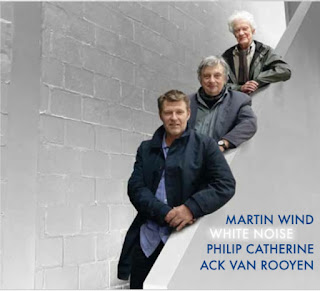
Martin Wind's "White Noise" w Philip Catherine and Ack Van Rooyten : A Sound Oasis.

White Noise Martin Wind, Philip Catherine & Ack Van Rooyen, Laika Records

There is a beautiful warmth and sonorous resonance to the work of bassist Martin Wind. I have heard Wind’s playing musically enrich work performed with saxophonist Scott Robinson, the drummer Matt Wilson, the guitarist Ulf Meyer and the pianists' Bill Cunliffe and Bill Mays. The soloist/accompaniest has composed, played, and recorded on over ten of his own leader /co-leader releases including Get It (2010), the orchestral Turn Out the Stars, Music Written and Inspired by Bill Evans (2014), and Light Blue (2018). 

Flensburg, Germany born Wind graduated from the Cologne Music Conservatory in 1995 where he studied with orchestral bassist Wolfgang Guettler. He placed 3rd in that year’s Thelonious Monk Bass Competition in Washington. At the age of seventeen, Wind was exposed to the work of Belgian guitarist Philip Catherine in a duo with the iconic Danish bassist Niels-Henning Ørstead Pederson on their album The Viking and the Dane’s bass work left a lasting impression. Wind came to the US in 1996 where continued studies at NYU earning a Master’s degree in jazz performance and composition. His bass work has a distinctive orchestral influence. His large, warm sound and inherent sense of rhythm deftly anchor any work that he performs, and he can employ a gorgeous arco technique at will. 

Philip Catherine, Ack Van Rooyen and MArtin Wind

Wind realized his wish to play with the respected guitarist Catherine in 2013 when the duo recorded their first album the duo New Folks. The latest release White Noise is an attempt by Wind to create a “Kind of sound oasis.” His goal “In a world where silence is becoming more and of a luxury, I wanted to create a little acoustic opposite pole.” The album succeeds and it is in no small part due to his two seasoned bandmates. Wind is the youngest of this trio at fifty-two, with Catherine at a sprite seventy-seven and Van Rooyen as the elder master at the age of ninety! 

Wind opens a Kenny Wheeler composition “Canter” with a vibrating arco opening that resonates with overtones and emanates with a visceral yearning. A gorgeous melody, Catherine’s gentle touch, and Van Rooyen’s mellow-toned flugelhorn lead the listener to this magical world of calm and beauty, as Wind sustains the gentle rhythm of a canter. A rewarding respite to another world of tranquility and beauty. 

Cole Porter’s “Everything I Love” captures a nostalgic time when a good song and some swing could take you to a less strenuous time. Van Rooyen's horn is mellow and bubbly, and Catherine’s guitar adds some offbeat licks that surprise. Wind’s bass solo is buoyant, cheerful, and swinging. 

Wind wrote the title song “White Noise” with his bandmates in mind. Catherine utilizes some subtle and effective echo and electronics to create the opening that leads you into this unknown territory. The music has an ethereal ECM feel to it with Van Rooyen's searching horn work floating over the soft accompaniment of his bandmates. Catherine’s guitar work here reminds me of some of guitarist John Abercrombie’s atmospheric outings. Despite being able to lose yourself in the clouds that these guys create, you never lose the beauty of the melody that sustains you throughout. 

Van Heusen and Burke’s standard “But Beautiful” is one of two duo features on the album with Catherine and Wind taking it slow and demonstrating a sense of familiar simpatico. Catherine’s playing is just beautiful and a modicum of artistry.

“The Dream” is a moving ballad that Wind wrote for his first meeting with guitarist Pat Metheny when they played together at Jazz Baltica in 2003. Catherine’s gorgeous strumming and Van Rooyen’s plaintive horn work are at top form and Wind’s plucky bass solo work is superb.

Ack Van Rooyen's composition “Autumn Bugle” is a searching, blues-based ballad that features the Dutchman’s warm tone and Catherine’s sensitive accompaniment. I’ve not heard this artist before, but the man's articulation and expressive emotional delivery are especially noteworthy. In the liner notes Wind called Van Rooyen an angel and the nonagenarian jokingly admits to being maybe an aging angel.

Wind wrote the “Genius and a Saint” for a friend and fellow bassist Bob Bowen who had sadly been the victim of a fatal bicycle accident. There is a somber, deliberate sense to this tune initially. Soon Catherine and Wind change the feel enlivening it with more hopeful approach. Catherine's inventive approach offers strumming his guitar like a mandolin, adds some rapid arpeggios, utilizes some beautiful fingered chording, and includes some modulated volume. Wind buoys the rhythm with a more aggressive pace that energizes the mood behind Catherine's expressive adventures.

Wind opens up with a bellowing bass solo on Styne and Kahn’s poignant standard “I Fall in Love Too Easily.” Van Rooyen's flugelhorn spells out the melody before Catherine’s guitar harmonizes the music with his own improvised ideas to end the set.

Van Rooyen and Catherine have lived through a period of time that has given them a sage's perspective of history's vagaries. With Wind, these gentlemen lend their maturity and sensitivity to this project with this music and their artistry. Martin Wind’s White Noise is a welcomed celebration of music that soothes, entertains, and delights in today’s age of uncertainty and tension.

Thursday, April 13, 2017

Interview With Bassist Christian McBride as He Brings His "Tip City" Trio to the Variety Theater, Atlanta

Bassist Christian McBride
Forty-four-year-old bass virtuoso Christian McBride was born in the musical city of Philadelphia back in 1972. It didn’t hurt his musical education to have a father, Lee Smith and a great uncle Howard Cooper who both played bass professionally and he acknowledges them as early influences.

In many respects the sounds of the City of Philadelphia was another subliminal McBride influence. The City has a history of the musical tradition. It was a multi-ethnic training ground for early jazz artists like guitarist Eddie Lang and violinist Joe Venuti. Local singing star Ethel Waters was one of the first black female jazz artists to record on Harlem based Black Swan Records. The stable of jazz artists that hail from Philly is a Who’s Who of American jazz – Jimmy, Percy and Albert “Tootie” Health, McCoy Tyner, Clifford Brown, Hank Mobley, Stan Getz, Jimmy Smith, Bobby Timmons, Lee Morgan and of course “Philly” Joe Jones to name a few.


Philadelphia
The tradition is being carried on by the next generation; musicians like Orrin Evans, Stanley Clarke, Uri Caine, Terrell Stafford and of course Christian McBride all hail from the City of Brotherly Love.

Jazz wasn’t McBride’s only influence, just as jazz isn’t Philly’s only music. There was gospel like the Mighty Clouds of Joy. There was the R & B and soul music of the Delphonics, the Stylistics, Teddy Pendergrass, The O’Jays, Harold Melvin and the Bluenotes. There was even the more blue-eyed, rock and roll soul of the popular Hall and Oates. Let’s not forget the airwaves. McBride grew up in a generation where the funkmaster bassists like Larry Graham of Sly Stone’s Band and Bootsie Collins with James Brown and George Clinton all made their imprint. Seeing the Philadelphia Symphony Orchestra with Yo Yo Mah made for a lasting memory. These disparate sources of musical inspiration all formed the musical psyche of Christian McBride. 

Through hard work and an incredible facility, he has been able to incorporate the whole spectrum of these flavors into his own unique approach to the bass, and in the process, he has attracted a legion of followers that anxiously await his next musical move.

Currently McBride is perhaps the busiest man in jazz. The five time Grammy award winning bassist hosts and produces a NPR/WBGO/JALC sponsored weekly nationally syndicated radio show on Sirius XM radio’s “Jazz Night in America” called “The Low Down: Conversations with Christian.” He is the artistic advisor for the jazz programming at the New Jersey Performing Arts Center (NJPAC.) and has been creatively associated with Jazz Snowmass in Aspen, the National Jazz Museum in Harlem, The Newport Jazz Festival and for Jazz at the Los Angeles Philharmonic program.

With all these commitments, it is a wonder he still has time to create and perform music. He is the leader of four distinct groups, his newest trio Tip City, his quintet Inside Straight, his 18 piece Christian Mc Bride Big Band, an experimental group called A Christian McBride Situation and his quartet New Jawn.

McBride’s Tip City will be at Atanta’s Variety Playhouse on April 29, 2017 and features the young pianist Emmett Cohen and the guitarist Dan Wilson. Notes on Jazz caught up to McBride via telephone on April 11, 2017.

NOJ: I am a big fan of your music probably since the late nineteen nineties. It is a daunting task to interview you. I must have gone through- either read or listened to- close to twenty interviews you had and it’s difficult to come up with questions that you haven’t already answered a hundred times. So I’ll try not to repeat what is already on record.

You hail from Philadelphia. We know your father and great uncle played bass and were influences. But there is a deep, across the spectrum wealth Classical, to jazz, to Reggae, to Soul, Rock and R & B and into Hip Hop that make up the Philly Musical experience. Can you share some of your growing up musical experience that are pure Philly?

CMB: When I think of my live musical experiences, that make me think of pure Philadelphia, I actually think of venues as opposed to the actual musicians. My uncle, Tony McBride, he used to be a promotions man at WHAT radio, which was one of two black radio stations in Philly. So he took me to every show that came through. From the time, I was maybe four years old, so my mother tells me, I was going with them to see Marvin Gaye, Gladys Knight or whoever it was. I remember the venues. We went to the Academy of Music quite a bit. I saw Smokey Robinson there, Wilson Pickett there and of course I saw James Brown there and that just changed my life forever. We went to the Robin Hood Dell quite a bit. There used to be an annual festival called the Gospell-rama and I saw the Mighty Clouds of Joy there. I saw Albertina Walker. Then there was the Valley Forge Music Fair which was a theater in the round. That place was legendary, I am sorry to see it go. It closed many, many years ago.

NOJ: Those experiences are impressionable for a young person growing up.

CMB: Yeah. I saw a lot of R & B and Gospel shows growing up. I saw the Philadelphia Orchestra when I was eleven years old. Our string teacher took a bunch of us down on the trolley. I’ll never forget that. It was just wonderful that we had a teacher that would actually take a group of us on public transportation to go see the Philadelphia Orchestra. Yo Yo Mah was the guest soloist and he played the Haydn Cello concerto in D. That it one of my most vivid memories of seeing live music.

NOJ: That’s very cool.

CMB: I can still remember the piece.

NOJ: So you went to Julliard after attending school in Philadelphia?

CMB: Yes. I only stayed for one year. I started to work pretty quickly after I started school. School started in the beginning of September and I started working with Bobby Watson’s group maybe two weeks later. I wasn’t going on the road, I was just making local gigs with him. It became evident by the end of the school year, that I wasn’t going to be able to keep a good balance of school and professional work. So, I had a long talk with my mother and she said I trust you.

NOJ: Did you take private lessons while you were playing professionally after school?

CMB: Well no, I did not take any private lessons after I left Julliard. Any lessons I did take were impromptu.

NOJ: My first time seeing you perform was 2003 when you were on tour with Pat Metheny and Antonio Sanchez at SUNY Purchase in New York. You three had amazing simpatico, creating a thoroughly engaging conversation at crazy

CMB: I first started working with Pat in 1993. When Joshua Redman’s first solo release came out. It is a little confusing, because Joshua Redman recorded his first two cds at the same time. They kind of staggered the release dates.  The self titled cd Joshua Redman came out first and then less than a year later Wish came out with Pat, Charlie Haden and Billy Higgins. When it was time for Joshua to go on the road and promote that album- now you talk about one of the greatest gifts someone could give you- Pat Metheny basically said Josh I’ll lease you my crew, my booking agency and I’ll come on the road as your guest to promote your record.

NOJ: Wow!

CMB: Yeah, but Charlie Haden couldn’t go on the tour so they called me. The minute we finished all the US tour dates under Joshua’s name, the band just reverted back to Pat Metheny’s.  It was the same exact band except he now called it the Pat Metheny’s Special Quartet. That was me, Billy Higgins and Joshua Redman with Pat.
After that I stayed in close touch with Pat. I played with him sporadically, you know a gig here and there. Then he started the trio with me and Antonio exactly ten years later in 2003.

NOJ: That’s when I saw you. You guys were amazing.

Christian McBride, Pat Meheny, Antonio Sanchez
CMB: Thank you, man. That trio stayed together, we played a good six years of gigs maybe even seven.

NOJ: Pat is obviously a virtuoso on his instrument, but he has turned out to be a pretty durable composer also. What did you take away from playing with such a creative force as Pat for all these years?

CMB: I think of Pat along the same lines as Chick Corea, in terms of their both being so prolific. I mean it is hard to compare anyone
(to Chick),if you think of the body of work that Chick has created over all these years. Certainly, Pat is no slouch. I love the fact that he is always challenging himself. He is always coming up with new groups to play with and he is always coming up with new music for those groups. I think that is admirable.

NOJ: I have the album Live at Tonic from 2006. That was a phenomenal, jazz/funk/fusion group and featured some of my favorite musicians including keyboardist Geoff Keezer, saxophonist Ron Blake and one of our local Atlanta homies, badass Terreon Gully on drums. What was the genesis of that group?

CMB: Around 2000, I didn’t really know where I was as a band leader. My first quartet, which I went on the road with after Gettin’ to It , my debut album, came out in 1995. I had Tim Warfield on tenor saxophone. I had a couple of different pianists. I had Anthony Wonsey, I had Joey Calderazzo, Charles Craig, Shedrick Mitchell, but Tim Warfield was always my guy. My drummers were Carl Allen, Gregory Hutchinson and Rodney Green. Between 1995 and 1999 my quartets revolved around those particular players. Tim Warfield left to go with Nicholas Payton’s group. All the rhythm section guys, by that time, had different gigs. Joey Calderazzo went to work with Branford Marsalis and Greg Hutchinson went to work with Joshua Redman and so I was kind of juggling and struggling to find guys that could simply make the gig.

"I decided, what music was I thinking of doing? And what musicians would be best suited to play that music? For me it all starts with the drummer."

The kind of music which I wanted to play, was a hybrid of straight ahead jazz, a little funk, avant garde you know a little bit of everything. Whose is my prototype of a drummer for music like that. The answer, for me was Jeff ‘Tain Watts. I said let me call ‘Tain and ask him for a recommendation, because I know he’s not going to do it, and I wasn’t going to ask him. He is one of my big brothers, I wouldn’t ask him to join my band. I said ,“‘Tain whose is the little you? I need somebody that plays like you basically.”  He said you should hear this guy, he’s been playing with Diane Reeves, he’s a bad dude. His name is Terreon Gulley. I pretty much hired him sight unseen just because of the recommendation from ‘Tain. We met and we played together and I fell in love with him. The hard part was the piano chair. I wanted somebody that loved Joe Zawinul and Keith Emerson just as much as Art Tatum and Oscar Peterson. I though man there really isn’t anybody who can do all that. Only person I could think of was Geoff Keezer. I knew he was playing with Ray Brown. Geoff is somebody I ‘ve know since Julliard, he is dear friend of mine. We all are from the same generation and we all played the same gigs when we moved to New York. After playing with Art Blakey and playing with Ray Brown, I thought, man this is going to be a significant step down in his career, asking him to join my group. But I have to ask him because he is the only person I can think of. I talked to Keezer and he said I’m not working with anybody right now so I would be honored to be in your band. That was the nucleus of putting that group together. When Tim Warfield left to go to play with Nicholas, the other saxophonist that I loved working with was Ron Blake. Ron was just finishing working with Roy Hargrove and so he was available. Before I knew it I had a brand new working band. It was tight, everybody liked each other, and we stayed together for eight years.

We made the Live at Tonic record and we made the Vertical Vision record. Funny how things work out. The Live at Tonic album was supposed to be my second Warner Brothers release and it was going to be Live at Yoshi’s. But I’m glad it worked out, in terms of what that band did, Tonic was the more appropriate place.

NOJ: It was a hipper place for sure.

CMB: Andy Hurwitz from Rope a Dope records said let’s blow it out and invite some special guests. I called up my buddies DJ Logic, Charlie Hunter and Eric Krasno and those were two memorable, memorable nights of music.

NOJ: Have you ever considered getting that band back together, just for the hell of it?

CMB: Oh yeah. At some point, we will get back together. It’s kind of hard though. The main reason that band broke up was Ron took the job with the Saturday Night Live Band, and that pretty much jams up his Friday and Saturday to work with anyone else but NBC. It’s kind of hard to have a band when one of your main guys can’t work on Friday and Saturdays. Then Geoff Keezer got married and moved to San Diego. Terreon got married and moved to Atlanta. I said oh man, everyone’s leaving me.


ut it worked out, because I think between 2000 and 2008 when that happened, I had that band which we called the CMB band. I was working with Pat’s trio and touring with Sting. There hadn’t been at particular band that I played in that was all acoustic, straight ahead. Kind of what I did when I first moved to town and I missed that. I thought maybe this is a sign that I should try another project and that became Inside Straight.

NOJ: Yeah with Steve Wilson, great player.
It is well documented that Ray Brown was a primary musical influence and a father figure to you. You have his bass, the good one, as I understand it.

CMB: ( Laughing) John Clayton has a good one. We each have a good one.

NOJ: If you were teaching a young student the bass today, what would you tell him to look for in Ray Brown’s playing that is so important to absorb?
Christian McBride and  Ray Brown photo credit unknown
CMB: The feel. The feel and the clarity. As a bassist, particularly an acoustic bassist, I am a stickler for clarity. The bass is a very hard instrument to play with clarity, just because the frequency of the instrument. Especially in jazz. It’s easy   to play out of tune and kind of slip under the radar to the ear. Sometimes notes will run into each other. When there’s drums going and piano going and saxophone going, a lot of what the bass does gets lost. You can still feel the bass but you can’t always hear details of that particular player is playing.

NOJ : So Ray’s clarity is what is really important?

CMB: Yeah. When I listen to Ray Brown playing I hear every single note clear as a bell and they are always in tune, which lets me know his focus never wanes. That’s the first thing I would tell my students.

NOJ: I want to continue that thread and name a few bass players and get your response. What would teach a student was the most important stylistic feature of the playing of a Bootsie Collins or Larry Graham?

CMB:  I would kind of hold off on talking about them to students. To me, Bootsy and Larry Graham were the innovators of the electric bass. I would make sure that my students would understand something a little more simple and basic before I would get them to Boosty and Larry Graham. 

Bootsy Collins photo credit unknown
The story goes, which is true, that the whole time Bootsy was in James Brown’s band, James Brown was always trying to get him to play simpler. He’d say “Bootsy these bass lines that you’re playing are too busy, they move around too much, I just need something simple and in the pocket.” Boostsy would say “yes sir Mr.  Brown” and come up with this complicated but funky bassline, and James Brown would just shake his head. It just meant that Boosty’s talent was so big, not even James Brown could hold him down. As hard as he tried.


I would just tell a student to try to pay attention to the simplicity. The same is true when listening to Ray Brown, because although Ray Brown was a virtuoso, your prime directive as a bassist is to be the best supporting instrument you can be. Play simple and always pay attention to the groove.
NOJ: How about Paul Chambers or Scott LaFaro?

CMB: I think they all have the same qualities that I love in Ray Brown. Paul Chambers had a more relaxed beat than Ray Brown. Ray Brown was always pushing and I kind of like that personally. He always kind of had his foot a little bit on the gas pedal, whereas Paul Chambers was on cruise control, you know what I mean.?

You could set the tempo and he just laid there and the groove was so, so good. He was just as much of a virtuoso as Ray Brown. Had just as big a sound as Ray Brown, his note choices were just as clear as Ray Brown. I think the only difference between the two of them was their beat. Ray was a little more forceful and ahead and Paul Chambers was more right in the middle.

Scott LaFaro, well we all know what his contributions were to the acoustic bass in terms of being a more interactive player, as opposed to just simply being a four to the bar kind of player. Of course, he could do that too. If you listen to very early Scott La Faro recordings, particularly what he did with Hampton Hawes. The album with Harold Land and Frank Butler, For Real it’s called.  He sounds like Ray Brown. Also on Introducing the Victor Feldman Trio with Victor Feldman on piano, Scott LaFaro on bass and Stan Levey on drums.


It’s clear Scott LaFaro knew the basics of what it meant to be a bass player. He could hold it down with the best of them, but then when he got to Bill Evans, he found his perfect musical partner where he didn’t need to be just playing bass lines. He was interacting with Bill Evans quite a bit and his technique was such that he sort of broke the mold. In the sense that every bass player thought “I want to develop my chops too, I want to play fast.” I am sure if Scott La Faro had lived he would have said “Hey guys, learn how to walk first, develop your sound, before you try to play fast.”  

NOJ: With all the many hats that you wear, you have a very serious, kickass big band, which I saw one year at The Caramoor Jazz Festival in 2011. You have written for this band as well as for other large ensembles. 

Most modern big band arrangers like Maria Schneider, Ryan Truesdell, Bob Mintzer or James D’Arcy Argue all have been under the tutelage of a former master arranger like Gil Evans, Gerald Wilson or Bob Brookmeyer.

Who do you consider your mentor when it comes to arranging for a multi-piece ensemble and how did it start for you?

MCB: A lot of people. I think I have gotten a lot of help from everybody that has written for a big band. I’ve spent a lot of time with Jimmy Heath. My big brother John Clayton is one of my biggest heroes. I’ve spent time with Maria, picking her brain about certain things. I love Maria so much because she has a lot of her own great ideas, but also she studied under Gil Evans. She would tell me somethings that Gil told her. 

"You almost physically feel your body change when someone gives you some useful information that you know is going to help you."

Maria and John and the great Patrick Williams, Johnny Mandell and Lalo Schifrin, who I’ve been on the road with many times with his Jazz meets the Orchestra projects. I’ve spent a great deal of time with many great arrangers.Yeah.

NOJ: So you have absorbed all these ideas of different arrangers from your experiences with them?

CMB: Absolutely.

NOJ: Any arranger that you are particularly fond of?

CMB: There is Ellington of course, he goes without saying. But I think the first arranger that I really started to pay attention to was Oliver Nelson.

NOJ: I saw your trio with Christian Sands and Ulysses S. Owens Jr. at a small supper club called Alvin & Friends in New Rochelle, NY back in June of 2014. You were a bit under the weather that night, but somehow you rose to the occasion and that trio was simply mind blowing. What do you have in store for that trio?

CMB: That was a good show, I remember that. That trio is sort of officially non-existent at the moment. Christian is about to embark on his own solo tour.  I am extremely happy for him, he wound up signing a solo deal at Mack Avenue records. His new cd will be released in two weeks in fact. He’s going on the road this year with his own group. I’m just happy to be a part of that young man’s life, because he is a very special guy.

NOJ: The Sands, that’s quite a family. I saw him in New Haven and I think he has a brother who is a helluva drummer.

CMB: That’s right, a younger brother Ryan, who plays drums. The family unit is a tight unit.

Ulysses is doing quite a number of different projects with a lot of different people so I don’t know when that trio will ever get back together again. I already know that Christian will be one of those people who will never be out of my life. Even when Oscar Peterson and Ray Brown no longer played together in an actual trio they still played together all the time in various All Star projects and things like that. I see Christian and I doing that.

NOJ: You’ve won five Grammies and been on over 300 hundred recordings as a sideman, thirteen recordings as a leader. What’s missing for you musically? What do you feel you haven’t yet accomplished as a musician?  

CMB: I hope one day to be able to…I feel like I am always composing on the fly. I haven’t really had a chance to sit down and actually focus on writing music that I would like to write for me. I’ve been doing a lot of commercial writing, in terms of like there is a big engagement coming up at NJPAC or Jazz Museum of Harlem or Jazz House Kids and I have to get some arrangements for specific events.

In terms of my own groups, I’d like to maybe once a year go on a writing retreat. I actually spoke to Metheny about that. He said, even when he’s off the road and at home, he can’t write at home, because he has got kids and there is too much going on in his home to concentrate and write. Pat takes a moment where he gets away to his second place and gets to write. I talked to JJ Johnson’s wife and she said JJ used to do that too. I need to go somewhere for like a week and just bang out some new music. I would like to do that one day.

NOJ: They do have artist’s colonies where they allow and subsidized artists of worth who need a place of quiet to work. I know there is one in Connecticut and one in Vermont.

CMB: Yeah. Melissa and I took a vacation on Vancouver Island and the place we stayed, it was beautiful. They call it a Bed and Breakfast, but it was huge. They had a grand piano in middle of the lobby and I thought oh man this is perfect. The perfect atmosphere for me to sit down and write some music. But, you know, I couldn’t use our vacation as a writing retreat. That wouldn’t be fair to Melissa.

NOJ: That would put you in hot water pretty quickly, I think.

CMB: Exactly!

NOJ: You have played bass behind singers like Diana Krall, Queen Latitfah, Sting and I actually got to see you play with Dianne Reeves a couple of years back. How is it different from playing without a singer and is it a format that you like?

CMB: I love playing with great singers. Playing with Dianne is no different than playing with a great instrumentalist. For me Dianne is sort of like the greatest living jazz vocalist. Everything she does is awe inspiring. She is very musical.

 
Dianne Reeves and Christian M
Diana Krall, we both come from the same Ray Brown School. Dee Dee Bridgewater, not only is she a great singer, but she is also one of the great performers I’ve been on stage with. It can get distracting watching her. She’s so bad, she is so badass that I sometimes almost forget it’s my cue. Cyrille Aimee, that young lady is killing it. I love working with her. Man, there are too many people I can name.

NOJ: Speaking of vocalists, I did a recent interview with the fine vocalist Jose James and he told me he was trying to get you to do a record with him in the near future. If Jose is reading this, is that something we can expect?

CMB: That’s my man too. Yes. We have worked quite a bit in the past and I love working with Jose.  I’ve always felt there hasn’t nearly been as many male vocalists that we’ve been excited about as there have been female vocalists. I have been thinking where are all the guys? All the guys that are really kind out there doing it, they all eventually just start to sing R & B. Or they kind of go for some sort of hybrid, which is cool, but I miss somebody like a Joe Williams or….

NOJ: But even Jose is trying to break out of that jazz crooner pigeonhole. His new album is much more R& B and neo soul.

CMB: Even though Jose is not wedded to straight ahead jazz, he can do it so well. It is a pleasure to see a guy with so much diversity. 
Jose and I have a couple of things possibly in the pipeline. We just have to figure out the when, that’s always the hardest part. Jose is one of my favorite musicians in the world. That’s a guy who can go a lot of different ways. I mentioned how I miss the guys, I don’t see a lot of guys out there singing a lot of jazz.  I wrote some big band arrangements for him a couple of years ago, we did a thing at NJPA, and he sang my arrangement of “Moanin’”and oh man he killed it.

NOJ: He had a great album with that Billie Holiday material. When we spoke, he indicated it was a sort of pinnacle for him in the jazz genre.

CMB: Yes, he did. Man, I was so proud of him when he did that record. That was an amazing project.

NOJ: On a philosophical note, you seem very driven, what could you see yourself dedicating the rest of your life to if for some reason you couldn’t play music again?

CMB: Sleep. (Laughs) No education.
"I think it’s important to share your knowledge."
It weirds me out when I meet people who are tight with their information. I know some musicians who don’t want to impart some of the wisdom that they have gotten from older musicians, because they think that someone may take it and it will no longer be special to them specifically anymore if they share it. If I tell you a story or share something with you that Ray Brown told me, then 'am going to be afraid that you’ll take that story and try to make it yours? To me that is sort of selfish.

If I couldn’t play music anymore, then I would dedicate my life to of these young musicians that are coming up. More than I do now.

NOJ:  You’ll be playing with your group Tip City here in Atlanta on April 29, 2017. What do you like or don’t like about playing in Falcon, Braves and Hawks territory?


MCB: (Laughing.) There is nothing that I don’t like about playing in Hawk or Braves land. I hate to see the Braves going through such hard times, but you guys have had such a long run, so maybe I really don’t feel so bad for you.


I know a lot of people in Atlanta, a lot of musicians and I don’t feel like a stranger there.

NOJ: Tell us about Tip City, who is in that band and what we can expect at the concert.

CMB: There is young pianist by the name of Emmett Cohen and the guitarist is Dan Wilson, he plays with Joey DeFrancesco quite a bit. I’m looking forward to working on this new project. A group that is nothing like my previous trio, but also nothing like my New Jawn project either. I like to stay as fresh as possible.


NOJ: What do you expect these young musicians will bring to the table?

CMB: The first time I played with Dan Wilson, he knocked me out. He comes form that lineage of George Benson, Pat Martino, Kenny Burrell school. He’s got such great technique with great ideas and he swings real hard.

Emmett Cohen I sort of watched grow up. He is from the Montclair area and was one of the students that we had at Jazz House Kids. This will be sort of like a good hometown story.

NOJ: I know you are also very involved in your home community of Montclair, New Jersey, where your wife Melissa founded Jazz House Kids, a nationally recognized community based arts organization. Tell us about what you guys do there and how this started?

CMB: She started this fifteen years ago because most of these school, not just in New Jersey, but nationwide, were getting rid of their music programs. She was getting hired to put together musicians to come into public schools in Newark to do some music programs. She realized she should her own organization to put bands together to come into these schools. Next thing she knows Jazz House Kids turns out to be a big hit.

NOJ: That’s very commendable. It’s what we need more of now-a-days as it is clear that the present political climate is not too favorable to promoting the arts in our public education system.

CMB: Between grants and private donations, we are able to keep this thing going qand we serve over a thousand kids in the State of New Jersey during the school year. We have up to two hundred and fifty students come to our summer program. It’s been real fulfilling to watch some of these young people to get to express themselves.

NOJ: Christian, I look forward to seeing you and Tip City at the Variety on Saturday April 29th here in Atlanta and will continue to follow your multi-dimensional career, which I am sure will have a lot of surprises ahead. Thanks for spending the time with us.