Showing posts with label jazz fusion. Show all posts

Saturday, May 2, 2026

Tigran Hamasyan: Manifeste- Introspective Music as a Path to Self-Discovery


Tigar Hamasyan: ManifesteNaïve Records 


The Armenian born pianist Tigran Hamasyan has been a bit of an outlier.  He played rudimentary music on his family piano from the age of three and was in music school from the age of six. By the age of nine Hamasyan was immersed in jazz, but he was also highly influenced by the abrasive power guitar sounds of thrash metal! The man is a bit of an enigma; not a pure jazz pianist in the traditional sense, but a prolific improvisor. He is armed with the weapons of dexterity, skill, classical piano training, Armenian folk music influences, deftly using his voice instrumentally, and his own brand of fusion-inspired, prog-rock jazz, peppered with electronica. The pianist/composer is a percolating caldron of musical creativity that can inspire you with his pure talent and acumen and yet surprise you with his unpredictable excursions. If you listen to what this artist has already said in interviews, you get some insight into what is driving this man. Hamasyan once said “When I solo, I tend not to think of myself as a pianist.” He also has a seemingly unsatiable appetite for music from many disparate styles and origins. “I get into different types of music and really immerse myself in each one and then I move on…” These inclinations and the strong identification with his culture and its indigenous music remain driving forces that motivate his creativity.

At the age of 16, Hamasyan went to California to study and became entrenched in the LA jazz scene.  I was aware that Hamasyan won the prestigious Thelonious Monk International Jazz  Piano Competition back in 2006 at the age of nineteen, edging out Gerald Clayton and Aaron Parks! My first exposure to the pianist was from his well-received Verve album Shadow Theater from 2013. This album scratched the surface of the creativity that this composer and his musical mind held. The music was powerful, ethereal and different. The pianist utilized elements of jazz, prog rock, Armenian folk music, creative choral voice work and a deft use of strings and woodwinds. I was hooked by this man’s vision.


The latest album, released on Naïve Records on February of this year, is titled Manifeste and offers fourteen compositions that the artist uses as a vehicle for exploring into and discovering himself.

Hamasyan plays piano, synth, synth bass, drum programs, whistles, and provides vocals. He is joined by Nick Lierandi on guitar, Marc Karapetian on bass, and four different drummers- Mark Garskta, Arthur Hbnatek, Arman Mnatsakanyan and Nate Wood. There are also guest appearances by trumpeter Daniel Melkonyan on “Yerevan Sunrise” and “Years Passing (For Akram), Evan Marien plays bass on “Dardahan” , Agtghik Mamikonyan adds her voice on “Per Mane ( E Flat Venice Song)” and the Yerevan State Chamber Choir provide their angelic voices on  “One Body, One Blood” and “National Repentance Anthem.” The production of this project is obviously no small task. It speaks volumes about the details and thought that Hamasyan invests into the creation and execution of his multi-layered music.

Manifeste is a lot to process. Can this music be assigned to a particular genre? Not likely in my humble opinion. But if you marvel, as I do, at the process of a fertile, creative mind exploring the possibilities of musical expression, then you can clearly not ignore this man’s offerings.

There is much to be listened to like the restless prog rock-drive of the opening number “Prelude for All Seekers.”   The gorgeously swelling sounds of “Yerevan Sunrise” as Hamasyan layers multiple electronically generated aural colors and his synched-in whistling into his musical landscape. Daniel Melkonyan’s trumpet adds another element to this one as Hamasyan’s rhythmic vibe carries the pulse in tandem to Hnatek’s intuitive trap work.

The title cut “Manifeste” revels in Hamasyan’s powerful ostinato opening before the pianist is joined by Karapetian’s throbbing bass, Mnatsakayan’s syncopated drums and Tigar’s haunting overlayered vocals. The music has a foreboding feel to it. There is drama and it conjures up Black Sabbath and Emerson Lake and Palmer coming to my mind.

“One Body, One Blood” finds the pianist creating a hauntingly repeating theme upon which he incorporates the gorgeous, celestial voices of the Yerevan State Chamber Choir and the electronics and drum programming of Arthur Hnatek.

“Seven Sorrows” opens with clanging church bells over which Hamasyan plays some beautiful repeating piano flourishes. Artyom Manukyan’s cello adds some poignancy before the pianist adds his own fluid, chicanery of exploration including some Jarrett inspired moans. Mnatsakayan’s propulsive drum work is on display before Manukyan’s cello reenters and Hamasyan’s voice matches the cellists bowing in an moving and eerie coda.

“Years Passing” is a song dedicated to British/Bangladeshi choreographer Akram Khan. Hamasyan composed the music for Khan’s 2014 dance production iTMOi  (In the mind of Igor) a celebration of Stravinsky’s music. The two have a rhythmic connection that the pianist seems to have reflected on in this composition. The music features a beautiful repeating theme that Hamasyan plays on piano and that is supplemented by a searching trumpet solo by Melkonyan.

“Dadanhan” is a fusion-like song that features Hamasyan’s synth work and his tracking, almost primal vocals. Marien’s electric bass work and Hnatek’s explosive drum work complete this trio.  

“War Time Poem” has a heavy metal fierceness. Led by Hamasyan’s relentless and almost frantic synth work and Lierandi’s guitar, the band is rounded off with Karapetian on bass and Garstka on drums.

“The Fire Child” (Vahagn is Born) is a reference to the Armenian god Vahagn who by legend was born from a splitting reed in a fiery cosmic birth. The origin is as an Indo-European warrior god that is a dragon killer. Hamasyan’s music is like a chant. The pianist plays all the electronics and overdubs his vocals to the music unassisted. There is a ceremonial reverence to this Armenian mythical tradition that the artist expresses here touchingly.

“Ultradance” is a composition that transposes driving prog rock pulses in contrast to lyrical folk-inspired rifts. The music is driven by Nate Wood’s drums and Karapetian’s throbbing bass working in conjunction with Hamasyan’s repeating synth and piano lines.

 The remaining album includes “Per Mane (E Flat Venice Song) featuring the voice of Agtghik Mamikonyan and some agitated piano work by Hamasyan.  “A Window from One Heart to Another” a song inspired by the work of the poet Rumi, featuring the percussionist Hamin Honari and Blul (wooden flute) played by Yessai Karapetian. “A Eye” (The Digital Leviathan) is an ostinato-driven piece with Lierandi’s singing guitar, Hamasyan’s slashing synths, and Karapetian and Garstka supplying rhythm.

The final composition is “National Repentance Anthem” which opens with Hamasyan’s tinkling piano entre setting the stage for the Yerevan State Chamber Choir to enter tracing the music’s somber melody. Manifeste seems to culminate the theme of self-exploration, revelation and catharsis that Hamasyan is exploring by his creation and performance of this music.

Wednesday, August 20, 2025

Béla Fleck, Edmar Castañeda and Antonio Sanchez Defy Genres on "BEATrio"


BEATrio-Béla Fleck, Edmar Castañeda and Antonio Sanchez- Fleck Productions

The American Banjo master Béla Fleck was born in New York City in 1958. His full name, Béla Anton Leoš Fleck, is a combination of three of his father’s favorite classical composers, the Hungarian Béla Bartok, the Austrian Anton Webern, and the Czech Leoš Janacek. With such a namesake imposed on the young Fleck, there is no wonder why he has found his path creating a new level of respectability for his unlikely instrument through his inventiveness, imagination and virtuosity.


Fleck didn’t take up the banjo until he was fifteen, after a failed run at mastering the French horn. He was initially inspired by the bluegrass sounds of Earl Scruggs that he heard on the theme of the show The Beverly Hillbillies which ran on national television from 1962 through 1971. The song “Dueling Banjos” which was played for the 1972 film Deliverance by Eric Weissberg and Steve Mandell also made its impression.

Never satisfied with just brilliant mastery of his six-string acoustic/electric banjo, or with the artificially created boundaries that limit the banjo to its bluegrass roots, the genre-bending Fleck has envisioned expanding the possibilities where his instrument could be creatively used and succeeded.

Over the years, Fleck went beyond his bluegrass projects that included his groups like Tasty Licks, Spectrum and New Grass Revival, and his duet project with mandolinist Chris Thile. In 1988 he formed his jazz/fusion/Americana inspired group Béla Fleck and the Flecktones with Howard Levy, Victor Wooten and Roy Wooten. Despite many sojourns along the way, the group is reuniting this season, now celebrating close to forty years of collaboration. Fleck would create classical projects, like his double concerto for banjo and bass with bassist Edgar Meyer, where the two played their debut with the Nashville Symphony Orchestra. Béla also created a trio concerto for the Nashville Symphony Orchestra, this time with bassist Meyer and the late table master Zakir Hussain. Insatiably driven to create for his instrument and to obliterate boundaries, Fleck collaborated and toured with the late piano master Chick Corea on three duet albums, "The Enchantment", the live recording "Two" and "Remembrance" between 2015 and 2024. With all this on his plate and an astounding nineteen Grammy awards under his belt, Fleck has time to have a continuing banjo duet collaboration with his wife and fellow banjo player/singer-songwriter Abagail Washburn. These two artists are also parents and are raising two sons in the Nashville area.

Antonio Sanchez, Edmar Castañeda, Béla Fleck 

Fleck’s newest group collaboration BEATrio is an acronym for the members first names, Béla, Edgar, and Antonio. Edgar is the Colombian harpist Edgar Castañeda whose has leant his brilliant virtuosity on this instrument to jazz and pop projects that featured Wynton Marsalis, Paquito D’Rivera, John Scofield and Sting. His heavenly harp work can also be heard on the Disney animated film Encanto from 2023.

Antonio Sanchez is a fluid drummer/percussionist, originally from Mexico City, whose work has previously been seen as a member of guitarist Pat Metheny’s Trio 
with bassist Christian McBride between 2005 through 2008. He has also worked with the late pianist Chick Corea, with rockers Trent Reznor and Dave Mathews, and has composed and played the drum-based musical score for Alejandro Iñárritu’s 2014 film Birdman.

This latest project, BEATrio, is just one more piece in the genre-defying puzzle that seems to drive Fleck’s musical aspirations. He has said that it is often rhythm that drives his playing, and he is often aware of how an orchestral scope to his work makes it more expansive. These elements are clearly on display on this collaborative album.

There is a global feel to this album. The three instruments seem to melt together in a symbiotic, organic way. There are elements of bluegrass, jazz, fusion and world music on display on this album. It’s a cultural feast of styles, sounds and colors that can’t be ignored.

The opener “Archipelago” sways with a Latin inspired feel. The rhythmic drive comes from a bass line that is maintained by Castañeda’s facile left hand and Sanchez’s deft percussive accompaniment. Fleck’s melodic banjo weaves in and out like a hummingbird quickly hovering over the nectar flower of the enticing melody. Just beautiful.

The group got a chance to work out some of the kinks on this mostly collaborated music when they performed at NYC’s Blue Note Jazz Club in 2024. “Each night felt like an adventure,” says Castañeda, “and it was special to see the audience experience the music’s evolution.”

“Pellucidar” is a stop/ start piece that seems to have the feel of theme to a detective mystery. Sanchez’s cadenced drum work and Castañeda’s harp create the stepped rhythm as Fleck’s banjo dances across the floor. Castañeda’s harp has a weightless feel as he explores the tonal possibilities of his instrument. Sanchez is particularly creative in his rhythmic magic that he skillfully manipulates seamlessly.

“Kaleidoscopes” is exactly that, a rhythmic and tonal Kaleidoscope that has an Afro-Caribbean dance feel. The trio move in synch with virtuosic sections that show joyous and impossibly fleet lines from three artists at the top of their game. Fleck’s Banjo lines are clean, precise and Castañeda’s harp hums with celestial buzz. Sanchez’s trap work is perfectly timed and explosively expressive. If this doesn’t raise your pulse, then see a doctor.

“Countryside” perhaps comes the closest to Fleck’s bluegrass roots, but even with a name like Countryside, Castañeda’s harp, Sanchez’s drum work and Fleck’s otherworldly banjo makes you believe this music is at home at a location that could be anywhere in the world. A feast of music cultures, colors and ideas combined so skillfully that it is a class by itself.

“Cloak and Dagger” is the most cinematic of the compositions. The music walks you through a scene of suspense and mystery. You feel you are sneaking around trying your best not to being discovered by the evil forces. Fleck spells out the theme and Castañeda has the dual role of bass lines from his left hand and harmony with his right hand. Castañeda eventually gets a chance to show his own expressiveness when he trades ideas in a give and take with Fleck. Sanchez takes his turn to make his own percussive statement close to the coda. This one is fun!

“Whispers of Resilience” opens with some slow, softly played string sounds from Castañeda before being matched by Fleck’s banjo strings. The trio create a wispy, hushed approach to creating the almost whispered, repeating melody. The three slightly intensify their playing in a sustained tonal approach to a simple melody. The cut seems to strangely end abruptly on my copy.

The album continues with “Coda” and its repeated, descending Banjo lines that send us to a peaceful place with sensitive playing by Fleck and some shimmering cymbal work by Sanchez. Castañeda maintains a steady bass line that anchors the piece.

“Walnut and Western” could easily be a theme song to a whimsical spaghetti western. Castañeda’s harp projects with sounds that seem to be from a fairy tale and Sanchez’s adds propulsion and fire. Fleck’s banjo creates a sustained whirl of sound, the armature of this song’s structure.

As the title implies, “Three Is Not a Crowd” is almost like a proclamation about how these guys feel playing together. The three work in synch, repeating each other’s line like musical Swiss movements. They change up the rhythmic time effectively always keeping the listener on their toes. Fleck and Castañeda exchange improvisational ideas like they share the same mind and Sanchez maintains a rhythm that just ebbs and flows as the music requires.

The album ends with “Hooligan Harbor” a stirring collaboration that has a driving beat that has some of the audaciousness of Irish folk music. You feel yourself getting up and doing a jig. Castañeda’s harp almost does a bass solo before allowing the higher register of his instrument to cover you with a blanket of joyous plucked notes. Fleck, always at his best when in his element, plays with vigor and panache that often accompanies Irish folk or dancelike bluegrass style music. Sanchez offers a powerful solo with rolling tom-tom and splashing cymbal work that just kills it.

“Touch and Go” is a bluegrass inspired hootenanny. Castañeda creates waves of flourishing notes against Fleck’s bubbling banjo and Sanchez creates the percussive counterpoint. Get ready to kick up your heels.

Tuesday, October 15, 2024

Jenny Scheinman's: All Species Parade: Appreciating Our Relationship to Nature

Jenny Scheinman: All Species Parade: Royal Potato Family

The master violinist/composer/arranger Jenny Scheinman has released her latest musical gem, All Species Parade, on October 11, 2024 out on Royal Potato Family. For Scheinman fans, its been a long five years since the violinist and her then co-leader  drummer Allison Miller,  released their successful Parlour Game in 2019. But by all accounts the wait has been worth it. The album is a twelve composition, polymorphous, two-cd effort that gets its inspiration from Scheinman's return to her Pacific Northwest's roots in her Humboldt County, California home in 2012 after leaving a prolific career in the New York City area. Scheinman is the product of a folk-inspired, nature-immersive upbringing that has made an indelible tattoo into her musical psyche. Her sound has found its way into collaborations with such diverse artists as Lucinda Williams, Norah Jones, Ani Di Franco, Joni Mitchell ,Lou Reed and the metal band Metallica. 

As a youth in what is still called the "Lost Coast," hundreds of miles north of San Francisco, and in the western most location in the United States, Scheinman studied violin and piano. She attended Oberlin Conservatory and graduated from U.C. in Berklee and Santa Clara. As a young artist who moved to NYC, she found herself joining guitar wizard Bill Frisell on a fourteen show run at the Village Vanguard in 2002. Frisell has since become a frequent collaborator. 

On this release, All Species Parade, Scheinman is joined by a stellar cast of like- minded musicians who together help make her vision into a reality. The group includes guitarist Frisell, the pianist Carmen Staaf, the intuitive roots inspired rhythm section of bassist Tony Scherr and drummer Kenny Wollesen and guest artists guitarist's Julian Lage on three songs and Nels Cline on two others. 

Scheinman's vision for this album was inspired by "...a charged relationship to nature, a feeling of being part of something bigger than ourselves, powerful, fragile and constantly changing..." 


Jenny Scheiman and Bill Frisell (photo credit unknown)

The music is eclectic, fluid and spans across genres. The opener, "Ornette Goes Home" is a bouncy, playful, mixture of down home fiddling and free jazz. Scheinman's violin is vibrant, somewhat off-center and swings as Staaf's piano melds brilliantly with her in emphatic communication. Frisell's intuitive guitar work is on point as Scherr and Wollesen create a liquid rhythmic background that swells with organic feel and vibe. Pure joy.

If your a fan of cinematic music then look no further than the "Every Bear That Ever There Was" a song that reminds me of Henry Mancini's "Baby Elephant Walk" from the movie Hatari of 1962. Scheinman's violin spells out the melody in a Stuff Smith inspired take, as the piano, bass and drums spell out the cadenced, processional direction. You can't help but feel that as your listening to this one, you might look down and see some bear prints staining your hardwood floor.

"Juroujiji" is a part of a three song suite along with "The Sea Also Rises" and the title composition " All Species Parade." "Jurounjiji", a song dedicated to the  Northern California based native American Wiyot tribe, opens with a plaintive piano line by Staaf and features some gorgeously intuitive acoustic guitar work by Julian Lage over some shimmering cymbal work by Wollesen and pulsing bass by Scherr. Scheinman's sorrowful violin accentuates the somberness of the music as Lage's guitar explorations float in the ether.

"The Sea Also Rises" is at less than two minutes, the shortest of the compositions. It features Staaf's piano meanderings as Wollesen's percussive accents. 

"All the Species Parade" creates a slow, soulful groove that has you bopping your head to the beat with Frisell's twangy guitar sending out electrical waves of accent into the atmosphere. Scheinman's violin strings are plucked and bowed creating a tension and release that encourages your body to respond in like. The sounds weave together in a fusion of colors, feelings and emotions.

"Shutdown Stomp" is a cross between a hoedown and a gypsy jazz jam with Lage's acoustic guitar again entering as a foil to Scheiman's violin and Staaf's honky-tonk piano work. 

"House of Flowers" is a pastoral piece that features Scheinman's evocative violin, Staaf's ostinato piano work, and Nel Cline's delicate electrical guitar explorations. There is an Americana feel to this one. Music that wraps you in a blanket of welcoming sound. Scheinman's violin is most fluid here with a sinewy attack that is most engaging as it interacts with Cline's ethereal electric offerings.

Where there are waves there will always be surf and on the Lost Coast's Cape Medocino so there is surf rock. On "Cape" the group create a surf music groove that rocks out. Wollesen's drums open this one up with a relentless drive as Scheinman's violin, Frisell and Cline's electric guitars, Staaf's piano and organ,  and Scherr's bottom keep this one from letting up.

The north coast is known for its sun bathing sea lions on the rock formations that pock along the Pacific North West shoreline. "With the Sea Lions" Scheinman is paying homage to these majestic creatures in their home habitat. She creates a cosmic composition without adding herself to the mix. Frisell provides his magical, otherworldly guitar wizardry that offers an  peaceful, cloudlike atmosphere that represents how much beauty and tranquility these creatures bring to us who can just stop, observe, respect and enjoy. Wollesen's sympathetic cymbal work is a treat and Staaf's piano accompaniment is majestic and yet subtle. 

The album ends with gorgeous "Nocturne for 2020" which is an elegiac reflection on the turmoil and stress that we as a nation and a planet had to live through during Covid. Scheinman's violin brilliantly expresses sorrow and lamentation with select lines that eek with empathy. Lage's sensitive finger picking and guitar solo is at its best. The music has a distinctive Flamenco inspired feel to it. There is a exquisite support from the entire crew of Staaf, Frisell, Scherr and Wollesen. 

Saturday, March 26, 2016

Evolution of a Giant: Larry Young in Paris the ORTF Recordings

Larry Young in Paris The ORTF Recordings Resonance HCD-2022
It is not hyperbole to say that Larry Young was perhaps the last great innovator on the Hammond B3 organ. His trailblazing fusion work with Tony Williams, John McLaughlin, Miles Davis, Carlos Santana and as a leader in his own right would all be part of a seemingly un-matchable legacy that catapulted the organ from the confines of the groove to limitless possibilities of the stratosphere. Tragically he passed away at the age of thirty-eight while being treated for pneumonia, but it leads one to speculate on the endless possibilities his continued development would have brought to the music has he lived.

Thankfully, producer Zev Feldman, of Resonance Records along with executive producers Michael Cuscuna and George Klabin, uncovered this gem of a discovery at the INA (Institut national de audiovisual of France) which oversees the RTF/ORTF (Radiodiffusion-Television Francaise and Office de Radiofussion-Television Francaise) archives that document an important part of his development as a player. This beautifully packaged two-disc set captures Young in Paris sometime between 1964 and 1965 and features a series of ten songs played with different line ups and broadcast over French public radio.

Importantly it marks the period just preceding Young’s Blue Note Years and you can hear the sound that Young was developing, one that would later be honed with such precision on the groundbreaking album Unity. Young, just twenty four years old during these recordings and  is predominantly a sideman on these sessions; a key figure in tenor saxophonist Nathan Davis’ quartet along with fellow Newark, New Jersey band mates Woody Shaw- an amazing nineteen years old at the time- on trumpet and Billy Brooks on drums. These are inspired young black musicians in a pivotal time for Black Americans, ogether these guys just cook, driven by Young’s pulsing B-3 moan and Brooks relentless traps. The music is electric like on Davis’ “Trane of Thought,” which shows how well Young’s left foot bass line could just drive the rhythmic heartbeat of the band. Woody Shaw’s fabled intervallic leaps are on grand display and saxophonist Davis shows his strong Coltrane influence.

The band is also featured on two Woody Shaw compositions the driving “Beyond All Limits” and quirky “Zoltan.” The first a skillful demonstration of tight group interplay-clearly owing a debt to the Blakey legacy- with Davis’ muscular tenor voice leading the way and Shaw’s sinewy trumpet lines weaving in and out of complex phrases. The rhythmic surety of Young and Brooks surge is like the endless splash of waves on a beach. When Young solos, his deft use of pull bars and masterful harmonies show the man’s unerring sense of time and space.  On “Zoltan” the cadenced opening by Brooks is reminiscent of a military march. This is a live recording and the energy level is palpable. Young and Brooks lay the modal groove over which Davis-sounding more like Rollins here- and Shaw soar in opposing statements of acclamation with fury.  Shaw is particularly kinetic in the higher register having at times a decidedly Gillespie-like sound to his horn. After a long Shaw solo, Young finally gets his chance to shine playing at first with a restrained, almost muted sound before skillfully adjusting his pull bars to create a wail of urgency that brings the entire song up a notch in intensity. This leads the group into a frenzied exchange with Shaw, Davis and Brooks all trading licks in a flurry of excitement and drama that is just a marvel to behold.  

The Nathan Davis Quartet circa 1964 Photo Credit Jean Pieree Leloir
The group is expanded into the Jazz aux Champs-Elysees All Stars with the addition of French players. Tenor saxophonist Jean-Claude Forhrenbach, trumpeter Sonny Grey, and pianist and leader Jack Diếval, along with Italian drummer Franco Manzecchi and conga player Jackie Bamboo.   Together they tackle Young’s bopping “Talkin’ About J.C.” with a joyful abandon. The extended front line is fluid and precise as they navigate tune’s head. The solos flow solidly throughout. Half way through Fohrenbach takes his turn on tenor with a deeply melodic, Getzian tone to his swing, complimented by Diếval’s piano comping. Drummer Manzecchi is delightfully loose and freewheeling, he and conga player Bamboo push the tempo. Maestro Young holds down the fort with the two percussionists keeping the groove smooth as silk throughout with brilliantly understated comping that is like of carpet of sound-very similar to McCoy Tyner’s work on piano- that sets the scene for the others to make their statements. Diếval and Young have a wonderful interchange of ideas at about the twelve-minute mark, with Larry sometimes laying leading basslines for Diếval’s pianistic explorations. Young’s solo on this is perhaps his most creative of the album probing and exploratory all within the framework of a deep groove. The international group continues with “La valse grise”, a song presumed to be penned by the French pianist and the All Star’s band leader Jack Diếval. The cool blues groove “Discotheque” is more traditional fare. Young creates his own groove with his pedal driven walking bass line and deeply sultry organ comping. Diếval offers a Martial Solal inspired piano solo.  

Perhaps the most striking part of these internationally spiced sessions is the stark contrast in the playing styles of the horn and reed players. The American players being much more under the influence of the Coltrane/Tyner legacy then their European counterparts whose sound is much more rooted in the legato, deep throated tone of Webster, Hawkins and Ellington.

Young is featured on two songs in the trio setting with conga player Jacky Bamboo and drummer Franco Manzecchi, the campy “Mean to Me” and Young’s own “Luny Tune.”  There is an immediate intuitive connection between Young and Manzecchi, with the drummer  being particularly attuned to Young’s lofty explorations. Listening to Young breath life and excitement into the otherwise lackluster “Mean to Me” is just a joy to behold. You can hear Manzecchi playfully responding to Young pushing the harmonic boundaries of the song’s limits.


On the jaunty “Luny Tunes,” Young is at his most creative, laying down a firm bottom and adjusting his drawbars to the perfect gurgling sound, always facile enough to adjust his sound appropriately as he changes direction, all the while Manzecchi is step for step with him accenting at all the correct breaks as if the two musicians were of the same mind.

Hearing Young on piano is a rare treat and he plays brilliantly on the finale titled “Larry’s Blues.” He is joined by French bassist Jacques B. Hess and the intuitive and Italian drummer Franco Manzecchi who again proves up to the task of anticipating Young's excursions. Young is particularly Monkian in his dissonant approach and yet he always keeps that groove. 


The booklet that comes with this cd set is filled with a treasure trove of information and never before seen photographs that just make the whole listening experience so much more complete. Larry Young’s connections to both Eric Dolphy and Bill Evan’s makes for some fascinating reading. Notes and comments by guitarist John McLaughlin and organist John Medski are equally compelling as are recollections from Nathan Davis, the musicians' progeny Woody Shaw III and Larry Young III.  For any student of the music and the jazz organ in particular Larry Young in Paris the ORTF Recordings offer a rare glimpse into the evolution of a truly unique giant of his instrument. 

Wednesday, November 17, 2010

My interview with writer Walter Kolosky on his new book Follow Your Heart: John McLaughlin song by song – A Listener’s Guide.

Follow Your Heart - John McLaughlin Song By Song


My first contact with author Walter Kolosky was a simple e-mail response he sent to me upon reading my brief bio on All About Jazz, the on-line jazz journal, where both of us were contributing reviewers. I had put a line in my bio stating how my first exposure to the Mahavishnu Orchestra in 1971 was undoubtedly the most awe inspiring performance I had ever witnessed. As it turns out almost forty years later it still holds that place of distinction in my heart. Walter, seeing a kindred spirit, wrote simply “…any fan of John McLaughlin is a friend of mine.” So began a mutual awareness that has continued over the last several years. When Ted Goia was forming jazz.com, we were again brought together as reviewers for that noble, but short-lived experiment in online jazz reporting. Ted distinguished himself from other editors, by astutely choosing to focus on the review of individual tracks, allowing the reviewer more ink to express what made a particular song or recording of that song something to be savored. I soon discovered that Walter became the de-facto expert on all things John McLaughlin on jazz.com.  I also had an opportunity to read his first book "Power, Passion and Beauty" , undoubtedly the most authoritative book ever written about fusion’s premier super group, John McLaughlin’s Mahavishnu Orchestra, which as a fan I found thoroughly entertaining.
Power, Passion & Beauty: The Story of the Legendary Mahavishnu Orchestra

When Walter e-mailed me recently that he had completed a new book and would like me to review an advanced copy, I was naturally enthusiastic and flattered. His book Follow Your Heart: John McLaughlin song by song – A Listener’s Guide is an enthusiast’s guide to virtually every song ever recorded by the talented guitarist. As a sometime guitarist myself, I found the detail incredible.Walter’s dedication to his subject is tantamount to religious zealotry.
After reading this listener’s guide, I thought it would be interesting for my readers if Walter would answer some of my lingering questions.
RAM: Walter, I just finished your book and I must commend you for the excellent job you’ve done in chronicling John’s amazing body of work. The previously unpublished photos, which you include, add so much to the overall appeal of the book. How long did this book take you to complete and how were you able to gather so many great photos?

WK: First, thanks for the kind words. I started the actual writing in April of this year, but you could say I have been writing this book for many years. I certainly had a head start being a lifelong fan and chronicler of John’s music....  I was also influenced by many readers of Power, Passion and Beauty who wrote to me that one of their favorite things to do was to listen to certain Mahavishnu tunes while they read about them. I am so pleased you like the photos.... I am grateful to everyone who took the pictures and to everyone who helped me obtain the rights to them.... Many of the images have true historical value.

RAM; You are an unabashed fan of McLaughlin and it clearly shows, but I am impressed by your inclusion of what you don’t like in his repertoire. You are clearly not a fan of his use of the synthesized guitar. What turns you off so much about his forays into the outer limits of electronica?

WK: It is impossible for me to like everything John McLaughlin has done. I am human. Besides, my credibility would be shot to holes if I enjoyed every single nugget he has offered. ..., only in the last few years have I begun to appreciate some of John’s synthesizer work more. I think I am like many other fans who want to hear John’s articulation in a straightforward way and not in a processed digital manner. In the process of writing Follow Your Heart I changed my mind somewhat because I have determined that there is a silver lining to much of McLaughlin’s synthesizer material. I think his composing has been overshadowed by his guitar virtuosity. In some ways when you can’t quite figure out what sound is John McLaughlin, you can focus more on the quality of the composition.

RAM: You make some definitive claims in this book I’d like to ask you about a few of them.

• You say unequivocally Birds of Fire is the greatest jazz-rock album ever recorded.”
   What makes this album receive this highest of honors?
Birds of Fire
WK: Birds of Fire was the Mahavishnu Orchestra at its apex. Since they were the greatest jazz fusion band that ever was – this album was the greatest jazz-rock album ever made.

• You also say of “One Word"  , from Bird of Fire, it is “…perhaps the greatest of all Mahavishnu tunes…”
Again what in your mind makes this song the greatest?

WK: It is the one tune on which all five members are allowed to stretch. Generally bassist Rick Laird performed the important task of holding the band together by supplying a strong and steady foundation. But on “One Word” he takes a wonderful solo that hints at further things he could have done.

RAM: Have you ever asked John what he considers his greatest single achievement?

WK: No, but I bet you it would have nothing to do with music.

Belo HorizonteRAM: • You mention that John’s composition “Stardust on Your Sleeve” from his Belo Horizonte album is “…the most stunningly melodic song John McLaughlin has ever written.” He is obviously capable of gorgeous melody in his writing, why do you think he prefers to write more rhythmically challenging compositions that eschew melody for complexity and speed?

WK: Well, first I would actually say I don’t know what he prefers to write. And, quite frankly, I don’t know that I agree with the premise of the question. I write about 298 songs in Follow Your Heart. There is no doubt, as you say, that much of that music is rhythmically challenging. However, I would point out that most of those songs possess strong melodies. They may not be the type of melodies that people were used to, but the themes, at least to me, have always resonated.

RAM:• You write in a passage explaining his Live at the Royal Festival recording “John McLaughlin loves drummers.” I recently saw him in concert with his latest group The Fourth Dimension and it was obvious he loved to see dueling drummers. I watched him prod keyboardist Gary Husband to the drum kit and intoa veritable duel with drummer Mark Mondesir.
Live at the Royal Festival Hall

He has played with some of the best drummers in jazz. You document his work with Tony Williams, Elvin Jones, Billy Cobham, Narada Michael Walden, tabla player Zakir Hussain, percussionist Tirlok Gurtu,
Dennis Chambers, Vinnie Colaiuta and now Mark Mondesir.

RAM: In your conversations with John,  did he ever intimate who he thought was the most sympathetic drummer that he worked with in his career?

WK: John doesn’t talk that way. I mean he doesn’t say “my favorite” drummer or bassist or anyone. As he says in the book, he likes people. So, I think the most important aspect for him is to like the person. I think that is everyone’s goal really, don’t you think? Obviously, he develops a different rapport with everyone.

RAM: After all your extensive research, do you have an opinion about your favorite McLaughlin drummer?

Tokyo LiveWK: Ralph, that is a most difficult question. My favorite drummer in Lifetime was Tony Williams and my favorite drummer in the original Mahavishnu was Billy Cobham. I think Zakir Hussain was the best drummer to have in Shakti and that Dennis Chambers was perfect forThe Free Spirits and The Heart of Things. You see? McLaughlin’s projects have been so disparate that I just can’t say I prefer one drummer over another. I have loved them all!
(Interviewer's note:  for what it is worth: Despite Walter's reticence to single out one drummer and with no slight intended to any of the monsters that he has played with, , I personally have never seen such sympathetic playing between a drummer and a guitarist as I witnessed between Billy Cobham and John McLaughlin)
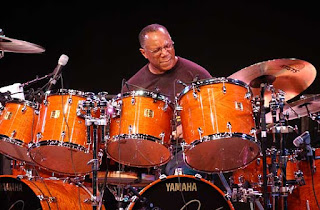
Billy Cobham picture from Tim Brooks Rythmn Section
RAM:  Under your section on McLaughlin’s “Que Alegria” you state McLaughlin is always trying to find the sounds he hears in his head and he’ll try anything to get them.” You stated in several instances how you sometimes winced at his choice of  tone or how his synthesized guitar was sometimes indistinguishable from Que Alegriaother accompanying instruments. Do you feel John’s music has suffered from his fondness for trying the latest electronic effect?

WK: I did ask him one time if he ever thought technology was influencing how he approached his music. For instance, if he had a new synth that made a sound like an elephant – would he feel he needed to play that sound? (That is not the example I used with John.) He absolutely dismissed this notion. I just have to believe him. I want to be clear about my own view of the synthesizer. I was always impressed with how John forged ahead with the new technologies. But, given my druthers, I preferred a sound, a tone, an approach that sounded like it came from an actual guitar. I sometimes missed the attack. John McLaughlin is very much aware about the misgivings some fans have had about some of his tone choices. However, he must follow his muse. There is no doubt in my mind that someday his trailblazing work will be the subject of scholarship.

RAM: One of the things I most enjoyed about your book was the cogent comments from John under various sections. One comment I found particularly telling.It was his explanation of the meaning of the title to his song “Hijacked” from  his Live at the Royal Festival album he said “ We get hijacked periodically by our own minds. That is the real hijacker. The whole point of existence is to become un-hijacked. We become trapped in our thoughts, desires and ambitions. In short, we become trapped in our own egos.”

It is well known that John has been on a personal spiritual quest for most of his life. Despite this purposeful dedication to a higher way, I was somewhat surprised to find out from your book how many personal disagreements he has had with other musicians over the years. You mention disputes with
Jerry Goodman, Jan Hammer , disagreements with Al Dimeola and Jean Luc Ponty, and a deserved beef with Jaco Pastorius and most surprisingly and a twenty-five year spat with drummer Billy Cobham.

WK: Well, I think when you look at the record, McLaughlin has not had that many spats compared to the hundreds of musicians he has interacted with. It is just that the tiffs happened to be with some famous people. I am happy to say that most of those issues are over and these musicians have reached out to each other in some way. Music, like any art, is full of strong-headed individuals who have distinct visions. When you combine artistic ideas with business, horrible things can happen. The artists who manage to make it through the minefields unscathed are rare.

RAM: Ever since the first Mahavishnu exploded on the scene; John's influence on guitar players and other musicians is undeniable. Other than this obvious ground breaking work, what sets apart John's playing for you when compared to the other icons of the guitar world like Bill Frisell, John Abercrombie,
Allan Holdsworth, Pat Metheny and /or John Scofield?

WK: That is some list. Each one of those guitarists holds McLaughlin in the highest esteem and the same is true in return. Comparisons can be useless as each of these players has a distinct style and approach.. But, I think I could say what sets him apart is that he has been a driving force in several different genres of music. Metheny has even written about this. McLaughlin helped lead the way for jazz fusion, world music, acoustic guitar appreciation and synthesizer guitar movements. It is really quite an accomplishment when you consider it.

RAM: Walter as a fan who was first blown away by the Mahavishnu Orchestra in its first iteration many years ago, as was I, is it possible for John to ever be able to meet the expectations that this first band created for many of us?

WK: Nope.

RAM: I detect from your writings that despite your respect for the many paths John has taken with his music, you prefer the slash and burn, stunning virtuosity that was a hallmark of his early career. Is this accurate? What is your favorite recent album and why?

To The OneWK: True, I prefer the slash and burn when it comes to him playing electric guitar. However, it is inaccurate everywhere else. For instance, one of my favorite albums is the acoustic Belo Horizonte. I am absolutely thrilled by
 To The One. I love its slurring energy and the spiritual aura, in both a secular and non-secular way, which permeates it. It is a masterpiece.


RAM: Need I ask what your all time favorite McLaughlin album is and  your favorite song?

WK: I would be lying to you if I could say which album was my favorite. It would depend on the day of the week, the hour on the clock and my mood. My favorite song is still “One Word” for the reasons I told you before. I think one of the things Follow Your Heart will do is to make listeners reassess their favorite tunes and even change their minds back and forth. My goal is to make people realize we are dealing with one of the greatest guitar players ever, who just happens to be a remarkably important composer as well.

RAM: Thanks Walter. As far as my own observations, John's considerable composing talents were reintroduced to me recently when I  reviewed the HR Big Band with Billy Cobham playing the "A Meeting of the Spirits: A Celebration of the Mahavishnu Orchestra" . The music continues to inspire young musicians and fans alike.

To some degree I think John and the first Mahavishnu Orchestra was like a convergence of five comets colliding together at one particular time in space. This fortuitous union created a supernova in my music world never to be repeated. It also happened at a moment in time, for me at least, where I was particularly receptive to the message and unabashedly embraced it. Despite John’s ceaseless journey to free himself from the confines of that glorious achievement, he will always be inextricably tied to it  and for many of us may never be able to surpass it.
.
But  frankly John doesn’t have to surpass what he has done, nor does the brilliance of past achievements in
any way diminish what he has subsequently so valiantly pursued. Part of that pursuit is excellence, a goal few of us achieve to the extent that he has in both his playing and compositions. He continues to inspire loyal fans and a global bevy of musicians with his beautiful and complex music. For a perfectionist like John, who in the final quotation of Walter’s book states “ Just so you know- I never stop.” , his continuing quest is a solely personal journey. He generously offers us what he discovers along the way. We can choose to embrace or reject the offering as we like, but it is of little consequence to his own primary goal of following your heart.


Walter's book is available on Amazon or Abtract Logix through these links.
Follow Your Heart - John McLaughlin Song By Song
http://www.abstractlogix.com/xcart/product.php?productid=24829&cat=369&page=1