Showing posts with label Bob Sheppard. Show all posts

Friday, September 10, 2021

Eberhard : An Orchestral Homage by Lyle Mays

Lyle Mays : Eberhard Self Produced

The pianist/composer Lyle Mays, shockingly to many of us, transitioned on February 10, 2020. His niece Aubrey Johnson, a talented jazz vocalist, said only that his untimely passing was the result of
 “…a long battle with a recurring illness.”  No further clarification of Mays’ medical condition has ever been revealed publicly.

Lyle Mays Photo credit  Wayne Scott Jones

During his closing days, Mays devoted himself to honing, polishing, and completing a musical project that had consumed him over the years, a recordable dedication to one of his early inspirations, the progressive double bassist Eberhard Weber. Mays first started playing the armature of this composition back in 2009 at a festival in his home state of Wisconsin. The German bassist had suffered a stroke in 2007, and so Mays’ first public performance of this piece was as much a healing, a musical encouragement to Weber to recover, as it was a homage to the man, his work, and its influence. Sadly, Weber’s medical setback was more permanent than originally hoped for. The now eighty-one-year-old bassist has never played again. 

Mays came to national prominence for his work as the collaborator and co-composer of the Pat Metheny Group.  During that period Mays always left his unmistakable imprimatur on some of the group’s most endearing records. The artist won ten Grammy Awards and was nominated twenty-three times over the years.  Despite his importance to the success of the PMG, Mays was satisfied to work his musical and technological magic, mostly avoid the spotlight and be satisfied to play the sidekick to Metheny, his Doc Holiday to Pat’s Wyatt Earp at their musical OK Corral. Throughout his life he was always fascinated with technology, chess, architecture and mu

Mays was playing piano and organ from a young age. He attended North Texas State University (later University of North Texas) and won his first nomination as the composer/arranger for his work on the album Lab ’75 with the school’s One O’clock Lab Band.


North Texas State University Lab'75

While still a student, Mays performed at the Wichita Jazz Festival in 1975 and it is interesting to look at the festival’s performer list from that year as this event proved to be pivotal to Mays' future career. Exploring a musician’s trajectory is always of interest and timely intersections with other musicians often lead to life-changing paths.


From WJF 25 years of Great Jazz Compilation by Gary Hess

Mays’ Student Quartet included bassist Marc Johnson, drummer Steve Houghton, and woodwind player Pete Brewer.

It was unpredictable the way new connections casually made at venues like the WJF could be so important to a young musician’s future. For the bassist, Marc Johnson stars somehow cross each other’s paths and the festival likely served as an informal entre to the pianist Bill Evans. Johnson was eventually chosen to replace a departing Gomez in Evans’ last trio with drummer Joe LaBarbera, and he did so from 1978 until Evans’ death in 1980. No doubt a life-changing experience for the bassist. Johnson went on to a stellar career as one of jazz’s most respected bassists. He remained associated with his classmate Mays for years with his sonorous double bass heard on six of the keyboardist’s recordings as a leader including  The Ludwigsburg Concert from 2015. 

Drummer Steve Houghton continued his career as a respected sideman, eventually turning to academia, becoming a respected associate professor of percussion at Indiana University among other institutions. Woodwind artist Pete Brewer would continue his career as a successful freelance musician.

If you look at the artist roster for the 1975 Wichita Jazz Festival, the lineup had s a plethora of great drummers that included Max Roach, Ed Soph, Mickey Roker, and Bob Moses (with Burton), but you will also see other important acts including Woody Herman’s Young Herd, Bill Evans Trio, and Gary Burton’s group which included the young guitarist, Pat Metheny. Woody Herman, the legendary bandleader, and clarinetist must have liked what he saw of the Lyle Mays Quartet in Wichita. Shortly thereafter Mays, Brewer, and Houghton were recruited to become new members of Herman’s traveling Thundering Herd later in 1975. Mays was to be the keyboardist for Herman for eight months into 1976 until another Wichita twist of fate would change his path again. Mays and the Metheny first met at the Wichita festival in 1975. They mutually found that they had musically compatible goals. Metheny would leave Burton and Mays left Herman and the two decided to start a new group.  The group would record and release their first collaboration Watercolors in 1977 under Metheny’s name. The collaboration would be a rich one and it would last for most of twenty-eight years through their last recording together as the Pat Metheny Group This Way Up in 2005. By that time, traveling and presumably, health issues induced Mays to call it quits.

Watercolors ECM 1977

Watercolors would be Mays' first opportunity to work with the progressive European bassist Eberhard Weber. Metheny had worked with Weber while he was with vibraphonist Gary Burton on his albums Ring from 1974 and Passengers from 1976.  Mays again played with Weber on the bassist’s album Later That Evening from 1982. There is little doubt that the German’s playing influenced both these young American pioneers.

Despite being strongly influenced by his classical training, a musical history that he shared with Mays, Weber created his own minimalist, ostinato-based, ethereal, and melancholic approach to his work. He was most likely influenced by the avant-garde composers Steve Reich and Terry Riley. By the early seventies, Weber designed and preferred a five-string-electric bass that extended the instrument’s range, adding more depth and drama to his playing. He was never a boisterous performer who commanded attention. Instead, he wanted his music to speak for itself.  Like the free-jazz movement that went off in one direction that veered away from traditional hard bop jazz, or even the frenetic fusion of the early seventies, Weber’s music was a detour that embraced a gentler, more thoughtful approach. There is no doubt Weber’s musical approach, almost chamber-like, was a serious signpost that caught Mays’ attention.

Eberhard is a thirteen-minute opus of pure Mays’ magic. It is a splendid piece of mostly through-composed music. Mays explores elements of classical, jazz, chamber, minimalism, vocalization, and cinematic musical qualities. Typical of Mays’ work, the piece has a tonal depth and emotional reach that displays the man’s expansive concept of what music should be. While the work is a homage to Weber, the music is pure Mays.

Mallett artist Wade Culbreath opens the piece with a repeating tonal movement that creates an almost other-worldly atmosphere upon which Mays solemn pianistic probing floats. Jimmy Johnson’s electric bass bellows beautifully with authority and poignancy in what I have read is a fully composed part. Mays’ niece, the vocalist Aubrey Johnson, enters the scene with a feathery vocalization that has angelic elements as she vocally traces the music lines emphatically. At one point, Mays’ piano has a very bluesy crossed with Americana feel to it that has always been part of his style. Steve Rodby’s beautiful double bass anchors the time with its fluid bottom tone. Bob Sheppard’s flute is introduced for another tonal factor that adds to the orchestration along with some electronic synthesizing effects that seem to be a identifiable part of Mays’ signature style. A quartet of cellos seamlessly adds to the pallet of tonal possibilities. Mallett, piano, flute, bass, and drum interact swelling with energy, and Bill Frisell’s twangy guitar voice briefly makes its appearance. The separate voices of Johnson and Rosana and Gary Eckert almost conjoin. They meld like three pieces of gold transforming into one brilliant ingot by the heat of a scorching crucible that is Mays' music. Jimmy Branly’s drum work erupts like percolating lava, and Alex Acuna adds perceptive percussive accents that just increase the temperature of the rhythmic brew that Mays compositionally constructs. Culbreath and Johnson beautifully match each other’s notes like two empathetic savants.  Mays introduces a jazz septet that gets into a fiery vibe section that is the apex of the piece. The section includes some perceptive organ work by Mitchel Forman, with Mays on piano, the explosive Branly on drums, subtle Acuna on percussion, Steve Rodby’s strong acoustic bass, and the multi-reed master Bob Sheppard’s tenor saxophone. 

Sheppard’s improvised solo runs for a little over two and half minutes and starts at about the 8:24 minute mark. It is a masterwork of controlled passion powered by a internal sweltering fire that he can call on at any time as is needed. Mays’ orchestrates the music to the summit and then allows Culbreath’s gorgeous, resonant mallet work and some of his own synth accents to melt the piece away, like a fading crimson sunset, turns the sky into a brilliant pastel haze.

The more I listen to this, the more I aurally observe the nuances of his orchestration, the more I realize how much we will miss Lyle Mays and his beautiful world of sonic colors. Eberhard could certainly be positioned as Lyle Mays epitaph, his crown jewel, but while it certainly is his last recorded work, I am sure that Mr. Weber will listen to this piece, love it and it will certainly put a bittersweet smile on his face.  This work should excite those of us who have loved Mays'work for so long, to go back and revisit the body of this exceptional artist's life work. If we do this, we will undoubtedly honor this man’s legacy in the fashion he intended it to be listened to, with joy.

Wednesday, May 3, 2017

Vocalist Mark Winkler celebrates life with "The Company I Keep"


It is not easy to lose someone who you are close to. Grief can be debilitating, especially if the person you lose has been the object of your undying affection for thirty-five years. Vocalist Mark Winkler experienced this when he lost his husband and friend movie executive Richard  Del Belso last year.

Instead of using the experience to sit and sulk, Winkler turned the emotions this loss elicited into a source of inspiration to renew friendships, immerse himself in his music and create his latest album, The Company I Keep. Winkler is one of the few hip, male singers that has both the chops and the intellectual affinity for writing clever lyrics of the type we associate with the Great American Songbook.

On The Company I Keep, Winkler has shown he also has an ear for great collaborations. The album features duets with longtime collaborator Cheryl Bentyne of Manhattan Transfer fame, vocalists Jackie Ryan, Claire Martin, Sara Gazarek and Steve Tyrell. The musicianship on this album is stellar with arrangements by Jamieson Trotter, John Beasley, Josh Nelson and Rich Eames.  

My favorite tracks feature Mark singing his own lyrics. Songs like the campy Bill Cantos’ composition  “Midnight in Paris”  with special kudos to the clarinet work of Don Shelton and the poignant violin of Paul Cartwright. The Bourbon Street flavored “But It Still A’int So” with Steve Tyrell singing with a gusto reminiscent of a young Mac Rebennack, is another highlight, punctuated with a gusty tenor solo by the yeoman Bob Sheppard.

Winkler is a developed taste, like appreciating a fine bourbon, he grows on you over time with his smooth, smoky delivery. His voice just nails all the right notes and he has a mastery of that long-lost art of storytelling.

If you have any doubts, just listen to his captivating story about an old jazz singer on “That Afternoon in Harlem” featuring the magical stride-like piano work of Eric Reed, the soulful trombone of Bob McChesney and the incomparable brush work of Jeff Hamilton. The musical scene just lingers in your mind and then as the lyrics lament “For a moment the world just fell away.”

Mark was strongly influenced by the late jazz vocalist Mark Murphy. His treatment of one of Murphy’s lyricized versions of Oliver Nelson’s “Stolen Moments” is a special tribute. The duet with Claire Martin includes Winkler’s own lyrics that accurately depicts seeing the singer famously performing his daring do “without a net,” capturing Murphy’ spirited, vocal adventurism.  A delicately bowed bass intro/outro and a subsequent pizzicato solo on the tender “Loves Comes Quietly” by the great John Clayton is a real treat. The song also features Reed’s sensitive piano comping and again Jeff Hamilton’s superb trap work.  

The joyful Leonard Berstien song "Lucky to Be Me" features David Benoit on piano and uplifting clarinet solo by the versatile Bob Sheppard. Rich Eames gorgeous piano accompanies Winkler's heartfelt rendition of "Here's to Life."

This is Winkler’s fifteenth cd and features an eclectic repertoire of songs from composers as diverse as Gershwin, Donald Fagen, Prince, Leonard Bernstein and Oliver Nelson. There is something here for everyone. The man has exquisite taste and a beguiling voice that deserves widespread attention. Bravo Mark,  I’am sure Richard would be most proud.

Friday, October 29, 2010

My Review of Bassist Chris Colangelo's "Elaine's Song"

Elaine's Song
Chris Colangelo;s  “Elaine’s Song”   
C Note Records     CNR 001
Many weeks ago I started to listen to an album I received in the mail by West Coast bassist Chris Colangelo titled “Elaine’s Song”. Despite my unfamiliarity with his name or pedigree I was impressed by the musicians he had assembled for this date. The Cd is predominantly a compilation of the bassist's own
original compositions. With fellow West Coast artists like Bob Sheppard on saxophones, John Beasley on piano and Steve Hass on drums, each  accomplished musicians in their own right, I was looking forward to my maiden voyage with bassist Colangelo and his music. This west coast excursion did not disappoint. After a few satisfying listens, I put the album aside with every intention of writing a review. I was impressed with Bob Shepard’s  playing on this album,  so much so that I made a point of trying  to see this veteran saxophonist ,a hidden but in demand voice on  many a studio session, at the venerable Van Nuys jazz watering hole Charlie O’s , while I was out visiting my daughter in LA several weeks ago 


Sadly Sheppard did not perform as scheduled, but we did get to see another local talent, the saxophonist Chuck Manning. Things subsequently got hectic and several reviews and live performances later, I realized that I never got around to reviewing Colangelo’s fine album.

From the start of this Cd you can hear the solid compositional acumen of Colangelo. Despite the predominantly original format, most of the songs resonate like they have always belonged to the jazz lexicon.
The entire album is as good a representation of the best in contemporary jazz as you will find, with fine ensemble playing throughout. Saxophonist Sheppard, whose a first call studio musician, gives a notable performance on the opener “ The Ubiquitous One” where he plays with a warm, precise tone that slithers through the chicane-like changes effortlessly, John Beasley’s piano solo is tasteful at every turn. Colangelo’s bass is full toned and round and Hass’s drums are taught and punctuate the breaks nicely.
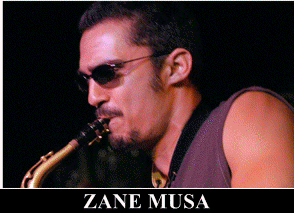
O the steamy “Like Kenny”, dedicated to one of Colangelo’s  favorite saxophonists, Kenny Garrett, altoist Zane Musa steals the show with a fabulously rambunctious burst of pure spontaneous combustion. I will be watching out for more of this guy.
The group cooks on this post bop vamp, with Colangelo’s full walking bass lines anchoring the driving rhythm. Hass adds a series of rolling tom crashes and a polyrhythmic solo as saxophonists Clatsworthy and Musa trade licks with Beasley and each other, ending in a splendidly crisp finale.

The title song, “ Elaine’s Song” , is dedicated to Colangelo’s wife and features some of this fine player’s solo bass lines. He has a round, generous tone that is warm, precise and inventive. Beasley is effective as Colangelo’s foil , keeping his comping light but brilliantly sympathetic. Shepard is particularly mellifluous and lyrical here.

On “Green and Blue” flautist Benn Clatworthy is featured in a clever take off the Evans/Davis classic.
His Dolphy like sound has a  hauntingly eerie quality.  Pianist Beasley is superbly tasteful here and once again proves to work extremely well with Colangelo as the composer solos on bass.

The straight-ahead “Gryffindor’s Revenge” will please anyone who appreciates a tight piano trio with truly in-sync musicians of such high caliber as Colangelo, Hass and Beasley.

“Watts Important” is a dedication to drummer Jeff “Tain” Watts .

 Colangelo deftly performs bassist Steve Swallow’s  elegant “Falling Grace” with pensive, resonating notes at the intro. Throughout the thoughtful piece, Beasley and Colangelo show a telepathic interchange of ideas that is both prodding and sympathetic, while Hass skillfully weaves his percussive sounds around them. Beasley performs his most expansive solo of the album here and it is jaggedly beautiful. Colangelo shows his most dexterous side as he solos with a fluid grace
towards the last quarter of the song.

John Coltrane’s “Straight Street” features Bob Sheppard on a wonderfully buoyant soprano saxophone. The versatile Sheppard has an affinity for playing this sinewy sounding instrument with joyful ease on this breathless solo.

Colangelo saves a real gem for his closer, the evocative “From Dark to Light”. Drummer Hass predominantly plays cymbals here as Beasley tickles out the barest of comps from his ivories over Sheppard’s brooding tenor. Colangelo offers fat, lingering Haden-like bass lines perfectly placed behind Haas’s beat. Beasley again offers a penetrating solo that seems to wander leading you in a contorted direction, but somehow getting you back to a satisfying conclusion. He incorporates some Latin  inspired chording intermingles with some classically tinged flourishes for good measure.  When it is Sheppard’s turn to solo, he is appropriately restrained, but subtly builds and releases tension in an almost stealth-like way. Colangelo finishes with a plucky bass solo, setting up the band as they bring the repeating closing refrain to a beautifully executed climax; very satisfying indeed. 

Recorded: Umbrella Music Studio, Chatsworth, CA


Musicians: Chris Colangelo (acoustic bass); John Beasley (piano); Steve Hass (drums) ; Bob Sheppard (tenor on tracks 1, 3 & 9& soprano saxophone track 8); Benn Clatworthy (tenor sax on tracks 2 & 6, flute on track 4); Zane Musa (alto sax on track 8)