Showing posts with label John Beasley. Show all posts

Thursday, March 7, 2024

The Biamp PDX Portland Jazz Festival: Sullivan Fortner Trio, Dianne Reeves & Band and John Patitucci Brazilian Trio

Yotam Silberstein, John Patitucci and Rogerio Bocacato at the Old Church

The Biamp PDX Portland Jazz Festival brought an amazing gathering of some of jazz music's most talented, diversified, and celebrated lineups to Portland this year. The festival ran from February 16 through March 2, 2024, and included a variety of venues -The Jack London Revue, The Old Church, Revolution Hall, Arlene Schnitzer Concert Hall, Alberta Street Pub, Newmark Theater, and the Roseland Theater [place a myriad of smaller locations to name just a few. True jazz fans should tip their collective hats to the producers of this year's festival. This year truly met and exceeded all reasonable expectations for supporters of this marvelous music. 

The festival included esteemed headliners-pianist Jon Baptiste, guitar master Julian Lage, trumpeter Nicholas Payton, modernist guitarist Mary Halvorson with drummer Tomas Fujiwara, piano master Bob James with guitar wizard Lee Ritenour, and some fine local artists that include guitarist Ryan Meagher and Dan Balmer, drummer legend Mel Brown and saxophonist Nicole Glover plus too many others to mention. Check the total lineup here. Suffice it to say, if there was music that you favored in this ever-accepting genre there was something to please almost any taste.

As a fan, it was a plethora of almost too many riches. The offerings were scheduled over a relatively short period, and the weather didn't always cooperate. I was lucky enough to pick and choose my events (with some help from a friend) and attended three superb events.

Sullivan Fortner and Tyronne Allen at the Old Church

The Sullivan Fortner Trio at Old Church:  February 27, 2024

I have been a fan of the pianist Sullivan Fortner for quite some time. He was born in New Orleans and started piano at the age of four. Blessed with perfect pitch, Fortner rapidly advanced with his keyboard skills. At age seven he began playing organ publically in his mother's Baptist Church. Gospel music made a permanent impression on the young man. Fortner went on to study music at Oberlin Conservatory in Ohio and later received his master's degree from the Manhattan School of Music. The musician made his bones as a sideman with the likes of vibraphonist Stefon Harris and trumpeter Roy Hargrove. In 2011 Fortner came under the influence of the pianist master Barry Harris. He has been tapped as an astute accompanist for vocalists like Lauren Henderson and the recent sensation Samara Joy. He is most celebrated for his collaboration with the amazing vocal chanteuse Celine McLorin Salvant. He has received numerous awards including the prestigious  Lincoln Center Emerging Artist Award in 2016.

By now, the thirty-seven-year-old pianist has become a revered master of his instrument being one of his generation's most promising artists. I named his recent 2023 release


Solo Game
as one of my Notes on Jazz Best of Jazz for 2023. I was most interested in seeing this impressive artist play live and in the moment. His February 27th concert at downtown Portland's intimate Old Church was the perfect venue to see him perform his magic up front and personally. 

Fortner casts a short, sturdy, but graceful presence at his piano bench. He is soft-spoken and when he does speak, there is an unassuming confidence in his voice, a voice that also projects a wry sense of humor and a deep sense of joy about what he does. Fortner was joined by his working band of Tyrone Allen on upright bass and Kayvon Gordon on drums. There is an immediate sense of connection between these three. A connection of respect and of the kind of familiarity that is built slowly from being exposed to many hours of woodshedding together, honing their skills as a unit, and creating that level of simpatico that usually only is seen in working bands. 

The Maryland-born Tyrone Jackson studied upright and classical bass at the Eastman School of Music in Rochester and later attended Berklee in Boston where he was mentored by local giants like saxophonists Jerry Bergonzi and George Garzone and the late drummer Ralph Peterson. Drummer Kayvon Gordon hails from Detroit. He was mentored by trumpeter Marcus Belgrave and attended the University of Michigan where he studied with bassist Robert Hurst and pianist Benny Green. With this pedigree, there is no doubt this trio has the firepower and finesse to make this a memorable evening of music.

The trio entered the stage and immediately went to work on what sounded like a Monk-inspired piece of music. Jagged, angular and edgy. There was little doubt that Fortner's music would be inspired by his study and mastering of the music's history. Despite his familiarity with the material, he is like a bubbling caldron of creativity that never settles for using well-worn musical cliques. He is expressive and surprising and there is a spontaneity to his approach that is quite refreshing.

The group played for two sets and covered some fourteen compositions, a few of which were originals and some music from composers Thad Jones, Cedar Walton, and Bobby Hutcherson. Two highlights were Charles Trenet's "La Mer" which was played in a stunning calypso style and the gorgeously embroidered take on Hoagy Carmichael's "Stardust," which was like hearing the well-healed classic in a new light. Throughout the performance, Fortner showed some amazing double-handed, Shearing-like block chording work. He has an impressive facility but he uses his skill to tell a story. Fortner's piano takes you time traveling. You can hear the art of Thelonious Monk, Erroll Garner, Eubie Blake, and even Art Tatum in his playing without it ever becoming mimicry. His bandmates are attuned to his changing directions and inventive excursions. Both are excellent soloists when called on. The set ended with the local tenor saxophonist, Nicole Glover, as a guest. She joined the trio for one ballad and two more energetic post-bop songs that added a new voice and some local flavor to the evening's music.

Diane Reeves and Reuben Rogers at Revolution Hall

Diane Reeves and her Band: Revolution Hall February 29, 2024 

One highlight of this festival was the chance to see Dianne Reeves and her band at the Revolution Hall. The Detroit-born Reeves is perhaps the ruling queen of current-day jazz singers in the world. Critic Scott Yanow called her "A logical successor to Dinah Washington and Carmen McRae..." In 2018 she was named a prestigious NEA Master. Her last album Light Up the Night: Live in Marciac was released back in 2016.

Reeves was joined this evening by the dynamic rhythm section of Reuben Rogers on bass and Terreon Gulley on drums, the talented pianist/arranger John Beasley on piano, electric piano and melodica, and the Brazilian master guitarist Romero Lubambo. 

Ms. Reeves is an eminent professional who captures the audience with her conversational rapport. Although the concert at Revolution Hall amazingly did not sell out, Reeves's buoyant stage presence never showed signs of being affected by the smaller but enthusiastic audience. She skillfully engaged with her fans and her warmth and ability to make the interaction personal made the event all the more special.

The band was exquisite. Keyboard artist John Bealey opened the set on a melodica, an air-activated keyboard device that created the closest thing to an electric saxophone sound. Beasley, himself an eight-time Grammy nominee, has won a Grammy for a song on his big band album Monk'estra Plays John Beasley released in 2020. Bassist Reuben Rogers hails from  St. Thomas in the US Virgin Islands and plays both electric and upright acoustic bass on the set. He is a prolific sideman and has been a long-time member of Diane Reeve's band and Charles Lloyd's trio. Terreon Gully is presently an Atlanta-based musician and Reeves's longtime drummer. Gully also holds down the drum chair in Beasley's Monk'estra Orchestra and has worked with Christian McBride and Stefon Harris among others. Romero Lubambo is a superb guitarist from Brazil. He came to NYC in 1985 and is known for his fluidity and inventiveness on both acoustic and electric guitars. He first played in the US with singer Astrid Gilberto in the early eighties and met and played with flutist Herbie Mann shortly thereafter. In 1992 he formed the Brazilian Trio La Paz with bassist Nilson Matta and drummer Duduka da Fonseca. Subsequently, Lubambo became a prolific recording artist and in demand as a top-flight studio musician. This world-class group of musicians complimented Reeves's magnificent voice at the show with a seamless interaction that was smooth as silk.

The show started off with Fleetwood Mac's popular number-one single "Dreams."  Reeves has the depth, timbre, and strength to let this one soar.  

Gigi Gryce's  "Social Call" with Jon Hendricks lyrics came next. It was popularized by Betty Carter in 1980. Reeves and the group made it all their own with the vocalist's facile scatting strongly accenting the music. 

Horace Silver's "Peace" is a ballad that was released by the pianist in 1959. It is a meditation on finding inner peace and tranquility, often through contemplation of nature's beauty. Reeves's soulful interpretation here transforms the ballad into a moving prayer with her Gospel-inspired performance.

The Brazilian master composer/vocalist Milton Nascimento's "Ponte de Areia" was first released in 1975 on his Minas and famously reimagined on Wayne Shorter's seminal Native Dancer of the same year, with Nascimento singing this mournful song. Reeves beautifully pliable voice and her talented band recreate this breezy song- a nostalgic story about the loss of a railway station as a metaphor for lost personal connections and its emotional effects. Reeves's commanding vocal acrobatics deftly replaced Nascimento's high-pitched falsetto to great effect.  Lumbaro's authentic guitar playing and the added jazz sensibilities transformed the audience into being part of a true Brazilian experience.

Reeves with Lumbaro on acoustic guitar played as a sensational duet, one on Reeves's composition "Nine" and the other on the Gershwin standard "Love Is Here to Stay," both intuitively presented in a way that captivated the audience with a feeling of intimacy. Lumbaro's guitar work never fails to emanate with intelligence and sensitivity.  

The set included another beautifully delivered Gershwin standard "Someone to Watch Over You" and the more challenging Wayne Shorter masterpiece "Footprints," which featured this group's musical acumen. After receiving a sustained and admiring applause from the audience, Reeves returned for her encore with her endearing composition "Better Days." If there was any doubt that Dianne Reeves's enormous stage appeal and upper-tier vocal talent were diminished in any way by her recent disappearance from the public's spotlight, this evening's performance put any doubts firmly to rest. She remains the ruling queen of vocal jazz.

The John Patitucci Brazilian Trio with Yotam Silberstein and Romero Boccato at the Old Church March 2, 2024

It is always a treat to get to see one of the world's finest electric and acoustic bass players in the world and John Patitucci rises to that level. I have seen John play twice before. Once with Chick Corea and his Elektric Band in Tarrytown, NY, and recently with the Jon Cowherd Quintet at Portland's now-defunct 1905. Each time you see this master musician in his milieu, his artistry and love for playing transpose you into a happy place. As the music critic, Rick Mitchell said, Patitucci is "...both a master of tone on the double-bass and the best electric bass guitar soloist since Jaco Pastorius."  Praise that I certainly concur with wholeheartedly.

The evening at the Old Church, the fittingly closing concert of the festival, took on the rhythmic sway and lilting beauty of Brazilian music. The accomplished Israeli guitarist Yotam Silberstein, who had previously performed as a leader in one of the festival's other concerts, played beautifully. Brazilian master percussionist Rogerio Boccato offered exquisite authenticity to the trio with his understated but timely drum and percussion rhythmic work. To watch this artist provide the most subtle but powerful accompaniment was a real treat.

The group played a series of Brazilian compositions from artists like Ivan Lins, guitarist Garoto, Milton Nascimento, and singer-songwriter Djavan. One highlight of the evening was the fluid Brazilian piece "Nilopolitano" from master accordionist Dominguinhas, which showcased the rapid-fire synchronous playing of Patitucci on his six-string electric bass along with Silberstein's equally blinding guitar lines. Another treat was Chico Buarque and João Bosco's composition "Sinhá" which was opened by a facile solo on Patitucci's custom electric bass. Toward the end of the performance, there was a Silberstein composition, "Requiem for Armando," a dedication to pianist Chick Corea, which highlighted the guitarists' most sensitive skills and Boccato's brilliantly subtlety. Patitucci did a solo encore and chose to play a hard bop piece on his double bass that showed just how liquid this inventive master can be.


Friday, December 4, 2020

Notes on Jazz : Best of Jazz 2020


The year 2020 will go down as a stressful, disappointing, and even a dangerous year for this country. Since March and the outbreak of Covid 19-undoubtedly the worst viral pandemic since the Spanish Flu took the world to its knees back in 1918- society has been endangered, quarantined, and generally stifled from any semblance of normality. It has also been an ugly and trying time. A time where we witnessed a string of racially motivated deaths that created reactive multi-racial protests demanding responsibility. These events stirred up intermittent riots across the country that vented frustration, destroyed property, and conjured up the appearance of a loss of law and order. It was a mess of a year.

Through it all, we have had to adapt to a world that demanded severely restrained travel and social intercourse. Work has been relegated to remote digital contact. These restrictions have economically beggared many previously active and engaged artists. Live concerts have been veritably obliterated. Many venues that allowed social connection between musicians, music, and their public have been stymied. Even the most natural of things for musicians, shedding, collaborating with peers, or performing for audiences,have become relegated to video engagements or zoom collaborations. Despite all these formidable physical and monetary obstacles, artists and musicians have found a way to still create, record, and share their endeavors with us, enriching our lives and bringing the light of creativity and passion to all us in these otherwise difficult times.

As the year is rapidly starting to close I am proud to have had the opportunity to carefully listen to, marvel, and enjoy the works of many artists, some new to me and others reliable masters who continue to create amazing work.

Here are my picks, in no particular order, for some of the best of jazz for 2020 The selections come from diverse categories that include Big Band and large ensemble jazz works, modern small jazz groups, chamber/theatrical jazz, Latin/Brazilian jazz, vocal jazz, and notable historical releases for jazz in 2020. As with any list of favorites, these are purely subjective choices, and they do not include many fine albums that for one reason or another I have not personally had the opportunity to listen to in the past year.  Where possible, I have included links to sample music from the albums selected. Check these musicians out, listen, and enjoy.

Best of Jazz 2020: Big Band Music

John Hollenbeck with Kate McGarry, Theo Bleckmann, Gary Versace and The Frankfurt Radio Big Band: Song You Like A Lot: Flexatonic Records

 https://youtu.be/_BC5ieb8k_E

Maria Schneider and Orchestra: Data Lords: Artists Share


Dave Stryker with Bob Mintzer and the WDR Big Band: Blue SoulStrikezone Records

https://youtu.be/5DSPaY2iWJM


John Beasley: Monk’estra plays John Beasley: Mack Avenue Records

https://youtu.be/Rto2gSDcWj0

The Ed Palmero Big Band: The Great Un-American Songbook Vol III:

 Sky Cat Records

https://youtu.be/J2QSyrUASOU


Gregg August: Dialogues on Race Vol 1: Self-Produced

https://youtu.be/wYrGQHJev7w

Smaller  Jazz Groups 2020:

Jerry Bergonzi with Renato Chicco and Andrea Michelutti: Nearly Blue: Savant Records

https://youtu.be/6VHUJ0mYDyk

Jeff Cosgrove with Jeff Lederer and John Medeski: History Gets Ahead of the Story: Grizzley Music

https://youtu.be/zOiAvW7RCzI

Wolfgang Musthspiel with Scott Colley and Brian Blade: Angular Blues: ECM

https://www.ecmrecords.com/shop/1578640543/angular-blues-wolfgang-muthspiel


Grégoire Maret with Romain Collin and Bill Frisell: Americana:

 Act Music

https://youtu.be/jeZb5z3lQDM


Brian Landrus: For Now: Blueland Records

https://youtu.be/oiKRxBYul1s

Ricardo Grilli: 1962: Tone Rogue Records

https://youtu.be/WPG-fbTpUcU


John Scofield w Bill Stewart and Steve Swallow: Swallow Tales: ECM

https://www.ecmrecords.com/catalogue/1580225075


Aaron Parks Little Big III: Dreams of A Mechanical Man: Ropeadope Records

https://youtu.be/0jaxs4mTMjY


Dayna Stephens Trio w Ben Street and Eric Harland: Liberty: Contagious Music

https://youtu.be/su744saoJzY


Eric Revis: Slipknots Through a Looking Glass: Pyroclastic Records

https://youtu.be/qG-5zwGaNcs


Chamber Jazz/ Jazz Opera 2020:


Ryan Keberle, Frank Woeste, Vincent Courtois: Reverso The Melodic Line: Outhere Music

https://youtu.be/5asGkl7DJ28


Juliet Kurtzman and Pete Malinverni: Candlelight Love in the Time of Cholera: Self-Produced

https://youtu.be/842RWji-2RM


John Ellis and Andy Bragen: The Ice Siren: Parade Light Records

https://youtu.be/16EfYeU35MM


Best Debut Jazz Album 2020:


Raphael Pannier Quartet: Faune: French Paradox

https://youtu.be/czTPdt2xI1c


Best Jazz Vocal Album 2020:


Somi w John Beasley and the Frankfurt Radio Big Band: Holy Room Live at Alte Oper:

https://youtu.be/pBE9pU-mJwI


Best Latin Jazz Alum 2020:


Chico Pinheiro: City of Dreams: Buriti Records

https://youtu.be/KHYxknX1NEo


Best Historical Albums Released in 2020:

Thelonious Monk Quartet: Monk: Palo Alto Live from 1968: Impulse Records

       https://youtu.be/tr1P6JWD2cU


Bill Evans with Eddie Gomez and Jack DeJohnette: Bill Evans Live at Ronnie Scott’s July 1968: Resonance Records

https://youtu.be/sjCN8nMLEyY


Nat King Cole: Hittin’ the Ramp, The Early Years 1936-1945: Resonance records

https://youtu.be/qW7h1HaRB0s


Further worthy recordings your consideration from 2020:

Aaron Diehl w Paul Skivie and Gregory Hutchinson: The Vagabond: Mack Avenue Records

Rudresh Mahanthappa: Hero Trio: Whirlwind Records

Chick Corea w Christian McBride and Brian Blade: Trilogy 2:Concord Records

Edgar Djangirov: Rhapsodize: Twelve Tone Resonance

Steve Cardenas: Blue Has a Range: Sunnyside Records

Amina Figarova Edition 113: Persistence: AmFi Records

Kenny Barron, Dave Holland  Trio w Jonathan Balke: Without Deception: Dare 2 Records

Marvin Stamm and Mike Holober: Live @ Maureen’s Jazz Cellar: Big Miles Music

Denny Zeitlin Trio: Denny Zeitlin Live at Mezzrow: Sunnyside Records

Martin Wind, Philip Catherine & Ack Van Rooyen: White Noise: Laika Records

Rez Abbasi w Neil Alexander and Michael Sarin: Django Shift: Whirlwind records

Chris Dingman: Embrace: Inner Arts Initiative

Jason Palmer: The Concert: 12 Musings for Isabella: Giant Step Arts

John DiMartino: Passion Flower: The Music of Billy Strayhorn: Sunnyside Records

Thana Alexa: Ona: Self-Produced

Sirkis/Bialis IQ: Our New World: MoonJune records

Dave Douglas: Dizzy Atmosphere Dizzy at Zero Gravity: Greenleaf Music

Marcin Wasilewski Trio w Joe Lovano: Artic Riff: ECM

Keb’ Mo’: Oklahoma: Concord Records (Blues)

Craig Taborn: Junk Magic- Compass Confusion : Pyroclastic Records

Jeff Hamilton Trio: Catch Me if You Can: Capri

Guiseppe Paradiso Meridian 71: Metropolitan Sketches: Self-Produced


Friday, October 29, 2010

My Review of Bassist Chris Colangelo's "Elaine's Song"

Elaine's Song
Chris Colangelo;s  “Elaine’s Song”   
C Note Records     CNR 001
Many weeks ago I started to listen to an album I received in the mail by West Coast bassist Chris Colangelo titled “Elaine’s Song”. Despite my unfamiliarity with his name or pedigree I was impressed by the musicians he had assembled for this date. The Cd is predominantly a compilation of the bassist's own
original compositions. With fellow West Coast artists like Bob Sheppard on saxophones, John Beasley on piano and Steve Hass on drums, each  accomplished musicians in their own right, I was looking forward to my maiden voyage with bassist Colangelo and his music. This west coast excursion did not disappoint. After a few satisfying listens, I put the album aside with every intention of writing a review. I was impressed with Bob Shepard’s  playing on this album,  so much so that I made a point of trying  to see this veteran saxophonist ,a hidden but in demand voice on  many a studio session, at the venerable Van Nuys jazz watering hole Charlie O’s , while I was out visiting my daughter in LA several weeks ago 


Sadly Sheppard did not perform as scheduled, but we did get to see another local talent, the saxophonist Chuck Manning. Things subsequently got hectic and several reviews and live performances later, I realized that I never got around to reviewing Colangelo’s fine album.

From the start of this Cd you can hear the solid compositional acumen of Colangelo. Despite the predominantly original format, most of the songs resonate like they have always belonged to the jazz lexicon.
The entire album is as good a representation of the best in contemporary jazz as you will find, with fine ensemble playing throughout. Saxophonist Sheppard, whose a first call studio musician, gives a notable performance on the opener “ The Ubiquitous One” where he plays with a warm, precise tone that slithers through the chicane-like changes effortlessly, John Beasley’s piano solo is tasteful at every turn. Colangelo’s bass is full toned and round and Hass’s drums are taught and punctuate the breaks nicely.
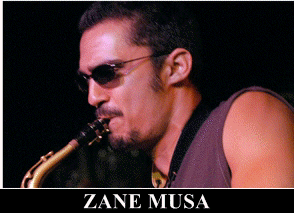
O the steamy “Like Kenny”, dedicated to one of Colangelo’s  favorite saxophonists, Kenny Garrett, altoist Zane Musa steals the show with a fabulously rambunctious burst of pure spontaneous combustion. I will be watching out for more of this guy.
The group cooks on this post bop vamp, with Colangelo’s full walking bass lines anchoring the driving rhythm. Hass adds a series of rolling tom crashes and a polyrhythmic solo as saxophonists Clatsworthy and Musa trade licks with Beasley and each other, ending in a splendidly crisp finale.

The title song, “ Elaine’s Song” , is dedicated to Colangelo’s wife and features some of this fine player’s solo bass lines. He has a round, generous tone that is warm, precise and inventive. Beasley is effective as Colangelo’s foil , keeping his comping light but brilliantly sympathetic. Shepard is particularly mellifluous and lyrical here.

On “Green and Blue” flautist Benn Clatworthy is featured in a clever take off the Evans/Davis classic.
His Dolphy like sound has a  hauntingly eerie quality.  Pianist Beasley is superbly tasteful here and once again proves to work extremely well with Colangelo as the composer solos on bass.

The straight-ahead “Gryffindor’s Revenge” will please anyone who appreciates a tight piano trio with truly in-sync musicians of such high caliber as Colangelo, Hass and Beasley.

“Watts Important” is a dedication to drummer Jeff “Tain” Watts .

 Colangelo deftly performs bassist Steve Swallow’s  elegant “Falling Grace” with pensive, resonating notes at the intro. Throughout the thoughtful piece, Beasley and Colangelo show a telepathic interchange of ideas that is both prodding and sympathetic, while Hass skillfully weaves his percussive sounds around them. Beasley performs his most expansive solo of the album here and it is jaggedly beautiful. Colangelo shows his most dexterous side as he solos with a fluid grace
towards the last quarter of the song.

John Coltrane’s “Straight Street” features Bob Sheppard on a wonderfully buoyant soprano saxophone. The versatile Sheppard has an affinity for playing this sinewy sounding instrument with joyful ease on this breathless solo.

Colangelo saves a real gem for his closer, the evocative “From Dark to Light”. Drummer Hass predominantly plays cymbals here as Beasley tickles out the barest of comps from his ivories over Sheppard’s brooding tenor. Colangelo offers fat, lingering Haden-like bass lines perfectly placed behind Haas’s beat. Beasley again offers a penetrating solo that seems to wander leading you in a contorted direction, but somehow getting you back to a satisfying conclusion. He incorporates some Latin  inspired chording intermingles with some classically tinged flourishes for good measure.  When it is Sheppard’s turn to solo, he is appropriately restrained, but subtly builds and releases tension in an almost stealth-like way. Colangelo finishes with a plucky bass solo, setting up the band as they bring the repeating closing refrain to a beautifully executed climax; very satisfying indeed. 

Recorded: Umbrella Music Studio, Chatsworth, CA


Musicians: Chris Colangelo (acoustic bass); John Beasley (piano); Steve Hass (drums) ; Bob Sheppard (tenor on tracks 1, 3 & 9& soprano saxophone track 8); Benn Clatworthy (tenor sax on tracks 2 & 6, flute on track 4); Zane Musa (alto sax on track 8)

Monday, September 6, 2010

Jazz on the Green :Review of New Haven Jazz Festival August 21, 2010


The end of summer is always hectic and I find myself knee deep in things that I should have already written about. The free jazz concerts that are offered almost every summer in New Haven, on the beautiful New Haven Green, are amongst the most enjoyable jazz events of the year in the Connecticut area. So if its not too late, here is a brief summary of the last concert in that series that took place on Saturday August 21, 2010.
This year, the 2010 New Haven Jazz Festival was presented by Jazz Haven in collaboration with Casey Family Services and the Department of Cultural Affairs. It was run on two consecutive Saturdays with the August 14th line up including Neighborhood Youth Jazz Orchestra; Noah Baerman's Jazz Suite “Know Thyself” Septet featuring Wayne Escoffrey; Afro-Peruvian Jazz Showcase; drummer Winard Harper’s Sextet and alto saxophonist Bobby Watson's Quartet.


I was fortunate enough to attend the August 21st concert which featured Jackie McLean Youth Jazz Orchestra ,The Joe Morris Quartet with Joe Morris (on bass) , Matthew Shipp (piano), Jim Hobbs (tenor), Gerald Cleaver( drums); The trombonist Steve Davis’ Quintet, Chilean songbird Claudia Acunas Latin Jazz Group and New Haven’s own Robby Ameen Latin Jazz Sextet.

This particular show was a homecoming of sorts, featuring some sons of Connecticut playing for the local crowd. The Jackie McClean Youth Jazz Orchestra led off the evening's performance and  although I didn't catch them, by all reports the group was impressive and started the audience off swinging.

Guitarist turned Bassist Joe Morris hails from the area and his fine quartet featured his quick walking bass lines accented by the percussive piano of Mathew Shipp the meandering alto of Jim Harris and the pulsating drums of Gerald Cleaver. I only caught the last two songs of the Morris set, but both were tight, high energy,  free jazz improvisations that were quick paced and rhythmically driven. The music is clearly influenced by the free improvisational style and spirit of Ornette Coleman.


The trombonist Steve Davis brought his quintet to the green that included the venerable Larry Willis on piano, Steve’s sonorous trombone, Mike DeRubio’s alto, local educator Nat Reeves on bass and the buoyant drummer Willie Jones III. In contrast to the more free style of Joe Morris's group, Davis played in a straight ahead manner. They started the set with a stirring rendition of “Surrey with the Fringe on Top”. Larry Willis opened off the next song with a beautiful interlude from “Nature Boy” leading into his own tender ballad “To Wisdom The Prize”. Willis is one of those veteran pianists whose mere presence  gives any performance instant credibility. He adds a touch of warm lyricism to whatever he does. Davis’s trombone has a buttery tone that was complimented nicely by DeRubio’s alto. The group did a particularly moving take on the classic “Milestones” toward the end of their set.

The Chilean songstress Claudia Acuna brought her Andean inspired vocals to the New Haven Green in a particularly moving performance. She was joined by a group of young, energetic Latin musicians on electric guitar, bass and drums. They played with a rock music like sensibility at times, interspersing slide guitar awkwardly into the mix. Her music spoke of things worldly and things spiritual, as her clarion voice evoked bird-like sounds of lush forests from South America. She touched on themes of class oppression in her country. On one song she brought us into her Andean Indian ancestry, lamenting on the spirituality of tobacco in Indian culture. Acuna is one of those rare performers who can transport you into her world. She has a beautiful voice-it is a gift and she uses it well.

The final act of this evening featured the Robby Ameen Latin Septet. Local drummer Ameen brought a powerhouse group that included trombonist Conrad Herwig, Saxophone and flutist Bobby Franceschini. . Bassist Lincoln Goines and pianist John Beasley.

This group cooked, playing tight post bop jazz in a direct and exciting way. They started the set with Ameen’s “Swift Boating” a tune that recalled the John Kerry smear campaign. The second song was Joe Farrell’s “Sound Dance’' and featured some brilliant interplay between Herwig on trombone and Franceschini. on flute, with Ameen ridding his cowbell hard. Herwig was impressive with his fluidity and tone and Beasley showed why he is an in demand session player on the west coast. The front line of Franceschini.and Herwig was tight and agile as it went through its serpentine paces flawlessly, with Amin and Goines keeping them all on track.

This year’s New Haven Jazz festival was indeed a homecoming of sorts that proved that Connecticut has spawned some great jazz musicians of its own and that it will continue to do so for the foreseeable future. This wonderful free event is a representation of the expansive and inclusive nature of jazz music. In stark contrast to some audiences that I have witnessed, this event brought together a diversified group of fans from all walks of life. They peacefully and respectfully enjoyed America’s indigenous art form- jazz in a beautiful open air setting and all for free! What could be better? Hats off to the City of New Haven and the Casey Foundation for continuing to foster such a great event.