Showing posts with label spiritual music. Show all posts

Monday, February 10, 2025

Therapeutic , Inventive, Spiritual and Expansive : aRT from akLaff, Robinson and Thayer


aRT: ScienSonic Records-


I recently received a new album from the multi-instrumentalist Scott Robinson released on his self-produced ScienSonic label. I have always been impressed by the music that comes out of this inventive spirit. Being one of the most accomplished musicians I have ever met, Robinson is also a thinking musician who has dedicated his life's work to both proficiency and expansion. He is a master practitioner and a collector of some of the most unusual and diverse instruments you might find in the business. He has often been awarded top acknowledgement on such instruments. His collection includes a contra-bass saxophone, bass clarinet, Theremin, C Melody saxophone, baritone saxophone, various trumpets,  a bass marimba and F Tuba to name just a few. His main instrument is the tenor saxophone. His multi-instrumental musicianship can be found on his many works as a section member and soloist in Maria Schneider's award-winning orchestra, and with the Charles Mingus Big Band, the Vanguard Jazz Band and the Sun Ra Arkestra not to mention some European orchestras. His work has also been been found in groups that have included Joe Lovano, Ron Carter, Marshall Allen, Paquito D'Rivera, Chet Baker, Teri Lynne Carrington, and Ella Fitzgerald to name a few. His most recent album Tenormore was released in 2019 and I named it one of my best of releases for that year. 

Scott is the proverbial mad scientist of jazz. He is always searching and exploring. Expanding the tonal palette that he uses to create his music is just one of his many pursuits, the quest to finding the perfect note. He has been playing music with two other unique musical explorers since the late eighties- drummer/percussionist/educator Pheeroan akLaff and distinguished Phycology Professor and bassist Dr. Julian Thayer- so it surprising that these guys never released an album of their music until now!
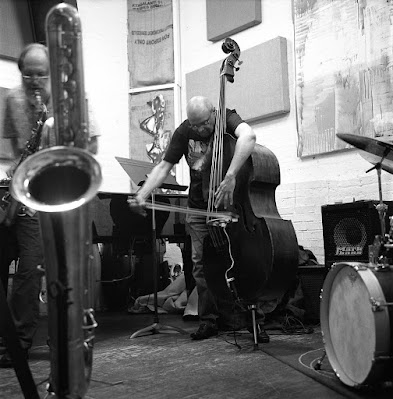
Scott Robinson and Julian Thayer (Photo credit unknown)

Brooklyn born Dr. Julian Thayer is an accomplished bassist who initially pursued a musical education at  Berklee in Boston before following his muse, receiving his PhD from NYU in psychophysiology. His distinguished career as an educator included faculty positions at Penn State, University of Missouri, Ohio State University, University of California Irvine and as a visiting professor at Carnegie Mellon and many European and Scandinavian institutions. Thayer has used his awareness of the therapeutic phycological and physiological aspects that music can have on our physical and emotional well being. He believes music can be vital to calming the heart rate variability (HRV) of our inner clockwork. To this end, Thayer has continue to be involved with like-minded musicians like akLaff and Robinson as well as artists like George Garzone, Jimmy Cobb and Terrell Stafford, to make music that can be adventurous, beautiful and uplift the listener.

Pheeroan akLaff (photo credit unknown)

Detroit born Pheeroan akLaff is a progressive drummer/percussionist and educator who currently teaches at Wesleyan University in Connecticut. His percussion work has been mostly seen with some of music's more Avant Garde and free jazz players in the business like saxophonists Oliver Lake, Sam Rivers, Henry Threadgill and Anthony Braxton, trumpeter Wadada Leo Smith and pianists Cecil Taylor, Mal Waldron and Andrew Hill. He believes that music can be a source for giving back to society and a vehicle for making change. There is a spiritual side to this man's music and his connection with the spiritual is woven into the way he interacts to his fellow bandmates when he plays. His intuition operates on another level, raising the art of percussion to an truly interactive art.

aRT consists of twenty improvisations all recorded at ScienSonic Laboratories on January 25th, 2024 as is a piece of art in itself. A beautiful cd package, "Abstract Sculptures Looking at Abstract Paintings, and, if the Truth Be Known, Vice Versa" a piece by Richard M. "Gorman" Powers, ca. 1991, adorns the cover and the inside artwork on this album. Scott takes his art seriously and that carries through into his packaging of the recording.

The music feels spontaneous, with titles that beckons you to attend a visual art gallery. It is twenty different aural pieces of art being presented here, but you are being invited to listen to these creations with an open mind, where the synapses of our brain are being encouraged to make the leap from the aural to the visual. We are asked to suspend our reality for  just under one hour that it takes to listen through this demonstration of artistry and free association. If you allow it, you can be immersed, taken away by the creativity and aural images that they create. The titles predominantly include the word abstraction. "Abstract Painting" and "Abstract Sculpture," "Abstraction in Blues" and "Abstract Interlude," and unless you don't yet get the immersion thing there is "Abstract Dance" too. 

aRT: akLaff, Robinson and Thayer @ Holyoke Media, Holyoke Mass June 2024

There's the intro, a brief invitation to the show. There are warbling sound sheets that lead to some shimmering cymbal work, and a probing saxophone that leads into a resonant arco bass line that comes to life. Some percussive accents all being added to the picture by akLaff, like colors by a skilled artist's brush on an open canvas.

The music continues, the next piece adding what sounds like a darting Tuba by Robinson and toms and snare skins being pounded in time by akLaff, as the musicians create their version of a choreographed piece of art, "Dancing About Painting." Thayer's string bass is again bowed like a sighing creature introducing a counterpoint to Robinson's bellowing Tuba, a preposterous creature that waddles through the scene with a boisterous authority, and akLaff's intuitive percussive accompaniment together makes this one piece titled "Electrabstraction."  

I can't do these pieces justice by allowing my insufficient word descriptions to faithfully capture for you what it is like to experience these free flowing, inspired improvisations for yourself. There is science here, as well as performance artistry and deep spiritualism. You can play this album multiple times and I can assure you that there is a peace and tranquility that emanates from this music. These guys want to transport the listener for a little while to a place where only music like this  can. There are cymbals, and gongs, bells and a Chinese transverse flute. There are Sarrusophones and contrabass saxophones, bass marimbas, an alto clarinet, and a string tremoloa. And of course there is a tenor saxophone, a theremin, a string bass, a drum and cymbal set, and and F Tuba. I am sure I missed something on this list, but most of all there is a superb sense of purpose, a sense that this music is healing, spiritual, evocative, exploratory and most of all creative. What more you could possibly ask for? In these times of stress and doubt,  supporting sincere art created with conviction and sensitivity like this is surely worth our support.


Sunday, October 15, 2017

The Pharoah Sanders Quartet taps into the Spiritual at the Rialto in Atlanta


William Henderson(p);  Pharoah Sanders (ts); Nat Reeves (b) and Jason Brown (drms) at the Rialto Center 

Last night at the Georgia State University Rialto Center for the Arts here in Atlanta, a nearly sold out crowd came to hear a jazz legend. The spiritual saxophonist Pharoah Sanders and his quartet entered the Rialto stage to a standing ovation from a respectful crowd.  The blue dashiki-clad Sanders, now seventy-seven, wore a simple turned-around cap and his signature chin strap beard now snowy white. His movement was a bit less spritely then in years past as he hobbled onto the stage.

Sanders is one of the fathers of the avant-garde and free jazz movements of the nineteen sixties. His name is in the pantheon of free and avant-garde players like trumpeter Don Cherry, saxophonists Ornette Coleman, Albert Ayler, John Tchicai and Archie Shepp and the pianist Cecil Taylor. But it was his association with futurist Sun Ra that brought him his moniker and the idea that he could freely express himself on his horn.  

Pharoah Sanders at sound check photo credit  James B. Ellison Jr.

Originally born Ferrell Sanders in Little Rock, Arkansas in 1940, it was Ra – himself born Herman Blount - who gave Sanders the new name Pharoah in the early sixties, when the young man was struggling to survive in New York City. His later association with the saxophonist John Coltrane would mark another turning point in Sanders’ career. The two can be heard on Coltrane’s Ascension, a pivotal album for the saxophone giant as well as eight other albums spanning the years 1965-1967. The relationship was symbiotic; Sanders long, emotional, overblown, often dissonant solos influencing Coltrane’s later playing and Coltrane’s spiritual quest influencing Sanders future musical direction.

In 1966 Sanders signed with the Impulse label and released his startling debut Tauhid. For me, Tauhid was a defining moment. More than any other music I had ever listened to, this album and Sanders’ playing could transport me into a state of transcendental bliss. It was a nuclear experience. I loved music but never thought it could transcend time and space. I thought it was my little secret but I soon found out that the music had the same effect on many others.

Sanders followed Tauhid with a series of spiritually uplifting albums and collaborations. His work on Alice Coltrane’s Journey in Satchidanada and his own albums Karma and Thembi all followed eastern dominated musical and spiritual themes. His discography lists over thirty albums as a leader and countless performances as a collaborator.

I was anxious to attend his performance at the Rialto, and see if this seventy-seven- year-old icon could still bring that energy and emotional involvement to the music as I remembered it. 

Sanders’ band included his pianist William Henderson who first recorded with Sanders in 1983 and Hart School of Music educator/bassist Nat Reeves who often works with alto saxophonist Kenny Garrett. The program originally called for the drummer Joe Farnsworth to be on the bandstand, but the drummer Jason Brown was brought in due to last-minute scheduling changes.

The set started off with bassist Reeves offering a bowed introduction to Coltrane’s “After the Rain,” from Coltrane’s Impressions album of 1966. Sanders’ evoking the meditative reflection with great tone and warmth. Drummer Brown using his soft mallets to make his cymbals shimmer.

The program went into a quicker paced Coltrane tune which I couldn’t identify but sounded like it was from the Giant Steps period. Here the band did the heavy lifting as they would do for most of the evening, as Sanders shuffled off stage after a brief but powerful solo. It was hard to tell if the septuagenarian was having difficulty standing as he moved very slowly on and off stage, his gait showing signs of a pronounced limp. His playing was brief, often only a few measures per song. Gone were the powerful overblows and the extended ventures into deep space, explorations that could last twenty minutes. Despite the brevity, when he took up his horn Sanders showed he still possessed that same command of tone and raw emotional vitality that earmarked his earlier work, even if it came with a more subdued physical power. Quality not quantity ruled the proceedings on this night.

His take on Coltrane’s “Naima” was a highlight, playing the emotional ballad with sublime sensitivity, occasionally adding some fluttering notes but with no dissonance. The saxophonist has shown a rare ability to channel something that goes beyond simple music and for a few moments he did so on "After the Rain" and “Naima.”

Pharoah Sanders photo by James B. Ellison Jr.

As the program progressed Sanders took a few opportunities to edge on drummer Jason Brown who seemed to be trying his best to hold his own in these unfamiliar waters.

On his own compositions, especially “The Creator has a Master Plan” and the encore “Ose Re Re” you could see the saxophonist became animated. He moved across the stage in a dance-like strut that belied his age. Sanders is one of those artist that feeds off his audience and he encouraged the crowd to chant along with him and make his “Creator has a Master Plan” into a communal experience. I found myself among those who willingly obliged.

Pianist Henderson chaired the group with a subdued refinement, playing some stirring passages that at times sounded very Tyner-esque. His ability to maintain lush fills or that drone effect that so often accompanied some of Sanders’ more spiritual music was impressive.  Reeves adapted his bass to the songs at hand using both pizzicato and arco techniques, keeping the sometimes-frantic beat pulsing or simply maintaining a sustained buzz. Brown did his best to maintain the swing, occasionally letting loose with a barrage of bombastic that seemed to appeal to the crowd.

At an after show gathering, I was able to get the taciturn Sanders to sign a copy of Tauhid that I had brought with me; my own personal highlight. Surrounded by his family this gentle, unassuming man proved a gracious artist who took the time to sign artifacts and take pictures with his adoring fans.

We are rarely given a chance to bear witness to a musician of the caliber and importance of Pharoah Sanders. He is one of those jazz masters that should be revered for his lasting contributions to the music and for his dedication to enriching our lives with his very spiritual offerings. The Georgia State University Rialto Center for the Arts its director Leslie Gordon and its jazz advisor Dr. Gordon Vernick should be applauded bringing Mr. Sanders to Atlanta. For anyone who has not yet seen him play live, what on earth are you waiting for?

Wednesday, July 12, 2017

Pete Malinverni Trio: "Heaven" The Spiritual Side of Jazz


I have had the pleasure of meeting pianist Pete Malinverni, and the fortune to have seen him perform his pianistic magic in some intimate and spiritual settings on several occasions. Malinverni is a thoughtful, serene man who brings a deep and abiding sense of reverence to his playing. He has been steeped in religious music for decades, with tenures as the musical director of the Devoe Street Baptist Church in Brooklyn, NY, the Westchester Reform Temple in Scarsdale, NY and the Pound Ridge Community Church in Pound Ridge, NY- where I went to several Sunday services just to see him play. He is also a eminent educator and currently is an assistant professor of jazz studies at SUNY Purchase. Pete was kind enough to entertain an interview for my blog back in 2013, which for those who are interested can be found here.

Make no mistake about it, Malinverni can swing, having played in trios with iconic drummer Mel Lewis and with Amhad Jamal drummer Vernel Fourier among others. His music has a naked honesty that sweeps you up in its sincerity and emotional content. 

On his latest release Heaven, Malinverni is joined by eclectic bassist Ben Allison and journeyman drummer Akira Tana.  Together these three make some beautiful and sensitive music. Not surprisingly, the album has a spiritual theme and explores two compositions from Duke Ellington, the title tune “Heaven” and “Come Sunday”; four traditional songs that have an enduring messages of hope and faith; two obscure gems a gorgeous arrangement of a song by Hannah Senesh titled “Eili, Eili” and an Ungar/ Mason composition “Ashokan Farewell;” the uplifting, gospel influenced Curtis Mayfield tune “People Get Ready” and one of Malinverni’s own “Psalm 23.”

“Heaven” is a swinging straight ahead rendering that features Malinverni’s fluid, sometimes Monkish, piano lines, Allison’s pulsing bass and Tana’s light comping. Allison and Tana each offer brief but potent solo work here, before the group returns to the melody line at the coda.

Malinverni’s “Psalm 23,” is based on the famous Biblical passage from David that starts with “The Lord is my Sheperd, I shall not want…” He uses a reverent musical treatment to portray a spiritual that acknowledges God’s grace and guidance given to his people even when they “….walk through the valley of darkness..” The pianist creates a delicate musical monologue that mimics the verse- each challenge met with faith in the higher being- and then he builds the musical tension to a tempest with a rumble created by the trio, until he resolves it to a peaceful conclusion at the coda.  

The bubbling “Down in the River to Pray” is given a buoyant 5/4 bounce with Allison’s pulsing bass line holding down the beat with Tana’s rim and cymbals, as Malinverni explores around the melody.

“Shenandoah” is given a sparse treatment, with vocalist Karrin Allyson lending her clear, light voice to Allison’s bass and Malinverni’s accompanying piano. Allison and Malinverni both take short probing solos before Allyson, whose vocal could bring a bit more emotional content to this song, returns to finish up this endearing American folk song.

“Eili, Eili” is a composition I ‘ve never heard before, apparently based on a poem written by a Hungarian woman, a Jew who fought the Nazi’s in WWII and died trying to save concentration camp prisoners. True to the feeling of the poem, Malinverni and Allison do a marvelous job of making this one of the most moving pieces on the album. The pianist is at his most emotive here and bassist Allison’s plump lines are in beautiful counterpoint to the piano and to Tana’s masterful brushwork.

The lyrics of Curtis Mayfield’s “People, Get Ready” have an uplifting message to an oppressed people and Malinverni deftly finds an elevating experience in this enduring melody, which he and bandmates play with great spirit and elation.

Ellington’s “Come Sunday” is a gorgeous composition that embodies the maestro’s sense of what is spiritual. Guest Jon Faddis’s longing trumpet solo is a case in point. There is a poignancy to his slurring, voice-like horn, a human cry that transcends formalized religious context and unifies us all no matter what our beliefs. The trio expertly backs Faddis exemplary playing of this gem and there is no way one can’t come away from this unmoved.

Another traditional song “A City Called Heaven” features a moving bass solo by Allison at the opening. The bassist has a tremendous feel for this music and it shows here. His tone is clear, his attack is clean and his ideas seem in line with the pianist’s own inclinations-warm, sensitive and uncluttered.

Alto saxophonist Steve Wilson is about as in demand as anyone on the scene today. On “Wade in the Water,” a song made popular by Ramsey Lewis, Malinverni plays a darting solo that floats above his rhythm sections steady pulse. Wilson’s angular alto brings some swinging bop to this one, and he and Malinverni play off each other effectively for a brief section before returning to the head.


The final song on the album is “Ashokan Farewell” a song made famous as the theme to documentary filmmaker Ken Burns “Civil War” series on PBS. The funny thing is despite its melancholy, old-worldish sound, it wasn’t written until 1982 and by a man from the Bronx. 

Notwithstanding the origins of this song- which is based on a Scottish lament- it has been heard by millions and construed to be a part of Americana folk music. Malinverni finds, as many of us do,that the song has a spiritual core to its tender, moving theme. He plays this as a sauntering slow waltz and it seems like the perfect tune to end this album of music on.