|
| Pete Malinverni photo by Abigail Feldman |
The pianist, composer and educator Pete Malinverni has been
on the New York City jazz scene since 1981. He has developed a style that has
incorporated the be-bop elements of a Bud Powell, the harmonic sophistication
of a Bill Evans and the quirky, angularity of a Thelonious Monk. As a young man he realized that he could more rapidly improve his skill by seeking out people to play with who were better than he was. He began to make inroads and establish himself as player to be taken seriously. At the same time Malinverni also maintained a presence in the world of musical education. He has contributed to the teaching and
mentoring of up and coming musicians and students at William Patterson
University, New York University and now Purchase Conservatory of Music where is
currently the Director of Jazz Studies. His close experiences with jazz
luminaries like the drummers Mel Lewis and Vernel Fourier, the bassist Dennis
Irwin and the saxophonist Ralph Lalama, among others, has shaped his voice and
been instrumental in moving him in his own distinct direction.
The most consistent thread that has run through the fabric
of this talented musician's life has been his continued affinity for sacred
music. Mr. Malinverni has been making the connection between worship and music
since his early days in his hometown of Buffalo, NY, where he at first
listened to his mother sing solos in the local Pentecostal church choir and
where he later played piano for the congregation.
After relocating to New York City, where he attended school for
his master's degree in music at Purchase Conservatory, Mr. Malinverni found a
rich supplement to his education in the thriving jazz scene of NYC. There on any given evening he could listen to the very best pianists on the scene. Pianists like Barry Harris, Walter Bishop Jr, Tommy Flanagan
and Hank Jones were all actively playing around town and infusing Mr.
Malinverni with ideas and wisdom. He started playing in trios with Mel Lewis
and Dennis Irwin and was on his way to becoming a well respected pianist and
composer.
For Mr. Malinverni the bond between sacred, gospel and jazz music
needed further exploration and he eventually became a musical coordinator for the
Devoe Street Baptist Church in Brooklyn. The spirited African American
community gave life to the music that he played with them and he served there
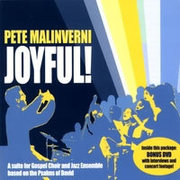
eighteen years from 1993 through 2011. It was during this period that he found inspiration from the Psalms of David to
create his wonderful gospel and jazz album with the Devoe Street Choir titled
Joyful from 2007. In 2009 Pete release
The Good Shepard a six movement, experimental big band piece with choir and orchestra, again based on Psalms.
On the personal side Mr. Malinverni met
and married the jazz singer Jody Sandhaus with whom he had a rare symbiotic
working relationship. The couple had a son Peter Luca and helped raise two other children, Hayes and Guss from Ms. Sandhaus's previous marriage, Mr. Malinverni produced
four albums with Ms Sandhaus, who possessed a beautiful, incandescent voice. She also had an authentically genuine delivery. Sadly Ms. Sandhaus succumbed to breast cancer in 2012.
Along with his duties as the Director of Jazz Studies at Purchase Conservatory of Music, Mr. Malinverni has also found time to continue his involvement in spiritual music working as musical director for both the Westchester Reform Synagogue in Scarsdale, NY and the Pound Ridge Community Church in Pound Ridge. In recent years Mr. Malinverni has also recorded his
Invisible Cities with a quartet
that included the trumpeter Tim Hagans, the saxophonist Rich Perry, the bassist Ugonna Okegwo and drummer Tom Melito . His latest release
A Beautiful Thing is with bassist Lee Hudson and drummer Eliot Zigmund. He gracious took the time to answer our questions.
NOJ:. You grew up
around Niagara Falls, New York and started studying piano at the age of six.
Were you a child prodigy or did you have an affinity for the piano?
PM: I don’t know about “prodigy”, but I know I took to the
piano and music in general pretty quickly.
I always heard music very deeply, even silly things like TV theme songs
(which were, some of them, pretty hip in those days), which I’d pick out on the
piano.
NOJ:. Which of
your parents encouraged your musical education?
PM: Both of them did.
We were lucky to get a piano when I was six and there was a great
teacher, Laura Copia, in town, with whom I studied until I was eighteen and
left home. My Mom ended up with the job
of keeping me at the piano practicing daily but my dad was also very supportive
and proud as my abilities progressed.
NOJ: Your mother
was a soloist in the local Pentecostal church choir. Do you attribute this
early influence to the subliminal linkage that your career has had between
music and religion?
PM: Well, I think the connection has been more than
subliminal. I grew up playing in church
and when I was around 16. I went to Europe on a tour of Pentecostal churches
with a group of musicians, including my guitarist cousin. We played every night in very emotional
settings where I saw the direct connection music can have to humanity.
NOJ: I have read
that you were strongly influenced as a young man by Soul, R&B, gospel
and funk artists like James Brown, Sly Stone and Andrae Crouch. Did the juxtaposition of this earthy, free
feeling , bacchanalian music against the more rigid, parochial music of the
Pentecostal church make it all the more attractive to you?
PM: I’m not sure I knew it at the time, but Sly’s music is
directly descended from music of the church, as was James Brown’s. And Andrae’s music is great, too, but overtly
religious lyrically, of course. I heard
his group several times and the chords and time feel were like those I was
hearing and loving, especially in Sly’s music. The thing about Sly’s music is the positivity of it, the appeal to the
good in people – and I see no disconnect between that and music of the church
at its best. I think the real difference
here was that I was appreciating music played by African-Americans. The music of the Pentecostal Black church is
pretty free-wheeling too, by the way. This
particular cultural approach to music struck me then and still strikes now as
somehow the most authentic I can hear and feel.
NOJ: How did you
make the transition from sacred and gospel music, to R & B, to funk and
eventually to jazz?
PM: When looked at historically, it’s clear that the Black
church in no small part gave rise to at least some elements of Jazz -- so
really, the leap is not so large. But,
as I grew more skilled as a musician I sought a vehicle for both my artistic
and emotional voices. I’d studied
Classical piano through my whole life (and still do), and I found that the
requisite musical skills of Jazz music offered the greatest challenge and
largest rewards for me.
NOJ: As a
contemporary jazz artist what do you think of the artists like Robert Glasper
who are being heralded for integrating hip-hop with jazz? Is this just the next
evolutionary step?
PM: I don’t really have any opinions on the work of other
musicians. I think everyone should do
what makes the most artistic sense to him or her.
NOJ: You yourself
have done some interesting integration in your compositions using elements of
gospel, classical, chamber music and jazz. Do you believe this type of cross
pollination opens new directions for the music or does it dilute the tradition
as some traditionalists believe?
PM: Bix Beiderbecke, Art Tatum, Bud Powell, John Lewis of
the MJQ, Artie Shaw, Duke Ellington, Charlie Parker, John Coltrane and many
others have found inspiration from Classical and other forms of music. I think that “Jazz” is a term used to more or
less categorize music of a certain bent but it’s important that each artist do
what his/her path says is the right one.
The task of categorization, as Aaron Copland once told me, is for the
writers, critics and historians.
 |
| Pete Malinverni photo by Ralph A. Miriello |
NOJ: You studied at
the Crane School of Music in Potsdam , New York. During that period what do feel was the most
important part of your musical education and who was you major influence there?
PM: The most important part of my education in Potsdam was
that which I learned OUTSIDE the school, playing with several bands, cutting
our teeth in the many pubs and rathskellers in that town during that time. The classes I enjoyed the most and from
which I took the most were not music courses but were, in fact, the many
literature classes I took. The way great
writers have looked at life and their ability to describe its many turns in
beautiful ways remains an inspiration to me.
Don’t get me wrong, for someone who wants to study Music Education,
Crane is a great school. And one of the
most important things college can do for a young person is show him or her what
he DOESN’T want to do. In my case, while
I finished the Music Ed degree, I learned that performance -- and not public
high school music education -- would be my path.
NOJ: You came to
New York and started studied for your Master’s of Music at Purchase
Conservatory of Music Was this where you concentrated on your compositional
skills?
PM: Yes, I’d been thinking of composition for a very long
time and had received some grants, including from the NEA, for that work, but
learned an awful lot studying Counterpoint with the great composer/keyboardist
Anthony Newman.
NOJ: By 1981 you
were gigging in and around New York, How difficult did you find it to become a
viable working musician?
PM: It was very difficult, of course, but I learned
perseverance and the most important life-skill of finding something, anything,
to learn from any and every situation. I
also made it a point to always take the risk of working with musicians who were
better than I. In that way, I learned
well and quickly (if painfully).
NOJ: . What were some
of the obstacles that you encountered when you started your musical career in NYC?
PM: I didn’t know a soul when I moved to NYC, had no idea
where the clubs were, who the players were or how to meet them. But I soon learned and made it a point to get
to know people, to play as often as possible and to continue to push, knowing
that if my destiny were to strike out I wanted it to be while swinging the bat,
not watching the third strike with the bat on my shoulder.
NOJ: Drugs were a known element that seemed to find a haven
in the jazz world especially post Parker, what were your experiences with this
culture when you were gigging in New York?
PM: Then, and now, I think that business people and
youngsters in suburbs with access to disposable money and without satisfying
life paths are far more prone to developing out-of-control drug problems than
musicians with a love for music and a desire to learn its many difficult
intricacies.
NOJ: . There have
been some books written about race and jazz that claim there exists what they
call a reverse racism in jazz. As a white musician in a predominantly black
musical genre have you encountered this and how has it affected you?
PM: I guess I wouldn’t know if I’ve encountered such a
thing. I’ve always gotten along well
with people of all races, with music as the important, common denominator. And, my eighteen years as Minister of Music
at the (African-American) Devoe Street Baptist Church in Brooklyn went a long
way toward making sure my son grew up in as open a relationship with all people
of good will as I’ve been blessed to have.
NOJ: You mentioned
that some of your piano influences included Thelonious Monk, Bill Evans, Herbie
Nichols and Bud Powell . With so many disparate voices influencing your music
mind how were ultimately able to find your own voice?
PM: When we find our influences, we are actually recognizing
some part of our true voice in each of those whose music we love. So, just in the same way each of us has a
multi-faceted personality, each musician does as well. Each of those you name (and more) have said
things in ways that ring true to me and that I’ve sought to emulate. The combination of those many voices, spoken
in my own musical “accent” is what I’d call my voice.
NOJ: Getting back to
your early days in NY, you met drummer Mel Lewis and became friends with him,
ultimately making a few albums with him and your friend the bassist Dennis
Irwin. How did this relationship come to pass?
PM: As I sought the best players in NYC I was led to the
Village Vanguard where I heard Mel’s group.
I learned that Mel was from Buffalo and I’m from Niagara Falls so that
was something we had in common. As I
said, my goal has always been to play with better players than I -- and Mel and
Dennis were greats and sounded beautifully together. So, whenever I got work I called them. We got to play quite a bit and eventually
recorded together, my first, Don’t Be Shy. I called Rudy Van Gelder and was shocked when he agreed to engineer the
date out at his famous studio in Englewood Cliffs, NJ
NOJ: . Did you play
piano with Mel’s Village Vanguard Orchestra?
PM: I did sub there on several occasions.
NOJ: Was this your
first experience with a big band?
PM: No, I played with a couple in college and then several
rehearsal bands after I moved to NYC.
NOJ: Then in 1989
you released your second album The Spirit with a quartet that included Mel,
Pat O’Leary on bass and saxophonist Ralph LaLama. This turned out to be Mel’s
last recording date.
How hard was it for you to loose such an important musical
comrade and what did you take away from your experience with Mel?
PM: Yes, this was Mel’s last recording and he was courageous
on that day. He was very sick at the
time, in the middle of chemo and radiation treatments, but played like the
youngest and smartest guy in the studio.
I learned a lot from Mel that day about the power of music to lift us
all up. Also, more generally, he taught
me to trust my own rhythmic instincts.
He encouraged me, saying he liked what I was doing. That meant everything to me.
NOJ: . You then
started working regularly with New Orleans drummer Vernel Fournier. I read somewhere that it was he who made you
aware of how much freer you played when you were in church playing sacred
music. Is this when you reconnected to
your sacred music roots?
PM: Vernel was a great drummer and great man. He invented the famous “Poinciana” beat when
he played with Ahmad Jamal and that trio greatly influenced the group of Miles
Davis at that time, so his shadow is large over the music that came after
him. He, too, encouraged me to feel the
music as I did naturally. And he taught
me a lot about professionalism, too, as we traveled together, sometimes he in
my group, sometimes I in his. He used to
come and play with me at Devoe Street and we found an even deeper connection
there.
NOJ: . How did
Vernel’s drumming differ from Mel’s and how did it affect your music?
PM: Their playing was, I think more alike than it was
different. They both played off beat
“one”, making the music more dance-able, more closely related to the human
body. I learned the value of the “one”
from both of them and, since then, every other great drummer with whom I've
played has further solidified that idea.
NOJ: . In 1993 you
started playing at the Devoe Street Baptist Church in Brooklyn, NY as its
musical director. You have stated that you were less self-conscious and found a
new freedom when you played sacred music in this predominantly African American
church. What was the difference between this congregation’s attitude toward
music and the way your hometown Pentecostal church celebrated with music?
PM: I guess the difference is a cultural one. But also, I have to admit that when I was
young I was much less a musician than I was when I got to Devoe Street. I’m sure, had I been better and more the
agile musician I became, I would have been better able to play appropriately to
the situation in which I found my young self.
NOJ: You have stated
that when you play music in church it allows you to act as a vessel for the message
that it brings to the congregation. Does
that transformation happen when you play for an audience in a club or at a
concert?
PM: Absolutely.
NOJ: . Can you
separate the musical experience from the spiritual experience or are they
un-separable?
PM: I suppose one could do that, but I fail to see why!
NOJ: . I read
somewhere that you met your late wife the singer Jody Sandhaus when playing a
gig for a friend of hers. Where you
aware that she was a singer before you met?
PM: No, I was not.
NOJ: You produced
and played on both of her records Winter Man from 1997 and I Think of You
from 2001. Jody had a very emotionally evocative voice, I especially loved the
way she did “It’s A Lazy Afternoon” which you posted on You Tube. Where did she study and develop such a warm and sincere delivery?
PM: Jody Sandhaus made four recordings with me, Winter
Moon, I Think of You, A Fine Spring Morning and Afterglow. They are all available on iTunes, through CD
Baby and from my website, www.Petemalinverni.com
The sincerity and warmth to which you refer pretty much describe the way
she lived her life. She never did a song
she couldn’t genuinely feel. As for the amazing vocal skills Jody possessed,
she worked very hard at developing her range, her dynamics and her
phrasing. The beauty of it was that, to
a non-musician, the effort was invisible.
She was a truly great artist. We
made one last recording, yet to be mixed and released, of music she chose from
the World War II era and which will be released along with Jody’s transcription
of many letters her Dad wrote home to her Mom from the European Theater of war.
NOJ: . How much has
Jody’s singing style affected your own playing style?
PM: She made me a better accompanist. She also proved to me that honesty, phrasing
and time are the true essentials to music.
NOJ: You’ve had to
endure the loss of people who you were very close to you both in your personal
and musical life Mel Lewis, Vernel Fournier, Dennis Irwin and most recently
your wife Jody.
How has your faith and your connection to sacred music
helped you deal with these challenges?
PM: Not sure that religious music has proven any different
from any other kind of music in helping me heal. It’s all the same and enormously important to
mental and spiritual health – if it’s honest.
NOJ: In keeping
with you affinity for sacred music, how have your experiences as Musical
Director with the Westchester Reform Temple in Scarsdale and your more recent
duties as Musical Director of the Pound Ridge Community Church changed your
musical vision?
PM: I’ve very much enjoyed learning the beautiful musical
language of the Synagogue. Of course,
once you get the specifics it’s all about the heart and the soul, just like
every other form of real music.
NOJ: Your repertoire
includes many spiritual compositions. In
2007 you release Joyful a gospel choir work based on the Psalms of
David. You once said that you believe
Gospel and Jazz were twins separated at birth. It seems as if Gospel is a visceral “feel” based music and jazz especially post
be-bop can be characterized as more of a
“mind” music. How did you manage to make both work together?
PM: Any seeker of a personal spiritual truth would indeed be
foolish to forego the visceral for the intellectual or vice-versa. Those are
both wonderful parts of the human experience and I want it all.
NOJ: . In 2008 you
released another ambitious album The Good Shepherd which was a six movement work for Gospel choir and Jazz Orchestra. Is
it more difficult to integrate voices as opposed to instrumentation into your
music?
PM: No, I believe it’s the same idea. I always think of music in a vocal way, that
each line of music should flow horizontally.
The only obvious difficulty is in putting melodic lines with a
lyric. But, of course, my choice of the
Psalms of King David solves that problem.
They are beautiful poetry, made for music.
NOJ: One of you recent
releases is titled Invisible Cities which was a collection of songs that represent your musical vision of famous
cities and is based on a novel by Italo Calvino. Perhaps the most interesting
songs are two of your compositions, one about Salem, Massachusetts and inspired
by Hawthorne’s Scarlet Letter and the other “A City Called Heaven.” How did you come to write these two pieces?
PM: ... for “Salem – Hester Prynne”, on Invisible Cities,
I was so moved by Hawthorne’s great book that I wanted to write something as a
sort of note to the heroine, expressing sympathy for her plight. I didn’t write “A City Called Heaven”. It’s actually a Spiritual, with my own
arrangement of it featured on “Invisible Cities”.
NOJ: You have
worked in choir, gospel, jazz, classical and folk-inspired traditional sacred
music and are now working with the saxophonist Steve Wilson and the Leipzig
String Quartet on integrating jazz with string oriented chamber music. Your repertoire of sacred or spiritual music
continues to grow and is a clear guiding force in your music, but you made it
clear you do not consider yourself a evangelical musician using music as a tool
to convert or convince. Why do you think
find such inspiration in the sacred rather than the secular side of music?
PM: I really don’t see any separation there. Open, human expression has found many
inspirations over time and I’m equally inspired by a Bach Chorale as I am one
of his Preludes and Fugues. I like Aretha
Franklin singing Spirituals as well as “R E S P E C T”. I like Thelonious Monk
performing “Abide With ME” as much as I like “Round Midnight”. Again, if it’s
honest, it speaks.
NOJ: As an Italian
American musician who has studied in Italy I was fascinated by your connection
to the Devoe Baptist Church which had originally been an Italian American
Baptist Church that first integrated their congregation with the growing
African-American community as their neighborhood cultural makeup changed.
Although a little known fact, Italian Americans were instrumental in bringing
western European music and musical education to the general public in this
country since as far back as the Revolution. Do you feel the musical connection
between African American music and the Italian American musicians and musical
educators they encountered along the way is often underestimated by jazz and
music historians?
PM: I’m not as familiar with that history as I should
be. It sounds like something very
beautiful. I do have some old Italian hymnals and am aware (Vernel Fournier
told me) of the importance in new Orleans of Italian-Americans in the
development of Jazz but it sounds like there’s a hole in my education.
NOJ: You have spent a
good deal of your career as an educator at institutions like William Paterson
University, New York University and presently Purchase Conservatory of Music. I
looked up your rating as a teacher on line and found that you were rated highly
for knowledge and well liked but were considered a pretty tough task
master. What does it take to be an
effective educator to fellow musicians?
PM: Thanks for asking.
I’m Director of Jazz Studies at the SUNY Purchase Conservatory of Music
and have an abiding respect for my students. Important, in my view, is to be
generous in sharing the knowledge gained from one’s experiences. But the most important thing is, once again,
to be honest. It’s better they hear
constructive criticism from me than NOT to hear it from some potential
colleague/employer later – that person will just lose his/her number and will
not spend the time or take the chance of “enlightening” the young person.
NOJ:. Finally what
can we expect from Pete Malinverni in the near future?
PM: All kinds of things going on – I’m building a curriculum
for a Jazz Singing Concentration to be introduced in the Purchase Jazz Studies
program in Fall 2014, I’m working on music for a new trio recording and am
writing arrangements of American Spirituals for a project for choir and Jazz
band. My latest album is “A Beautiful
Thing”, a trio date with Lee Hudson and Eliot Zigmund (another great drummer,
by the way. ) Oh, and I’m practicing a lot!